

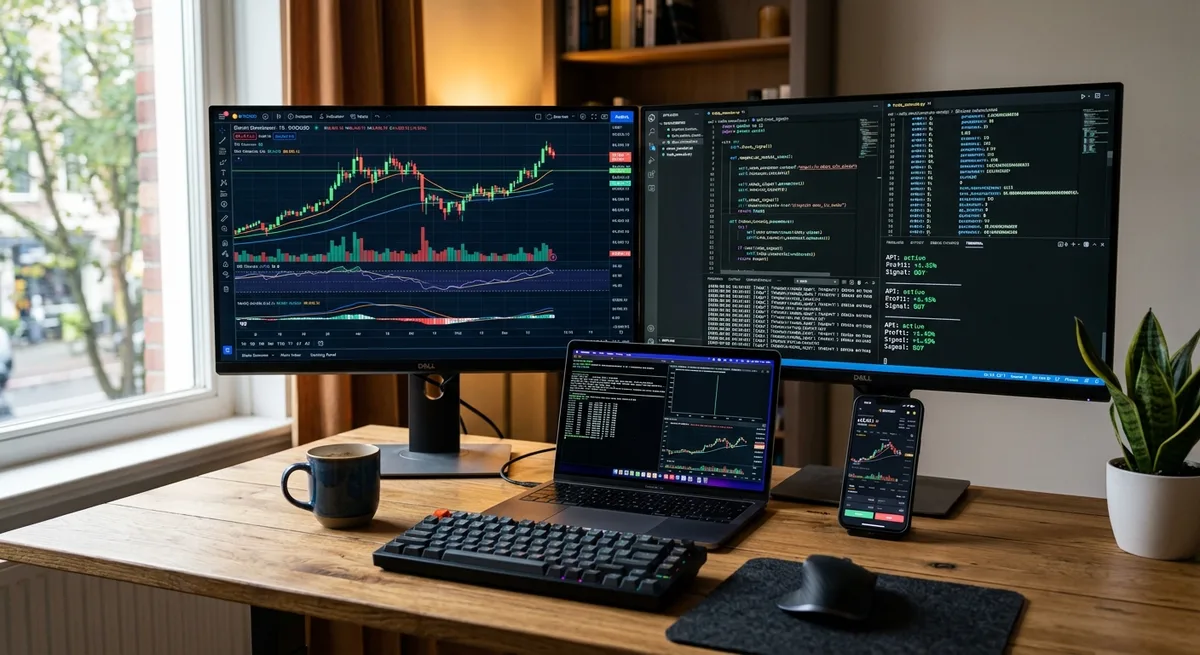
Automation in crypto sounds appealing the moment you realise the market never sleeps. While you’re asleep, the chart keeps moving. While you’re working, opportunities appear and vanish. That’s the gap crypto trading bots try to fill. They follow rules, execute orders, and stay calm when you wouldn’t.
But before you connect anything to your exchange account, it pays to understand what these tools actually do, where they help, and where they quietly fail. This guide walks through how crypto trading bots work, the different types, what to compare, and how to set one up without taking on more risk than you intended. No hype, no shortcuts. Just a clear look at the automated trading strategies and crypto trading tools that are realistic to use.
Introduction: Why Crypto Trading Bots Are Worth Understanding Before You Use One
Crypto is the rare market that never closes. The 24/7 crypto market means price action keeps unfolding through weekends, holidays, and the middle of your night. For most people, manually keeping up with that pace is unrealistic. You miss setups, you check your phone too often, and eventually you make decisions that have more to do with mood than logic.
That’s where automation gets interesting. A bot doesn’t get tired, doesn’t doubt itself, and doesn’t sell out of fear at 3 a.m. because Twitter is panicking. It just follows what you told it to follow.
But here’s the part most marketing pages skip: a bot isn’t a money printer. It’s a tool that executes a strategy. If the strategy is weak, the bot will execute that weakness with impressive consistency. Emotional trading is one of the biggest causes of losses in crypto, and bots can solve part of that problem. They cannot, however, save a flawed plan.
That distinction matters before you go any further.
What Are Crypto Trading Bots?

A crypto trading bot is software that monitors the market and places trades automatically based on predefined rules. Think of it as cryptocurrency trading software that does the clicking for you, faster and without hesitation.
It helps to separate three things people often blur together:
- The bot: The software that executes orders.
- The strategy: The set of rules deciding when to buy, sell, or stay out.
- The exchange account: Where your funds actually sit and where trades happen.
The bot doesn’t hold your money. It connects to your exchange, reads the market, and acts according to the strategy you’ve defined. Algorithmic crypto trading sounds advanced, but at its core it’s just rules running on autopilot.
How Bots Connect to Crypto Exchanges
Bots connect to exchanges through API keys. An API key is essentially a digital permission slip you generate inside your exchange account. It tells the exchange: “this software is allowed to do X, Y, and Z on my behalf.”
You decide what those permissions are. You can allow reading market data, placing orders, or, if you’re not careful, withdrawing funds. That last one is where many people get burned. Strong exchange API connection settings keep withdrawal permissions disabled, no exceptions.
If you’re still figuring out which platforms to use, this overview of what bitcoin exchanges are is a useful starting point.
What Crypto Trading Bots Can and Cannot Do
Bots are excellent at three things: speed, consistency, and discipline. They execute rule-based trading faster than any human, follow the plan even when it’s boring, and don’t second-guess a stop-loss because of a hopeful tweet.
What they cannot do is just as important. Bots cannot predict the future. They cannot eliminate market volatility. They cannot turn a bad strategy into a good one. And they cannot adapt to a sudden change in market structure unless you’ve explicitly programmed for it.
A bot is a mirror of your logic. If your logic is sloppy, the mirror is honest about it.
How Automated Crypto Trading Works Step by Step
Automated crypto trading sounds technical, but the workflow is straightforward once you break it down. Every bot, simple or advanced, follows roughly the same loop: gather data, check rules, place orders, manage the trade, review.
Step 1: Market Data and Trading Signals
The bot first pulls data from the exchange. That includes price, volume, order book depth, spreads, and any technical indicators you’ve configured, such as moving averages or RSI. These crypto trading signals are the raw material for every decision the bot will make.
The more reliable the data, the more reliable the decisions. Slow data feeds or limited indicators reduce what the bot can see. If you want a deeper sense of what actually drives those numbers, this breakdown of how Bitcoin price is determined is worth a look.
Step 2: Strategy Rules and Trade Conditions
Next come the rules. You define when the bot enters a trade, when it exits, how much capital it risks, and what timeframe it uses. Entry rules might be something like: “Buy when price closes above the 50-day moving average with rising volume.” The exit strategy might be: “Sell at 5% profit or 2% loss.”
Position size, leverage limits, and daily loss caps all belong here too. Without these, the bot has no idea when to stop. For a broader sense of how trading strategies fit together, the ultimate Bitcoin trading guide covers the foundations.
Step 3: Order Placement and Trade Management
Once conditions match, the bot places the order. From there, it can manage the position automatically: trailing stops, partial take-profits, stop-loss automation, and take-profit orders all happen without you touching anything.
This is where automation really shines. The bot doesn’t hesitate at a stop-loss, doesn’t move it down out of hope, doesn’t forget to take profit. It does what you told it to do, every time.
Step 4: Backtesting, Paper Trading, and Optimization
Before risking real money, you test. Backtesting runs your strategy against historical data to see how it would have performed. Paper trading runs it on live markets without real funds.
Both are useful, but neither is proof of future results. Markets change. A strategy that crushed it in 2021 might break in a sideways year. Treat strong backtests as encouraging, not as confirmation. Over-optimised results are one of the most common traps, and we’ll come back to that later.
Main Types of Crypto Trading Bots
Not all trading bot strategies are built for the same conditions. Picking the wrong type for the wrong market is one of the fastest ways to lose money, even with good automated portfolio tools.
Grid Trading Bots
A grid trading bot places a series of buy and sell orders at fixed intervals above and below the current price. When price moves up, it sells. When it moves down, it buys. It profits from the back-and-forth.
Grid bots tend to shine in a sideways market and struggle when price breaks strongly in one direction, especially down. If you’ve ever watched Bitcoin chop between two levels for weeks, that’s the environment grid bots are built for.
DCA Bots
A DCA bot automates dollar-cost averaging. Instead of buying a position all at once, it spreads purchases across time or price levels. This is popular with long-term investors who want to reduce timing risk.
DCA bots are simple by design, which is part of their appeal. They don’t try to outsmart the market. They just keep buying on schedule.
Arbitrage Bots
An arbitrage bot looks for price differences across exchanges or markets. If Bitcoin is trading slightly higher on one exchange than another, the bot buys on the cheaper one and sells on the more expensive one, capturing the price spread.
In theory it sounds easy. In practice, fees, withdrawal times, and liquidity often eat the profit. For a more detailed view, this guide on crypto arbitrage trading for beginners explains how it really plays out.
Market-Making Bots
A market-making bot places both buy and sell orders close to the current price, trying to profit from the bid-ask spread. It’s the strategy that professional liquidity providers use.
It’s also one of the harder strategies to run well. Thin markets, sudden volatility, and competing bots can quickly turn it from steady income into steady losses. Not a beginner tool.
AI Trading Bots and Signal-Based Bots
AI trading bots use data models and pattern recognition to generate trade ideas rather than following fixed rules. Some use machine learning models to adapt as conditions change. Others rely on external AI crypto signals.
Here’s the honest take: AI doesn’t guarantee better results. It guarantees more complex results, which can be harder to evaluate. A simple rule-based bot you understand is often more useful than a black-box AI you don’t.
Portfolio Rebalancing Bots
A rebalancing bot keeps your asset allocation in line with your target. If you want 60% BTC and 40% ETH, and ETH rallies hard, the bot trims ETH and adds BTC to restore the balance.
These bots aren’t trying to time the market. They’re enforcing portfolio rebalancing discipline most people don’t have the patience to do manually.
Key Features to Compare in Crypto Bot Software
When you start comparing crypto bot software, the marketing pages all start to sound the same. Cutting through that noise means focusing on practical bot comparison criteria, not promises.
Exchange Support and Integrations
First, check whether the bot actually supports your preferred exchange and the supported trading pairs you trade. Region matters too. Some bots can’t connect to certain exchanges depending on where you live or where the exchange is licensed.
If the integration is shaky, nothing else matters.
Strategy Builder and Customization
Some platforms offer prebuilt templates you can turn on with one click. Others give you a no-code trading bots interface where you drag and drop conditions. Advanced platforms let you write custom trading rules in scripting languages.
The right choice depends on you. If you’re starting out, no-code is fine. If you have a specific strategy in mind, you’ll want flexibility.
Security Controls and API Permissions
Look for platforms that enforce restricted API permissions by default, require two-factor authentication, and clearly explain how they store your data. If a bot platform asks for withdrawal access, walk away.
This is non-negotiable territory.
Pricing, Fees, and Subscription Models
Bot pricing varies widely. Some offer free plans with limits, others charge monthly subscription plans, and a few take performance fees on profits. On top of that, you still pay exchange trading fees on every order.
Add it all up before deciding. A “cheap” bot with high-frequency strategies can rack up surprising costs in exchange fees alone.
Reporting, Analytics, and Performance Tracking
Good crypto bot software shows you more than profit. You want to see drawdown, win rate, average trade duration, fees paid, and risk-adjusted returns. A strategy with a 70% win rate sounds great until you see a 40% drawdown along the way.
Performance tracking is where you find out if the bot is genuinely helping or just busy.
Best Crypto Trading Bots: How to Compare Options Without Falling for Hype
The phrase “best crypto trading bots” gets thrown around so much it’s almost meaningless. Best for who? A beginner with $500 has different needs than a quant managing a six-figure portfolio.
Skip the rankings and build your own framework instead.
Comparison Table Structure to Include
When researching, build a simple feature comparison table with these columns:
| Bot Name | Supported Exchanges | Strategy Types | Pricing | Security Features | Beginner-Friendly | Ideal User |
Filling this in forces you to compare crypto bot platforms on substance, not vibes. You’ll quickly notice which ones lean on marketing and which actually describe what they do.
Pros and Cons Checklist
The practical advantages of trading automation:
- Faster execution than manual trading
- Removes emotional decision-making
- Runs 24/7 without breaks
- Enforces discipline on stop-losses and take-profits
- Lets you test strategies before risking real money
The bot trading risks side:
- Costs add up between subscriptions and exchange fees
- A bad strategy executes losses faster than you can manually
- Technical issues like exchange downtime can break trades
- Security risks if API permissions are configured poorly
- False confidence from over-optimised backtests
If you only see the first list when reading reviews, that’s a red flag.
What User Reviews and Testimonials Should Actually Prove
Most testimonials online are either screenshots of cherry-picked wins or paid promotions. Useful user testimonials show something else: how the support team handled an issue, whether the platform was easy to set up, whether the published verified trading results matched reality.
If every review sounds like a sales pitch, treat it like one.
Setup Guide: How to Start With a Crypto Trading Bot Safely
A good bot setup guide assumes you’ll make mistakes early and helps you make small ones instead of big ones. The point of the first few weeks is learning how the system behaves, not chasing returns.
Step 1: Choose Your Exchange and Bot Platform
Pick a reputable crypto platform with strong security, decent exchange liquidity, and the coins you actually want to trade. Then pick a bot that integrates well with it. Don’t pick the bot first and then force-fit an exchange around it.
Step 2: Connect API Keys With Limited Permissions
Generate an API key with only the permissions the bot needs: read data and place trades. Disable withdrawals. Always. Enable IP whitelisting if your exchange supports it, and turn on two-factor authentication on every account involved.
Restricted API access is the single biggest thing standing between you and a bad day.
Step 3: Start Small With Testing Before Using Serious Capital
Use demo trading or paper trading first. After that, run the bot live with a small position size, the kind of amount where losing it would be annoying but not painful. Watch how it behaves for at least a few weeks before scaling up.
The bot will do something you didn’t expect. They always do. Better to discover that with $100 than $10,000.
Step 4: Monitor, Adjust, and Know When to Turn the Bot Off
Automation isn’t “set and forget.” Markets shift, exchanges have outages, and strategies decay over time. Build bot monitoring into your routine: check daily for the first month, then settle into a less frequent rhythm.
And know when to switch it off. During major news events, extreme volatility, or when your strategy clearly doesn’t fit the current market, manual override is part of good risk controls.
Realistic Case Studies: When Trading Bots Help and When They Fail
Numbers in case studies are easy to fake. What matters more is the pattern: which environments help a bot succeed, and which break it.
Case Study 1: Grid Bot in a Sideways Bitcoin Market
Imagine BTC trading between $58,000 and $64,000 for several weeks. A grid bot set across that range keeps buying near the low and selling near the high, capturing small gains repeatedly. In a clean Bitcoin trading range, the results can look impressive.
Then the range-bound trading ends. Price breaks below $58,000 and keeps falling. Now the bot is sitting on a pile of buys with no sells triggering. The same setup that looked great in chop becomes a problem in a trend.
Same bot. Same settings. Different market.
Case Study 2: Arbitrage Bot During Exchange Price Differences
An arbitrage bot spots BTC trading at $60,200 on one exchange and $60,350 on another. On paper, that’s a quick win through cross-exchange arbitrage.
In reality, by the time the bot accounts for trading fees, withdrawal delays between exchanges, and the chance the spread closes mid-trade, the profit shrinks fast, or disappears. Arbitrage opportunities exist, but they’re competitive and tighter than they look. This deeper explanation of crypto arbitrage trading shows how the real numbers usually work out.
Case Study 3: AI Bot in a Trending Market
An AI bot trained on trending data performs well during a strong bull run. Pattern recognition identifies momentum setups, and the trend-following strategy rides them.
Then market behaviour shifts. Volatility increases, fakeouts multiply, the regime changes. The model’s assumptions no longer match the data it’s seeing. Performance drops, sometimes sharply, before anyone notices the change.
AI bots aren’t immune to changing market conditions. They just hide the failure better, for a while.
Risks, Security, and Common Mistakes With Crypto Trading Bots
Automated trading risk isn’t one thing. It’s a stack of risks, and the obvious ones aren’t always the biggest. Most crypto bot mistakes fall into four categories.
Security Risks: Custody, Wallets, and Account Access
Funds sitting on an exchange for active trading are exposed to exchange risk. If the platform is hacked or freezes withdrawals, your money is stuck. Separate your trading capital from your long-term stack.
Wallet security matters even more for what you’re not trading. Cold storage for the bulk of your holdings, exchange or hot wallet only for what’s actively being traded. This guide on how to store Bitcoin safely covers the basics.
Hot Wallet vs Cold Wallet Considerations
Active trading needs liquidity, which means accepting some hot wallet risks for the portion of funds the bot uses. But that’s no reason to leave everything exposed. Cold wallet protection is for the part of your portfolio you’re not touching weekly.
A clear comparison of cold wallet vs hot wallet safety makes the trade-offs easier to think through.
Strategy Risks: Over-Optimization and False Confidence
A strategy can be tuned so precisely to historical data that it works perfectly in backtests and falls apart live. That’s over-optimization, sometimes called curve-fitting. The strategy memorised the past instead of learning from it.
Backtest bias also creeps in through unrealistic assumptions: ignoring slippage, assuming perfect fills, underestimating fees. Always stress-test with worst-case assumptions before trusting the numbers.
Platform Risks: Scams, Downtime, and Poor Liquidity
Scam trading platforms are common in crypto, especially ones promising guaranteed returns from “AI trading.” If a bot platform won’t show you how it works, what fees you pay, or who runs it, that’s enough information.
Even legitimate platforms have downtime. Exchange outages during volatile moments can leave your bot unable to close positions. Low liquidity in smaller pairs can mean orders fill at terrible prices, or not at all.
Who Should Use Crypto Trading Bots?
Bots aren’t right for everyone. Crypto trading experience, time, and risk tolerance all shape whether automation suitability is real or just appealing.
Beginners
Beginner traders can use simple automation, like DCA bots or basic grid setups on stable pairs, as a way to learn how the market behaves without making every decision manually. The key is staying small, avoiding leverage, and not letting the bot decide what you don’t yet understand.
If you can’t explain in plain language what your bot is doing, you’re not ready to scale it up.
Experienced Traders
Advanced traders typically use bots to execute strategies they’ve already validated manually. Automation lets them scale, run multi-market trading across pairs they couldn’t watch alone, and stay disciplined under pressure. They use advanced trading tools because their workflow demands it, not because a bot promised easy money.
Tech-Savvy Investors and Analysts
Data-driven investors lean toward quantitative trading: testing hypotheses, automating portfolio rules, building custom strategies from scratch. For them, bots are research tools as much as execution tools. Data-driven investing without automation eventually hits a ceiling.
FAQ About Crypto Trading Bots
A few questions come up over and over before people actually try a bot. Here are the honest answers.
Are Crypto Trading Bots Profitable?
They can be. They can also lose money fast. Bot profitability depends on the strategy, market conditions, fees, risk management, and how disciplined the user is. The bot itself is neutral. It amplifies what you give it.
Are AI Trading Bots Better Than Normal Trading Bots?
Not automatically. AI trading performance can be strong in specific conditions but harder to evaluate and harder to fix when it breaks. Transparent rule-based bots have the advantage that you can actually understand why they did what they did. Test, measure, and don’t assume “AI” means “better.”
How Much Money Do You Need to Start Using a Crypto Bot?
You can start with surprisingly little. Some platforms work with $100 or so. But factor in minimum trading capital per trade on your exchange, fees per trade, and any monthly bot subscription cost. Below a certain account size, fees eat any potential profit. Run the math first.
Can Bots Trade Bitcoin and Altcoins?
Yes. Bitcoin bots are the most common, but most platforms support major altcoin trading bots across ETH, SOL, and others. For smaller altcoins, liquidity becomes the limiting factor, not bot capability.
Is Trading Automation Safe?
Safe trading automation is possible if you control API permissions, understand the strategy you’re running, secure your accounts properly, and avoid sketchy platforms. A secure bot setup is something you build, not something the platform gives you by default.
Conclusion: Use Crypto Trading Bots as Tools, Not Shortcuts
Crypto trading bots are useful. They execute faster than you can, they don’t panic, and they keep working while you don’t. For traders who already know what they’re doing, that’s a real edge. For beginners willing to start small, they can be a way to learn the market with less emotional damage.
But they’re not shortcuts. They don’t replace strategy, they don’t remove risk, and they don’t make a bad plan profitable. The traders who get value from automation are the ones treating bots as execution tools inside a broader plan, not as substitutes for thinking.
Disciplined crypto trading is the goal. Automation strategy is just one way to get there. Start small, protect your accounts, test before you scale, and stay involved. The bot is doing the clicking. The thinking is still yours.