

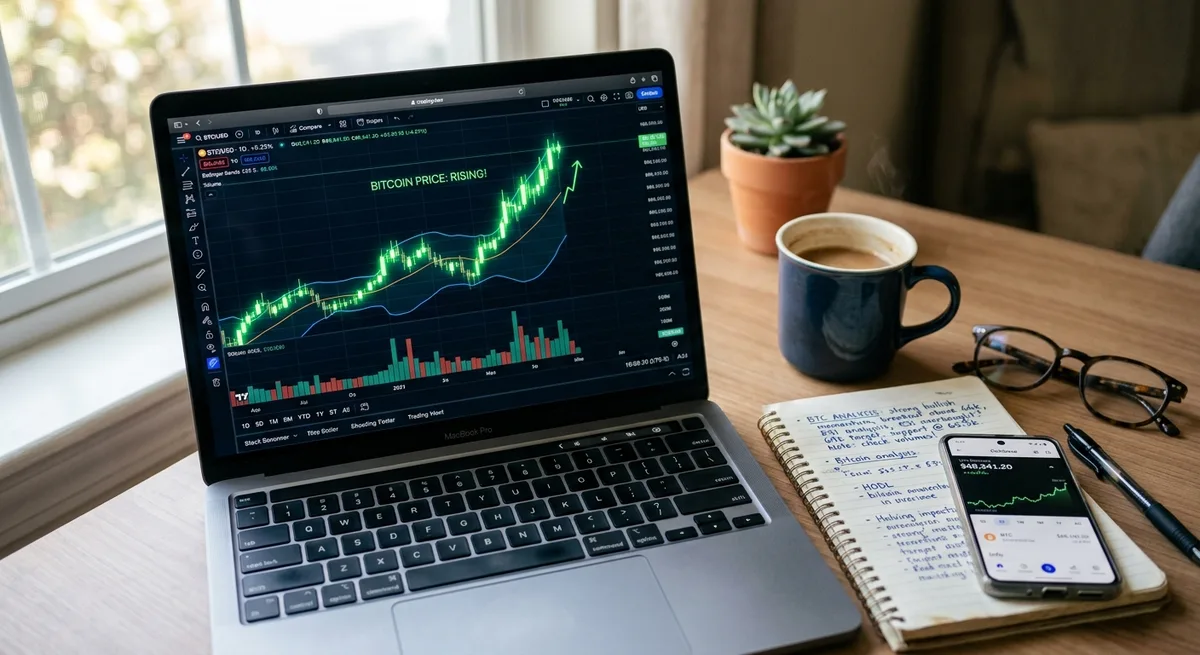
How Bitcoin Price Is Determined
Introduction: What “Bitcoin Price” Actually Means
If you’re asking how Bitcoin’s price is determined, the short answer is this: it’s whatever buyers are willing to pay and sellers are willing to accept at any given moment. That’s it. No government sets it. No company fixes it. No committee publishes the “correct” number. The real-time Bitcoin price changes constantly because trading never stops.
What you see on an exchange, a charting app, or a market tracker is usually the latest trading price based on recent activity. In practice, that number is shaped by active market participants, available liquidity, overall sentiment, and whatever outside events happen to be influencing demand at that moment.
This also explains why Bitcoin can move so fast. When demand picks up and there aren’t enough sellers at the current level, price rises. When sellers rush in and buyers pull back, price falls. Simple in principle, even if the reasons behind it can get more complicated.
If you want to understand why the market assigns value to Bitcoin in the first place, it helps to start with the basics of what gives Bitcoin value. From there, the next step is understanding the core engine behind every price move.
The Short Answer — Bitcoin Price Is Set by Supply and Demand

At the most basic level, supply and demand dynamics decide the price.
When more people want to buy Bitcoin than sell it, buy pressure builds and price tends to move higher. When more people want to sell than buy, sell pressure increases and price tends to drop. This is happening constantly, every day, across global markets.
Think of it like an auction that never closes. Buyers compete for available Bitcoin. Sellers compete to attract buyers. The current market price is simply where those two sides meet.
That sounds obvious, but it matters because a lot of people go looking for one hidden formula behind every move. There usually isn’t one. The market is balancing demand against available supply in real time, and that’s genuinely the whole engine.
Of course, that raises a practical question: where does this balancing actually happen, and how does the market turn all those individual buy and sell decisions into a visible price?
If you want the deeper foundation behind demand itself, this piece on why Bitcoin has value adds useful context before we get into the mechanics.
Where Bitcoin’s Price Comes From in Practice
Exchanges Are Where Price Discovery Happens
Bitcoin’s price is discovered on exchanges. These are the marketplaces where buyers and sellers place orders and complete trades. The process is called price discovery, which basically means the market finds the price through actual trading activity rather than receiving it from some central authority. Every time a buyer and seller agree on a number, that trade contributes to the live market picture.
There is also no single universal Bitcoin price. What you usually see online is a global average or a representative quote pulled from one or more major exchanges. Since trading takes place on many platforms at once, the market price is really a moving consensus.
If you’re new to how these platforms work, it helps to understand what Bitcoin exchanges are before looking at what actually moves price inside them.
Order Books, Bids, and Asks Move the Market
Behind the scenes, most exchange pricing revolves around the order book. Picture a long list of buyers and sellers all placing their numbers, waiting for a match.
The order book shows bids and asks. A bid is the price a buyer is willing to pay. An ask is the price a seller is willing to accept. When a bid and an ask match, a trade happens.
If many buyers are placing aggressive bids above the current market level, price can move up quickly. If many sellers are willing to accept lower prices just to exit, price can fall just as fast. Liquidity matters here. In a deep, liquid market, large orders get absorbed more easily. In a thinner market, even one big order can push price around noticeably. That’s one reason Bitcoin’s volatility often comes back to liquidity and order flow rather than just whatever headline is circulating.
Short-term moves can look chaotic for this reason. A sudden wave of market orders can eat through nearby bids or asks and create sharp swings. Once you understand that, it becomes easier to see why different platforms may not always show exactly the same number.
Why Bitcoin Can Have Slightly Different Prices Across Platforms
Different exchanges can show slightly different prices at the same time. These gaps usually come down to liquidity conditions, user demand, fees, regional trading activity, and the trading pair involved.
BTC/USD may trade at a slightly different level than BTC/EUR or BTC/USDT. Some platforms attract more institutional traders, while others are more retail-driven. That changes how quickly prices react to new information.
Arbitrage helps keep the gaps from becoming too large. If Bitcoin is cheaper on one platform and more expensive on another, traders can buy on the cheaper exchange and sell on the higher-priced one. That process pulls prices back toward alignment fairly quickly.
If you’ve ever wondered why the quoted price changes depending on the pair you’re looking at, this guide to Bitcoin to USD conversion helps make that more concrete.
The Main Factors That Influence Bitcoin’s Price
Market Sentiment and Investor Behavior
Market sentiment is one of the biggest short-term drivers of Bitcoin. Fear and greed often move faster than fundamentals, especially in crypto where markets run around the clock.
When investors feel optimistic, they tend to buy breakouts, hold through pullbacks, and price in future growth. When they feel uncertain, they reduce exposure, take profits faster, or panic sell. You’ve probably seen it yourself: one bad tweet and suddenly everyone’s convinced the sky is falling.
This is why the impact of news on Bitcoin’s price is often less about the headline itself and more about how the market is already positioned when that headline arrives. The same event can trigger buying in one environment and selling in another.
You can see this clearly in broader Bitcoin market cycles, bull vs bear. Sentiment doesn’t act alone, though. It interacts with a more structural force: scarcity.
Bitcoin’s Fixed Supply and Scarcity
Bitcoin has a hard cap of 21 million coins. That’s baked into the protocol and it won’t change. Supply cannot be expanded in response to rising demand the way it can in most traditional markets. If interest increases while available coins stay limited, price can rise sharply.
This idea is central to Bitcoin’s long-term supply and demand dynamics. Many investors build their thesis around the idea that a genuinely scarce digital asset may become more valuable as adoption grows. It’s not a guarantee, but it’s a real structural constraint that sets Bitcoin apart from assets where supply can simply be printed to meet demand.
The halving is one of the key mechanisms behind that scarcity narrative. This article on Bitcoin halving explained and why it matters is worth reading to understand the larger context before looking at issuance directly.
Halving Events and New Supply Entering the Market
A Bitcoin halving cuts the block reward miners receive for validating new blocks. In practical terms, it slows the pace at which new Bitcoin enters circulation.
That doesn’t guarantee a price increase. Markets often anticipate halvings well before they happen, and real demand still has to be there. But it does change the supply side. If miner selling stays steady or demand increases while new issuance falls, that combination can support price over time. If demand weakens, the halving alone isn’t enough.
This is a good example of why Bitcoin shouldn’t be viewed through any single variable. Supply matters, but broader macro conditions matter too.
Macroeconomic Conditions and Global Liquidity
Bitcoin doesn’t trade in isolation. Interest rates, inflation expectations, dollar strength, and global liquidity all influence how much risk investors are willing to take on.
When rates rise and liquidity tightens, speculative assets often face pressure. When financial conditions loosen and risk appetite improves, Bitcoin tends to benefit. This is one reason the inflation hedge narrative sometimes gains traction and sometimes fades, depending entirely on the macro backdrop at the time.
In strong liquidity environments, capital moves more freely into growth assets and alternative stores of value. In tighter environments, investors become more selective and cut exposure. So even without a single crypto-specific headline, Bitcoin can move simply because bond yields shifted or a central bank changed its tone.
Regulation, Adoption, and Major News Events
Crypto regulation can move price fast because it directly affects access, confidence, and expected future demand. A supportive policy signal brings in buyers. A restrictive announcement does the opposite.
The same goes for institutional adoption and ETF news. If large investors gain easier access to Bitcoin, demand can rise meaningfully. If a major company adds Bitcoin to its treasury or builds new infrastructure around it, the market may start pricing in broader adoption.
Negative events matter too. Exchange failures, security incidents, and aggressive government actions can all trigger sudden repricing. Context is important here. Sometimes the market responds to the event itself. Other times it reacts to expectations that were already baked in.
This is also where Bitcoin’s role relative to the rest of the crypto market matters, especially during shifts in Bitcoin dominance and market impact.
How to Calculate Bitcoin Price the Right Way
Most people don’t manually calculate Bitcoin’s market price from scratch. They observe it from live market data, which is usually the right call.
The simplest reference is the spot price: the current trading price on an exchange or market tracker. For a broader view, a weighted average price across multiple exchanges is more useful, since it gives more influence to platforms with higher trading volume and produces a more reliable market-wide reference.
Market cap is another common concept. It’s simply the current price multiplied by circulating supply. It doesn’t determine price by itself, but it helps with understanding Bitcoin’s scale and comparing it to other assets.
For deeper analysis, some investors use valuation frameworks rather than relying on raw price alone. These can look at scarcity, network growth, adoption trends, miner economics, or historical multiples. None of them produce certainty, but they can help structure thinking in a more disciplined way.
If you want a more detailed breakdown of valuation logic and price prediction methods, this guide to Bitcoin valuation models is worth reading before moving into chart interpretation.
How to Read Bitcoin Price Without Getting Misled
Spot Price vs. Short-Term Noise
Learning to read Bitcoin’s price starts with separating the spot price from the noise around it.
The spot price tells you what Bitcoin is trading for right now. It doesn’t tell you whether that move is meaningful, sustainable, or just normal daily volatility. Intraday moves can look alarming on a small timeframe while being completely irrelevant on a weekly chart. A one or two percent move in Bitcoin is not unusual. Even larger swings can happen without changing the broader trend at all.
The best way to stay grounded is to look at price in context. Compare today’s move with recent trading ranges, weekly levels, and historical behavior. If you need a better feel for that context, looking through Bitcoin price history and growth can help reset expectations before you start reading chart structure.
Support, Resistance, and Volume Matter More Than Headlines
Support and resistance are two of the most useful basic concepts in price analysis. Support is a level where buyers have historically stepped in. Resistance is where sellers have tended to appear. These levels matter because they show where the market has made decisions before.
If price breaks above a resistance zone with strong volume behind it, that can signal real demand. If it fails at the same level repeatedly, the market isn’t ready. Volume adds the context. A breakout on low volume is a lot less convincing than one backed by strong participation. This is one reason that basic technical awareness is more helpful than reacting to social media posts or dramatic headlines.
You don’t need to become a full-time trader to benefit from this. Even a rough understanding of where key levels sit can stop you from misreading normal market behavior as something more serious.
How to Check Bitcoin Price and Track It Effectively
Where to Check Bitcoin Price Reliably
Start with reliable and liquid sources. Good options include major exchanges, price aggregator websites, charting platforms, and portfolio apps. The key is to use sources with strong market coverage and enough trading activity that the quote actually reflects real conditions.
Always check the pair. BTC/USD is not the same as BTC/EUR or BTC/USDT. If you’re comparing prices across platforms without noticing the pair, you can easily misread what you’re seeing.
A live chart is usually more useful than a delayed quote because Bitcoin trades nonstop. Market aggregators are especially helpful because they pull from multiple exchanges at once and reduce the risk of relying on one outlier.
How to Track Bitcoin Price Over Time
The answer depends on your timeframe, and this is where a lot of people go wrong.
A short-term trader may watch hourly and four-hour charts and track shifts around key levels. A swing trader may focus more on daily structure. A long-term investor may care most about weekly and monthly context. Using the wrong timeframe for your strategy is a real mistake. If you’re investing for years, watching minute-by-minute candles will create stress without improving your decisions. If you’re actively trading, monthly charts alone won’t help with entries and exits.
Building a simple routine helps: check the daily close, review the weekly trend, note major support and resistance zones, and compare where price sits relative to your own plan. If you want help thinking through timing and context, this piece on Bitcoin price forecast and buy timing fits naturally into that process.
How to Get Bitcoin Price Alerts and Set Them Up Properly
When Price Alerts Are Useful
Price alerts are useful when Bitcoin approaches a target level, breaks an important zone, or moves into a range where your risk management plan changes. For example, you might set an alert near a major resistance area, below a key support level, or at a round number that tends to attract attention.
The real benefit is simple: alerts let you stop staring at charts all day. They’re especially helpful if you work full time, invest passively, or know that checking every five minutes makes you more reactive, not more informed.
Use alerts as prompts, not commands. When the notification comes in, it means: go check the chart and review your plan. Not: buy or sell immediately.
How to Set Up Bitcoin Price Alerts Step by Step
The process is usually straightforward across most platforms:
- Choose your platform. This can be an exchange, a portfolio app, or a charting tool. Most major options support mobile push notifications, email alerts, or both.
- Select the condition. You can set an alert when price moves above a level, falls below a level, or enters a chosen range.
- Name the alert clearly. Something like “BTC above resistance” or “BTC below support” so that when the notification arrives, you immediately know why it matters.
- Choose the delivery method. Push notifications are best for speed. Email works when the move is less time-sensitive.
- Review and adjust. If price has moved far from your original levels, update your alerts so they stay relevant.
Keep the number of alerts limited. A few well-placed alerts are far more useful than constant noise that trains you to ignore everything.
Why Bitcoin Price and Bitcoin Value Are Not Exactly the Same
Bitcoin’s market price is what people are paying right now. Bitcoin’s value is what people believe it’s worth based on a longer-term thesis. Those two things overlap, but they’re not identical.
Price can swing sharply because of short-term positioning, sentiment, or liquidity conditions. Value is usually a longer-term judgment built around scarcity, utility, security, adoption, and network effect. Some investors also think in terms of intrinsic value, even though Bitcoin doesn’t fit traditional valuation methods as neatly as a company with predictable cash flows.
This distinction matters in practice. If you confuse price with value, every pullback feels like a crisis and every rally feels like proof of something. A better approach is to understand both and keep them separate. That mindset also makes it easier to avoid the most common mistakes people make when trying to explain every move.
Common Mistakes People Make When Trying to Understand Bitcoin Price
One common mistake is assuming one headline explains everything. Markets are rarely that clean. News matters, but so do liquidity, positioning, and existing sentiment that was already in place before anyone hit publish.
Another mistake is treating every small move as significant. Small fluctuations happen constantly and most of them don’t mean anything. Reacting to every candle as if it signals a trend change usually leads to poor decisions.
Many people also rely on a single exchange, which can distort your view if that platform has lower liquidity or a temporary price dislocation. Comparing a few sources is always better.
Confirmation bias is a real problem too. If you already believe Bitcoin should go up, you’ll tend to interpret everything as bullish. If you expect a crash, the opposite happens. The market doesn’t care about your preferred narrative, and it’s worth being honest with yourself about which direction you’re already leaning.
Finally, there’s the expectation of a precise formula for every move. Bitcoin is influenced by many variables at once. Trying to reduce everything to one clean answer usually creates false confidence rather than real understanding. The goal isn’t to explain every candle perfectly. It’s to understand the structure well enough that your decisions become calmer and more disciplined over time.
Conclusion: The Best Way to Understand How Bitcoin Price Is Determined
So, how is Bitcoin’s price determined?
It’s determined in the market through a constant interaction between buyers and sellers. Supply, demand, liquidity, sentiment, macro conditions, regulation, and major news all feed into that process. Those are the real pricing factors behind the number you see on the screen.
You don’t need to predict every move to understand Bitcoin well. What matters is understanding the market mechanics clearly enough to know why price changes, how to read those changes in context, and when short-term volatility is just noise.
Focus on the basics: where price is discovered, what drives demand, how liquidity affects movement, and how your timeframe changes what’s actually relevant. That framework won’t give you certainty, but it will give you clarity. And that’s what actually helps you think and act better.