

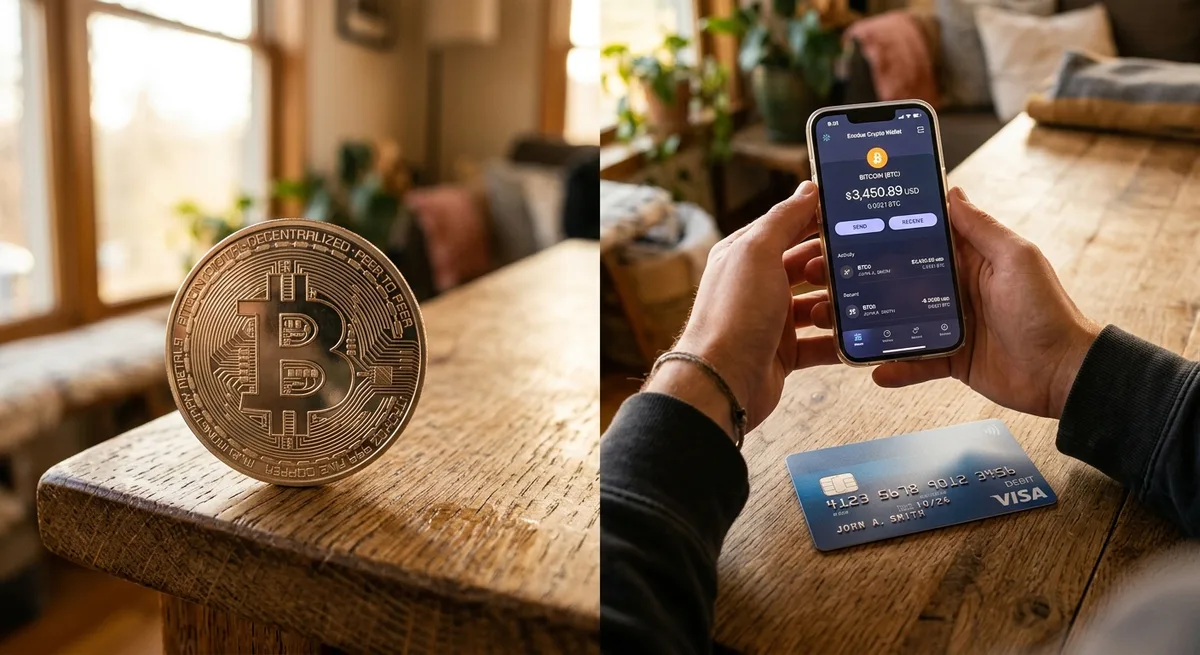
Bitcoin vs Visa: Can Crypto Replace Traditional Payments?
Why This Comparison Matters Right Now
The bitcoin vs visa debate has moved well beyond crypto forums and trader circles. Bitcoin is now part of a real conversation about digital payments, financial independence, and what money might look like going forward.
Visa, meanwhile, is still one of the most dominant payment networks on the planet. Most people use it without ever thinking about what’s happening underneath. It works, it’s familiar, and for everyday spending it feels completely seamless. That’s exactly what makes this comparison worth having, because Bitcoin and Visa were built for fundamentally different goals, even though people constantly lump them together.
For consumers, the question is practical: which option is faster, safer, easier? For business owners, it usually comes down to fees, settlement, and what customers actually want. For investors, it goes deeper into whether crypto adoption can genuinely challenge the payment rails powering global commerce.
Here’s the thing though: Bitcoin is not just a card alternative, and Visa is not a currency. They sit at different layers of the payment stack entirely. If you’re new to Bitcoin, it’s worth starting with What Is Bitcoin? before getting into the comparison.
The goal here isn’t to pick a winner. It’s to understand what each system actually does well, where each one runs into trouble, and how they both fit into a financial landscape that keeps changing.
Bitcoin vs Visa at a Glance
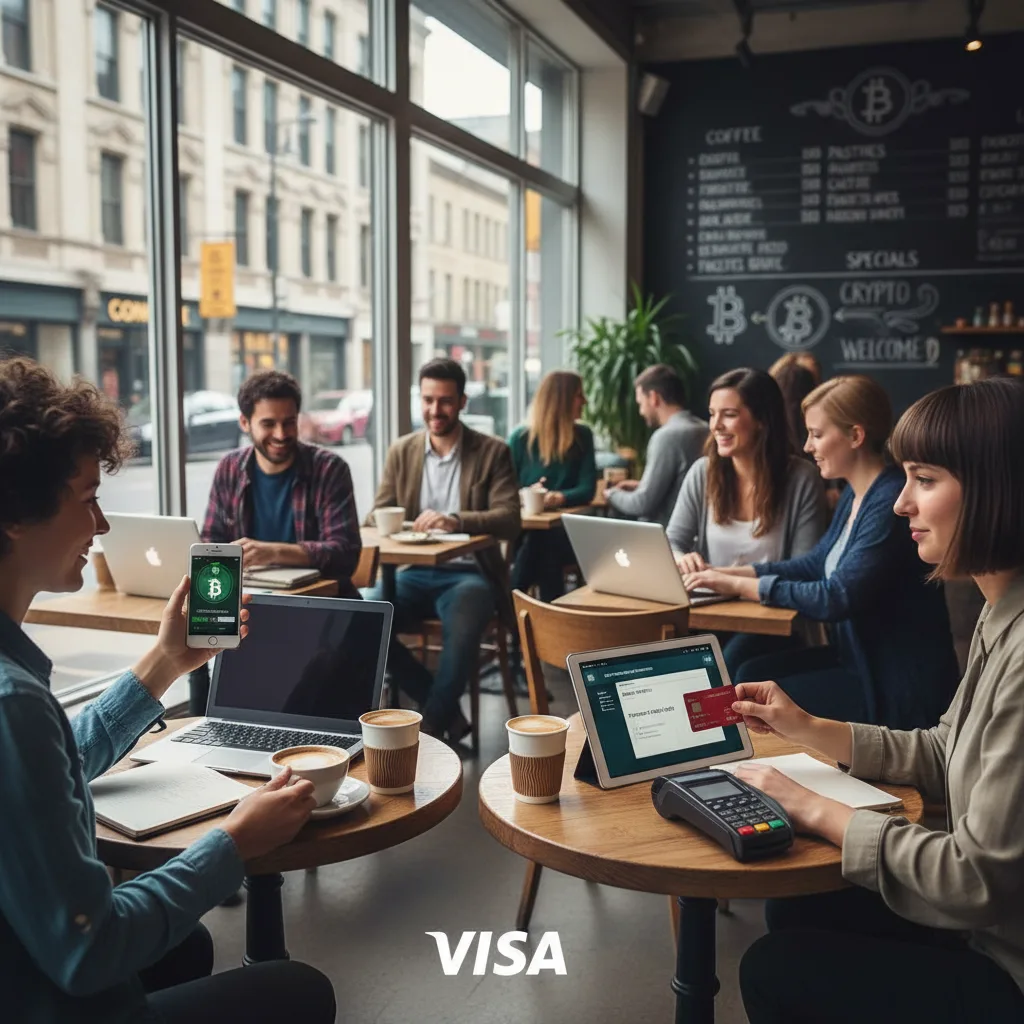
Here’s a quick side-by-side to frame everything that follows.
| Category | Bitcoin | Visa | |—|—|—| | Core role | Decentralized digital money and settlement network | Global card payment network connecting banks, merchants, and consumers | | Checkout speed | Usually not instant on the base layer | Usually feels instant at checkout | | Final settlement | On-chain after confirmations | Backend settlement often takes longer than customer authorization | | Transaction fees | Variable network fees based on demand | Merchant pays transaction fees, interchange, and processing costs | | Accessibility | Open to anyone with internet access and a wallet | Requires bank or card issuer relationship and merchant support | | Acceptance | Limited compared with major card networks | Extremely broad global acceptance | | Reversibility | Generally irreversible once confirmed | Reversible through disputes and chargebacks | | Security model | Cryptographic ownership and self-control | Centralized fraud monitoring and consumer protection | | Best use cases | Large transfers, borderless payments, self-custody, value transfer | Retail shopping, subscriptions, travel, mainstream spending | | Main tradeoff | More control, less convenience | More convenience, less direct control |
That table already shows the core tension. One system is optimized for open settlement and direct ownership. The other is built for smooth consumer payments at scale. To understand why those tradeoffs exist, you need to look at how both systems actually work behind the scenes.
How Bitcoin and Visa Actually Work
Bitcoin and Visa both move value from one party to another, but that’s about where the similarity ends.
Bitcoin is a decentralized network. No single bank, company, or government runs it. Transactions are broadcast to the network, verified by participants, and recorded on a public blockchain. The whole thing is designed around direct value transfer without a central operator in the middle.
Visa is a centralized payment system. It doesn’t issue money or hold your deposits directly. What it does is connect cardholders, merchants, acquiring banks, issuing banks, and payment processors into one functioning system. Visa is essentially the network that makes sure card payments get approved and routed to the right places.
The clearest way to put it: Bitcoin aims to settle value directly on a decentralized ledger, while Visa coordinates trust between institutions inside a traditional financial system. If you want a proper walkthrough of the Bitcoin side, Bitcoin Transactions Explained Step by Step is worth reading before going further.
That difference gets much more concrete when you follow an actual payment from start to finish.
How a Bitcoin Payment Moves From Sender to Receiver
A Bitcoin payment starts in a wallet. You choose an amount, enter the recipient’s address, and sign the transaction with your private key. If the wallet side of things is unclear, Bitcoin Wallets Explained covers it well.
Once signed, the transaction is broadcast to the network. Nodes validate it and miners eventually include it in a block. A transaction might appear quickly in your wallet app, but actual finality depends on how many confirmations it gets and what’s happening with network congestion at the time.
This design makes Bitcoin genuinely powerful for peer-to-peer payments, no bank needed to approve anything. The tradeoff is that settlement isn’t always immediate, especially when the network is busy.
How a Visa Card Payment Gets Authorized and Settled
A Visa payment starts with a card tap, insert, or online entry. The merchant’s processor routes the request through Visa to your issuing bank, which checks whether the card is valid, whether you have the funds or credit available, and whether anything looks off. If everything checks out, the approval comes back in seconds. You walk away with your purchase.
But that authorization is not the same as final settlement. The actual movement of money between institutions happens later, through clearing and settlement processes running quietly in the background. The front end feels instant. The full financial completion takes more time than most people realize.
Once you see that gap between what feels fast and what’s actually settled, the question of which system is faster gets a lot more interesting.
Transaction Speed: Which One Is Actually Faster?
If checkout experience is all that matters, Visa wins easily. Tap a card, done. For everyday shopping that frictionless feeling is important.
If you care about actual ownership transfer and final settlement, it gets more complicated. Bitcoin can settle directly on its own network without banks or clearing systems in the loop, but confirmation takes time. Block production isn’t instant, and things slow down further when the network is congested.
This is why comparing bitcoin payment vs visa transaction speed can be misleading. People often stack Visa’s instant-looking authorization against Bitcoin’s final on-chain settlement, which aren’t the same thing at all. Bitcoin Transaction Speed Explained goes deep on what actually affects confirmation times if you want the full picture.
Visa wins at the checkout counter. Bitcoin offers a different settlement model that matters more in specific situations. To compare fairly, you have to be clear about what “fast” actually means.
Why “Fast” Means Different Things in Bitcoin and Visa
Fast can mean at least three different things.
There’s instant authorization, which is what Visa does brilliantly. A merchant gets a signal in seconds that the payment is approved.
There’s full backend processing, covering clearing and actual fund movement between financial institutions. That’s not truly instant, even if the customer experience makes it feel that way.
And then there’s final, irreversible settlement. That’s what Bitcoin is designed around. Once a transaction has enough confirmations, reversing it is extremely difficult. That’s very different from a card payment that can later be disputed or charged back.
The honest summary: Visa is faster for buying coffee. Bitcoin’s settlement model matters most when finality itself is the priority.
Fees and Costs: Who Pays More?
Fees are one of the areas where people most often get the bitcoin vs visa comparison wrong.
With Bitcoin, the cost is upfront and visible. You pay a network fee to get processed. That fee fluctuates based on demand for block space. Sometimes it’s negligible. Sometimes, during a congested period, it spikes noticeably.
With Visa, the consumer usually sees nothing at checkout. But that doesn’t mean the transaction is free. Merchants pay interchange fees, processor costs, and various service charges. Those costs tend to get baked into product prices, so customers still pay, just indirectly.
Bitcoin vs PayPal: Best Payment Method? is a useful read here, because it shows how visible versus hidden costs shape user experience across different payment rails.
In short: Bitcoin makes the fee visible. Visa pushes it into the business side of the transaction. Which one is “cheaper” depends entirely on who you are and what you’re doing.
When Bitcoin Can Be Cheaper
Cross-border payments are the clearest example. Sending money internationally through banks and card-linked systems can mean currency conversion spreads, intermediary fees, delays, and settlement complexity. Bitcoin can sidestep some of that by letting value move directly across borders on one network.
For larger transfers, especially between parties who are comfortable with crypto, the total cost can end up lower than going through legacy systems. That’s why Bitcoin keeps coming up in conversations about remittances and international business settlement. How XRP Is Transforming Cross-Border Payments adds some useful context on how the broader market is approaching this.
Still, lower cost doesn’t automatically mean better experience, and that’s where Visa holds its ground.
When Visa Is More Convenient Despite the Costs
Visa’s friction is low and the experience is predictable. Consumers know how cards work. Merchants support them. Refunds, rewards, and familiar checkout flows all make a real difference in daily life.
For small purchases, most people would rather absorb a slightly higher embedded cost than deal with wallet management, price volatility, and confirmation waiting times. Fee optimization matters less than convenience for the majority of retail situations.
Merchant acceptance is the other big factor. A theoretically efficient payment method that almost no stores accept stays theoretical. Visa’s acceptance footprint is simply in a different league.
Security, Fraud, and Reversibility
The security differences between Bitcoin and Visa aren’t just technical. They reflect genuinely different philosophies about how trust should work.
Bitcoin puts ownership in the hands of the user through cryptography. Control the keys, control the funds. No central party can easily freeze, reverse, or dispute a confirmed transaction. That’s powerful, but it places full responsibility on you.
Visa places trust in institutional safeguards. Fraud monitoring, chargeback systems, and dispute handling give users a safety net. The protection is real, but it depends on intermediaries, and it creates chargeback risk for merchants.
Neither model is universally better. It comes down to whether you value direct control or reversible protection more.
Bitcoin Security Strengths and Risks
Bitcoin’s strongest point is that your ownership isn’t tied to anyone’s permission. A bank can’t freeze it. A payment processor can’t block it. For people who want genuine control over their assets, self-custody is genuinely attractive.
It also removes a common merchant headache: chargebacks. A confirmed Bitcoin transaction is essentially irreversible. That protects sellers from fraudulent reversal attempts.
The flip side is that same irreversibility becomes a risk for users. Send funds to the wrong address, fall for a scam, or lose access to your keys, and there’s no support line to call. Freedom comes with accountability, full stop.
That’s one of the clearest advantages of bitcoin over visa for users who value sovereignty, and one of the main reasons mainstream users hesitate.
Visa Security Strengths and Risks
Visa’s biggest consumer advantage is recovery. If your card is stolen or used without authorization, there’s a dispute process. Most people trust the system because there’s a familiar way to fix mistakes.
Fraud prevention also works quietly in the background. Issuers flag unusual spending, merchants use security tools, and suspicious activity can be blocked quickly. You don’t even notice it most of the time.
The downside is dependence. Accounts can be frozen, transactions declined, and disputes can go against you. For merchants dealing with chargeback claims, the system can feel less like protection and more like a structural risk.
Accessibility and Global Reach
Accessibility is one of the most meaningful differences between cryptocurrency and traditional payment systems, and it’s easy to underestimate.
Bitcoin is open by design. Internet access and a wallet is all you need. No credit history, no bank account, no approval from a card issuer. That gives Bitcoin real potential for financial inclusion in parts of the world where traditional banking is limited or unreliable.
Visa is globally recognized but not fully open. You typically need banking access, a card issued by a financial institution, and merchants who support the network. In developed markets, that’s easy. In others, it’s a serious barrier.
Legal status matters here too. Open technology doesn’t automatically mean unrestricted use everywhere. Is Bitcoin Legal? Global Overview gives a country-by-country perspective worth checking.
Where Bitcoin Has an Edge
For users in underbanked regions, or places where the local banking system is unstable or restricted, Bitcoin is more than a speculative asset. It’s a working alternative.
People facing capital controls, limited banking options, or transfer restrictions can use Bitcoin to move value in ways that traditional networks simply don’t support. Financial freedom with Bitcoin payments isn’t a marketing slogan in those contexts. It’s a practical feature that solves a real problem.
Where Visa Still Dominates
Visa dominates point-of-sale and mainstream payments for a straightforward reason: the infrastructure is already there. Stores accept it, consumers understand it, and the whole flow is built into daily life.
Groceries, hotel bookings, subscriptions, quick online purchases, it all just works. Most people don’t want to think about private keys and confirmation times when they’re grabbing lunch.
Bitcoin may be globally reachable in principle, but Visa is globally embedded in practice. That difference shows up most clearly when you look at specific situations.
Real-World Use Cases: When Bitcoin Makes More Sense and When Visa Does
The most useful way to evaluate payment networks bitcoin vs visa is by use case, not by ideology.
For everyday online shopping and routine transactions, Visa is easier. For remittances, large transfers, cross-border business payments, or moving wealth without banking intermediaries, Bitcoin becomes much more attractive depending on the context.
The broader market is also searching for better settlement infrastructure. How Banks Are Using Ripple XRP for Faster Transactions is a good example of how that search is playing out in practice.
The smarter question isn’t which system is better in the abstract. It’s what problem you’re actually trying to solve.
Best Situations for Using Bitcoin
Bitcoin makes the most sense when control matters more than convenience:
- Large value transfers where direct settlement is more important than card-style speed
- Sending money across borders without relying on banking hours or intermediaries
- Payments where censorship resistance or independence from financial institutions matters
- Long-term wealth transfer between two parties who want finality without a middleman
In these situations, the tradeoffs are acceptable because sovereignty, open access, and settlement finality are worth more than a polished retail experience.
Best Situations for Using Visa
Visa is still the obvious choice in most everyday situations:
- Retail purchases, restaurants, supermarkets
- Subscriptions and recurring payments
- Travel bookings and hotel stays
- Any situation where broad acceptance and instant authorization matter
It’s also the better option when consumer protection is important. Refunds, dispute resolution, and card-linked purchase benefits are part of the value for most mainstream users. That’s not going away anytime soon.
Can Bitcoin Really Replace Visa?
In the near term, no. Not if replace means taking over day-to-day global retail payments at Visa’s scale.
That doesn’t mean Bitcoin is irrelevant. It means the two systems occupy different layers of the financial future. Bitcoin can absolutely compete in specific niches: borderless money, settlement asset, an alternative for users who want less dependence on banks. In some cases it complements existing payment infrastructure rather than displacing it.
This is why crypto vs banks is rarely a clean winner-takes-all story. The future probably involves multiple systems running alongside each other. And if you’re comparing transaction-focused crypto options more broadly, XRP vs Bitcoin: Which Cryptocurrency Is Better for Transactions? adds another useful angle.
Bitcoin has genuine strengths that traditional rails don’t. But replacing Visa at scale means solving more than one problem at once.
What Bitcoin Still Needs to Compete at Scale
Volatility is the most obvious issue. Merchants don’t love accepting an asset that can move 10% in a day. Users who see Bitcoin as an investment often hesitate to spend it. That tension makes it awkward as a stable medium of exchange for everyday purchases.
User experience also needs work before mainstream adoption is realistic. Wallet setup, fee management, confirmation times, and self-custody can still feel intimidating to anyone who didn’t choose to learn about it. And regulation remains inconsistent across jurisdictions, which creates real uncertainty for businesses trying to build on top of it.
Bitcoin scalability compared to Visa remains a core challenge. Visa was built for high-volume retail throughput. Bitcoin was built for decentralized security and settlement. Those aren’t the same design goals, and closing that gap isn’t simple.
Why Traditional Payment Networks Still Have a Strong Moat
Visa’s moat is built on network effects, payment rails, decades of regulatory alignment, and trust that runs deep.
Merchants accept Visa because customers use it. Customers use it because merchants accept it. Banks issue cards because the network already works everywhere. That self-reinforcing loop is genuinely hard to break.
Add in established compliance structures, fraud systems, and consumer familiarity, and you have infrastructure that most people rely on without even thinking about it. Criticism of banks doesn’t stop most people from tapping their card at the checkout.
Broader Considerations Beyond Speed and Fees
A realistic view of the future of payments with bitcoin and visa has to go beyond performance metrics.
Regulation shapes how easy or difficult crypto is to actually use. Tax treatment, reporting requirements, and licensing rules can either accelerate adoption or slow it to a crawl depending on where you are.
Public perception matters too. Some people see Bitcoin as a tool for independence and innovation. Others still associate it mainly with speculation and complexity. That narrative directly affects adoption.
Environmental debate also plays a role, especially in institutional and policy conversations. Bitcoin’s mining model continues to attract scrutiny. Bitcoin Mining Energy & Environmental Impact gives a balanced look at that if you want to understand both sides of the argument.
These wider forces shape whether Bitcoin grows into a broader payment tool or stays focused on settlement, savings, and alternative finance for specific users.
Conclusion: Bitcoin vs Visa Depends on What You Need
The most honest take on the bitcoin vs visa debate is simple: they solve different problems.
Visa is better for fast checkout, broad acceptance, predictable experience, and consumer protection. Bitcoin is better for direct ownership, borderless transfer, censorship resistance, and moving value without traditional intermediaries in the loop.
The right choice depends on what you actually need. Groceries and flights? Visa is hard to beat. Control, final settlement, cross-border transfers without asking permission? Bitcoin has clear strengths there.
Hype tends to flatten this into a false either-or choice. In reality both systems can be useful, just in different contexts. Evaluate them by use case instead of narrative, and the decision usually becomes pretty obvious.