

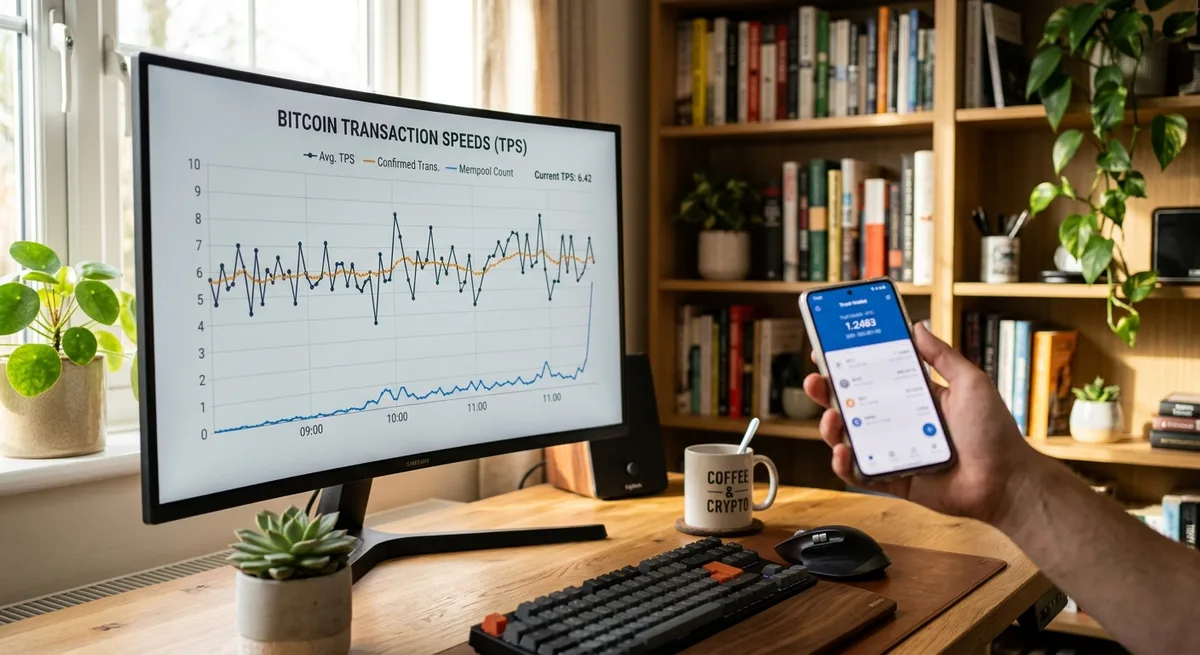
How Long Do Bitcoin Transactions Take? (Speed Explained)
How Long Do Bitcoin Transactions Take? (Speed Explained)
If you want the short answer: a Bitcoin transaction usually gets its first confirmation within about 10 minutes. But it can also take 30 minutes, an hour, or sometimes most of a day. That range surprises a lot of people.
You press send, the transaction shows up, and it feels like it should just… be done. But Bitcoin doesn’t work like a card payment app or a bank screen that flips to “completed.” It moves through a public network where miners pick which transactions to include in the next block, and they generally choose the ones paying the most.
In practice, your wait time comes down to three things above everything else: the fee you attached, how busy the network is at that moment, and how many confirmations the receiver wants before treating the payment as final.
So if you’re staring at a pending transfer right now wondering if something went wrong, the honest answer is: probably not. Delays are normal. To make that easier to judge, let’s start with what most users can actually expect.
The Short Answer: Average Bitcoin Transaction Time

The average bitcoin transaction time for a first confirmation hovers around 10 minutes, because that’s roughly how often Bitcoin produces a new block. But “average” is doing a lot of work in that sentence.
A transaction can be broadcast to the network almost instantly. You hit send, nodes see it within seconds. But visible is not the same as confirmed. A confirmed transaction is one that’s actually been included in a mined block and written to the chain. That second step is what matters.
So when people ask how long a bitcoin transfer takes, the real answer splits into two stages: broadcast and confirmation. The first happens fast. The second depends on conditions.
Bitcoin confirmation time can be quick during quiet periods if you’re paying a competitive fee. During busier stretches, a perfectly normal transaction can sit unconfirmed for far longer than you’d expect. Before getting into what causes delays, it helps to understand what a confirmation actually is.
What “confirmed” actually means
A confirmation means your transaction has been included in a valid Bitcoin block that was added to the blockchain. Once that happens, it has 1 confirmation. Every new block added after that increases the count.
Think of it as layers of security building up on top of each other. One confirmation means the transaction is on chain. Three means three more blocks have been stacked after it. Six means it sits deep enough that reversing it through a chain reorganization would be extraordinarily difficult.
For small payments, 1 confirmation is usually fine. For medium transfers, some services wait for 3. For large transfers, exchanges and institutions often require 6 or more. If you want a fuller picture of how a transaction moves from send to final settlement, this guide on Bitcoin transactions explained step by step is worth reading alongside this one.
Typical waiting times users can expect
In real use, most Bitcoin transactions fall into a few rough timing buckets:
- Under 10 minutes: your fee was competitive and you got into the very next block.
- 10 to 30 minutes: still completely normal. Maybe your fee was decent but not top tier, or the next block just took a bit longer to arrive.
- 30 to 60 minutes: common during moderate congestion. A lot of users start worrying here, but this is still within a normal range.
- Several hours: your fee was probably too low for current conditions, or the mempool was crowded with transactions willing to pay more.
- A full day or more: less common, but it happens during heavy traffic spikes or with very low fees.
The key point is this: Bitcoin is often fast enough, but it’s not fixed-time delivery. To understand why, you need to look at what actually drives speed inside the network.
Why Bitcoin Transaction Time Can Vary
Bitcoin doesn’t promise instant settlement. It runs on an open network where transactions compete for limited block space. That means your speed depends less on when you hit send and more on what’s happening across the network at that exact moment.
If a lot of people are moving Bitcoin simultaneously, or if your fee is below current market rates, your transaction waits. The main causes are straightforward once you see how they connect.
Network congestion and mempool backlog
Before a transaction gets confirmed, it usually sits in the mempool: a pool of valid but unconfirmed transactions all waiting for a spot in the next block. Picture a busy bar where everyone’s trying to get served at once. The higher tippers move faster.
When network activity spikes, the mempool fills up quickly. More competition for the same limited block space means lower-fee transactions get pushed back while higher-fee ones jump ahead. This is a big part of the bitcoin mempool and transaction times relationship. During quiet periods, even moderate fees get confirmed fast. During busy stretches, that same fee might suddenly not be enough.
That growing backlog is also one reason Bitcoin keeps running into scalability debates, especially as adoption grows. This article on Bitcoin scalability and mass adoption adds useful context if you want to dig deeper.
Congestion explains part of the delay, but fees decide exactly where your transaction sits in the queue.
Transaction fees and miner priority
Miners generally prioritize transactions that pay higher fees per unit of data. More revenue per block is simply better for them, so it makes sense.
This is why bitcoin transaction fees and time are so closely linked. A low fee during a quiet period might still confirm quickly. That same fee during a busy period? You could be waiting much longer than expected. This is also why people sometimes think Bitcoin has suddenly “gotten slow” when really the market price for block space has just changed.
Fee pressure is likely to matter even more over time as block rewards continue to shrink. This piece on how halving impacts transaction fees gives good background on that longer-term dynamic.
Even with a well-priced fee, though, timing can occasionally surprise you.
Block production timing is not perfectly regular
Bitcoin targets a 10-minute average block time. Average is the key word there.
Sometimes a block is found in 2 minutes. Sometimes it takes 20. That randomness is baked into the system. It doesn’t mean something’s broken. So even if your fee is competitive and your transaction is near the top of the queue, you can still wait longer than expected simply because the next block hasn’t arrived yet. It’s one of those quirks that catches a lot of beginners off guard.
If you want to understand why block timing drifts around the average, this article on block time fluctuations explains it well.
There’s one more delay factor that often gets overlooked entirely.
Wallet, exchange, and service-side delays
Not every delay comes from the blockchain itself.
Some wallets batch outgoing transactions to reduce fee costs. Some exchanges review withdrawals before broadcasting them. Some platforms only credit deposits after a certain number of confirmations, even if the transaction is already visible on chain. You might be sitting there refreshing your wallet wondering what’s happening, while the blockchain side actually finished its job an hour ago.
This is why users often blame Bitcoin for delays that actually come from the service they’re using. To judge your wait accurately, you need to understand confirmations more clearly.
How Bitcoin Confirmations Work
A useful mental model: your transaction is not fully trusted just because it exists on chain. It becomes more trusted as more blocks are built on top of it.
Each additional confirmation makes it harder for a competing chain to replace the transaction in some edge case. For everyday users, this is less about theoretical security and more about practical risk management.
The number of confirmations that matters depends on the size of the transfer and how cautious the receiver wants to be.
0 confirmations vs 1 confirmation vs 6 confirmations
At 0 confirmations, the transaction has been broadcast but not yet included in a block. Some merchants will accept this for tiny in-person payments, but there’s more risk involved.
At 1 confirmation, the transaction is in the blockchain. For many ordinary transfers, this is already solid enough.
At 6 confirmations, the payment is considered highly secure by most standards. This has long been the benchmark for large transfers, though individual platforms set their own policies.
Nodes across the network help validate and relay this information throughout the whole process. If you want a simple explanation of how that infrastructure works, this guide on what a Bitcoin node is connects well with this topic.
Why exchanges often require more confirmations
Exchanges are custodial platforms managing risk across huge volumes of deposits and withdrawals. They’re not just thinking about your transfer. They’re protecting their entire book of users.
That’s why a deposit might appear on a block explorer long before it shows up in your account. The blockchain already recognizes it, but the platform wants more confirmation depth before crediting the funds. On-chain visibility and account availability are not the same thing. Once you know that, the next step is figuring out how to actually check where your transaction stands.
How to Check the Status of a Bitcoin Transaction
The easiest way is with a block explorer. You paste in your transaction ID (usually called the TXID) and the explorer shows you exactly what’s happening: whether the transaction is still in the mempool, how many confirmations it has, and what fee rate it used.
This gives you real bitcoin transaction tracking without having to rely on a wallet’s vague “pending” label. It turns something abstract into something you can actually read. For beginners, that shift alone can reduce a lot of unnecessary stress.
What to look for in a block explorer
Start with the TXID. That’s the unique identifier for your transaction.
Then check confirmations. Zero means it’s not yet in a block. One or more means it’s confirmed.
Look at the fee paid and, more importantly, the fee rate. That’s what determines where you sit in the miner’s priority queue.
Check the time first seen. That tells you how long the transaction has been waiting.
Also look at whether the explorer labels it as unconfirmed, confirmed, or replaced. These fields together give you a concrete picture of where things stand and what’s likely to happen next.
Signs your transaction may be delayed
A few common red flags worth knowing:
- A very low fee rate compared with current network conditions.
- A long mempool queue with lots of higher-fee transactions ahead of yours.
- No confirmation after several block intervals despite being visible.
- The transaction isn’t showing on a block explorer at all, which usually means the wallet or exchange hasn’t broadcast it yet.
Once you can spot these signals, the next question is whether you can do anything about them.
How to Speed Up a Bitcoin Transaction
There’s no magic button. How to speed up a bitcoin transfer mostly comes down to making smart decisions before you send. The fastest approach is choosing an appropriate fee based on current conditions and using a wallet that gives you some control if things get stuck.
Choose the right fee before sending
Most wallets suggest a fee based on current demand. That estimate isn’t perfect, but it’s usually much better than just picking the cheapest option and hoping for the best.
If your transfer is urgent, paying slightly more upfront can save hours of waiting. If timing doesn’t matter, a lower fee is fine. The mistake most people make is treating fees as fixed when they’re actually market-driven. A low fee can look smart right now and frustrating an hour later if network activity suddenly picks up.
Transaction size also plays a role. Larger transactions consume more block space, so they often need higher total fees to stay competitive.
If you’ve already sent with too low a fee, you may still have one option.
Use Replace-by-Fee (RBF) if your wallet supports it
Replace-by-Fee, usually called RBF, lets you rebroadcast an unconfirmed transaction with a higher fee. You’re essentially telling the network: here’s an improved version that’s more attractive to miners. Not every wallet supports it, but when it does, it’s one of the most practical tools available for a stuck transfer.
It doesn’t guarantee instant confirmation, but it often helps when the original fee was simply too low for current conditions.
Consider when timing matters and when it doesn’t
If you’re moving funds between your own wallets with no time pressure, waiting is completely fine. If you’re sending to an exchange before a market move, paying for speed might be worth it. If a merchant needs confirmation before releasing something, urgency matters.
The practical mindset: don’t overpay when speed doesn’t matter, but don’t underpay when it does. Once you’ve internalized that tradeoff, it’s also natural to wonder how Bitcoin compares to other networks that make different choices.
Is Bitcoin Slow Compared With Other Cryptocurrencies?
Compared with many newer networks, yes, Bitcoin can feel slower. But that comparison needs context.
Bitcoin was designed with a strong emphasis on security, decentralization, and resilience. Those priorities affect throughput and settlement speed. So when people ask why bitcoin transactions take so long, the better question is usually: what tradeoff is Bitcoin making on purpose?
Speed matters, but it’s not the only thing that matters.
Why Bitcoin is designed differently
Bitcoin uses proof of work and a deliberately conservative design. Block production is slower, and block space is more limited than on some newer systems. Those choices reduce certain risks and support decentralization, but they also mean lower raw transaction throughput.
If you want a broader look at the underlying models, this guide on proof of work vs proof of stake is a useful read. Bitcoin being slower is connected to design priorities, not simple inefficiency.
How Bitcoin compares to faster payment-focused networks
Some cryptocurrencies confirm transactions much faster and process more of them per second. That can make them more convenient for everyday payments. But speed alone doesn’t tell you everything about reliability, decentralization, or long-term security.
If you want to see which networks push speed most aggressively, this roundup on lightning fast cryptocurrencies gives a good overview.
A practical example: XRP vs Bitcoin for transaction speed
XRP is often much faster for simple transfers. In practice, XRP transactions usually settle in seconds while Bitcoin needs at least one block confirmation and sometimes more.
That doesn’t automatically make XRP better for every purpose. It’s optimized differently. If transaction speed for payments is your main concern, this article on XRP vs Bitcoin for transactions breaks down that tradeoff in more detail.
FAQ About Bitcoin Transaction Time
Can a Bitcoin transaction be instant?
Not in the final settlement sense.
A transaction can appear on the network almost instantly after broadcast, but that just means nodes have seen it. It only becomes meaningfully settled once it’s included in a confirmed block. Visible and final are two different things, and that distinction trips up a lot of beginners.
Why is my Bitcoin transaction still unconfirmed?
The most common reasons: a low fee rate, network congestion, or a platform that hasn’t fully processed the transaction yet.
If your transaction is visible on a block explorer with 0 confirmations, it’s sitting in the queue. If it’s not visible at all, your wallet or exchange may not have broadcast it yet. In most cases, an unconfirmed transaction isn’t lost. It’s just waiting.
How many confirmations are enough?
For small payments, 1 confirmation is usually enough. For moderate transfers, 3 is a common comfort level. For larger transfers, 6 confirmations remain a widely used benchmark.
The right answer depends on the amount, your risk tolerance, and the policy of whoever is receiving the funds.
Can I cancel or reverse a Bitcoin transaction?
Usually not once it’s confirmed.
If it’s still unconfirmed and your wallet supports RBF, you may be able to replace it with a version that changes the fee or destination. But that’s not a guaranteed cancellation. The practical lesson: double-check the address, amount, and fee before you send. Prevention beats trying to undo a mistake after the fact by a wide margin.
Conclusion
Bitcoin transaction time is a range, not a fixed number. In many cases the first confirmation arrives around the 10-minute mark, but the actual wait depends on your fee rate, current network congestion, and how many confirmations the receiver requires.
Once you understand how the confirmation process works, Bitcoin becomes much more predictable. A pending transfer stops feeling random and starts making sense: a transaction waiting for block space based on current market conditions.
If you want smoother transfers going forward, check current fee conditions before sending, use a wallet with solid fee estimation, and track progress with a block explorer rather than guessing. Bitcoin isn’t always fast, but its logic is clear once you understand how the system decides what gets confirmed first.