

How to Calculate Bitcoin Mining Profit
Here is something a lot of people get wrong from the start: revenue is not the same as profit. You see a machine’s projected daily payout, and it looks decent. But that number is not what you take home. To know whether mining actually makes sense for you, you need to calculate bitcoin mining profit using real inputs, not the hopeful ones.
That means looking at what your miner can actually produce, what it costs to keep running, and how a shifting market affects your outcome. Bitcoin price moves constantly. Network difficulty climbs. Pool fees chip away quietly. And your electricity rate can make or break the whole thing before you even get started.
If you are new to this, treat mining like a business calculation, not a passive income shortcut. If you have been at it for a while, you already know the same rules apply. The only real difference is that experienced miners tend to stress test their numbers a lot harder.
What Bitcoin Mining Profitability Actually Means
Bitcoin mining profitability is what you keep after all costs come out of your revenue. It answers one straightforward question: after paying to run your machine, are you actually making money?
That sounds obvious. But this is where a lot of miners go wrong. They focus on gross payouts and overlook the quieter expenses. Profitability is not just about how much Bitcoin your machine earns. It is about whether those earnings are worth more than your electricity, fees, cooling, maintenance, and hardware wear.
A miner can produce Bitcoin every single day and still be losing money. That happens more often than people expect, especially when residential electricity rates are high or when difficulty rises faster than output can justify.
It helps to keep three ideas separate:
- Revenue: the value of the Bitcoin you mine
- Costs: power, fees, and everything else it takes to keep running
- Profit: revenue minus costs
Your earnings from mining are not fixed. You are not collecting a salary. Estimated income can shift without you changing anything on your end. A Bitcoin price jump can improve your margins overnight. A difficulty spike can shrink them just as fast. A heat wave in summer can throttle your machines and quietly cut output.
If you want a broader view of how rewards and profitability fit together, this guide on Bitcoin mining profitability and rewards is worth reading before you sit down to do the math yourself.
Once that foundation is clear, the next step is turning profitability into a formula you can actually use.
The Simple Formula to Calculate Bitcoin Mining Profit
The core formula is straightforward:
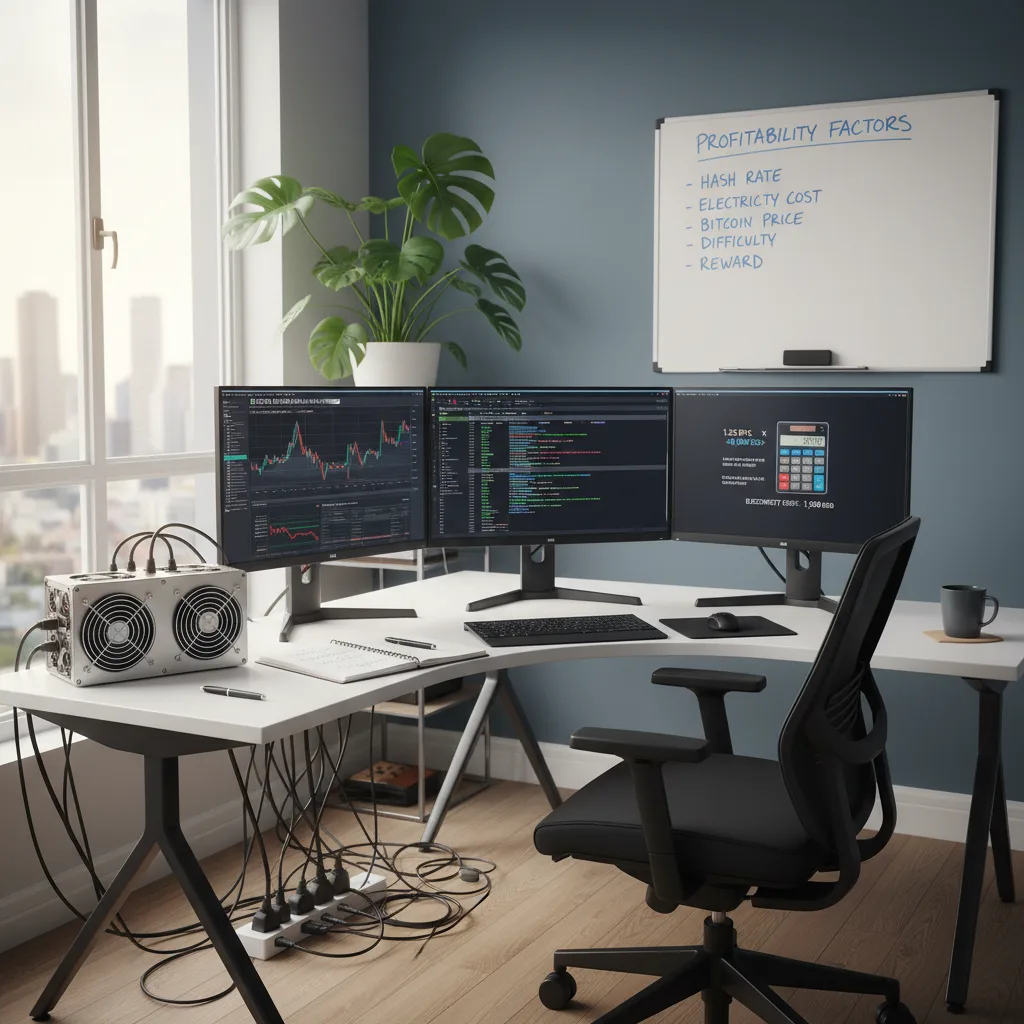
Bitcoin mining profit = mining revenue minus total mining costs
To make that usable, break it into smaller pieces:
Profit = value of BTC mined minus electricity cost minus pool fees minus other operating costs minus hardware cost over time
You do not need a finance background to work through this. You just need honest numbers.
A practical way to think about it:
- Estimate how much Bitcoin your miner can produce
- Convert that amount into your local currency
- Calculate what it costs to run the machine
- Subtract all recurring expenses
- Decide whether what remains actually justifies the setup
This process gets a lot easier when you cross-check your manual numbers against a mining profitability calculator. Calculators save time, but they only give you useful results if the data you feed them is accurate.
To use the formula well, you need to understand both sides: revenue and costs.
Revenue: How Much Bitcoin Your Miner Can Produce
Revenue starts with your hashrate. That is the amount of computational work your machine contributes to the Bitcoin network. More hashrate means a larger share of total network work.
But higher hashrate does not guarantee a fixed payout. Your miner is competing against the entire network. Rewards are distributed based on successful block production, and your share depends on your contribution relative to everyone else’s.
What you actually produce depends mainly on:
- Your miner’s hashrate
- Total network difficulty
- The current block reward
- Whether you mine solo or through a pool
Most smaller miners use a pool because solo mining creates wildly unpredictable income. Imagine waiting weeks or months for a block that might never come. Pools combine hashrate and distribute rewards proportionally, which smooths things out, though it also means paying fees.
Block rewards matter too, because they determine how much new Bitcoin is actually entering circulation. This article on block reward calculation breaks down those mechanics clearly if you want to dig deeper.
Once you understand revenue, the more important part begins: what it actually costs to earn it.
Costs: What You Need to Subtract From Revenue
Most mining mistakes happen here.
The main cost categories are:
- Electricity
- Pool fees
- Cooling or ventilation
- Maintenance and repairs
- Internet and uptime-related expenses
- Hardware depreciation
Electricity is almost always the biggest expense. If your machine runs 24 hours a day, even a small difference in your power rate can turn a profitable setup into a losing one. This is not a small detail.
Pool fees are easy to dismiss as minor, but they add up. A 1 or 2 percent fee matters when margins are already thin. Cooling costs are similar. Your miner does not just consume electricity directly. It throws off heat, and that heat has to go somewhere. Managing it costs money.
Maintenance is another one people ignore until something breaks. Fans fail. Dust reduces airflow and efficiency. Downtime cuts into revenue quietly. Small interruptions add up more than most people expect.
And then there is hardware depreciation. Even if your miner still runs fine, it loses economic value over time as newer, more efficient machines enter the market. Leave this out and your revenue and expenses calculation is incomplete.
If you want to understand how much fee drag actually hurts over the long run, this breakdown of pool mining fees and hidden costs makes a convincing case for why small percentages deserve attention.
Step-by-Step: How to Calculate Bitcoin Mining Profit Manually
You do not need to rely entirely on a tool. The manual process is manageable with a calculator or a basic spreadsheet.
The goal is not to predict the future perfectly. The goal is to build a realistic snapshot using current data, then test different scenarios to see how sensitive your setup is to changes in price, power costs, and difficulty.
Step 1: Find Your Miner’s Hashrate and Power Consumption
Start with the two hardware numbers that matter most:
- Hashrate
- Power consumption in watts
Both are usually in the manufacturer’s specs. A machine might be listed at 100 TH/s with 3000 watts of consumption. Those numbers are your starting point, not your final truth.
Real-world output often differs based on firmware, ambient temperature, airflow quality, dust buildup, and whether you are running in performance or efficiency mode. A machine sitting in a cool, well-ventilated room will behave differently than the same model crammed into a hot garage with poor airflow.
Hashrate tells you your earning potential. Wattage tells you your base running cost. You need both. Looking at just one gives you a distorted picture of what your setup actually does.
If you want to understand how these two variables interact, this article on difficulty vs hashrate adds useful context before you move forward.
Step 2: Check the Current Bitcoin Price and Network Difficulty
Next, look up the current Bitcoin price and current mining difficulty.
Bitcoin price matters because your machine earns BTC, but your electricity bill arrives in euros or dollars. If BTC rises, the same mined amount is worth more. If BTC falls, your fiat revenue drops immediately, even though your machine did nothing different.
Mining difficulty affects how hard it is for the network to produce blocks relative to total competition. As difficulty rises, the same miner generally earns less Bitcoin over time, unless price increases enough to compensate.
This is why any profitability estimate should be treated as a snapshot, not a promise. Calculate it today, and the result might look quite different in two weeks. Difficulty also adjusts on a regular schedule, which means your earnings can shift even when your hardware stays exactly the same. This explainer on difficulty adjustment is worth reading if that process feels like background noise you have been ignoring.
Step 3: Calculate Daily Electricity Cost
This is the formula:
Daily electricity cost = watts ÷ 1000 × 24 × electricity rate per kWh
Example: a 3000 watt miner running all day at $0.12 per kWh costs:
3 × 24 × 0.12 = $8.64 per day
Change that rate to $0.06 and the same machine costs $4.32 per day. Same hardware, same output, completely different economics.
Use your actual utility rate. National averages are mostly useless here. Also factor in delivery charges, taxes, and tiered billing if those apply in your area. Plenty of miners discover this is where the gap between expectations and reality shows up first. If you want to think more carefully about the cost side, this article on electricity costs in mining is a good reference.
Step 4: Factor In Pool Fees and Other Operating Costs
If you mine in a pool, check the fee structure carefully. A 2 percent fee might not sound significant, but over months of tight margins, it matters. If your gross revenue is $15 per day and the pool takes 2 percent, that is $0.30 gone immediately. Over a year, it adds up to real money.
Then include the rest:
- Cooling and ventilation
- Occasional repairs
- Internet if dedicated to mining
- Planned downtime for maintenance
- Replacement parts
- Hosting fees if someone else runs the machine
Understanding this side of the equation matters a lot for anyone trying to figure out whether mining is actually worth pursuing. Gross income only tells you half the story. This guide on solo vs pool hashrate is useful if you are still weighing your options before finalizing fee assumptions.
Step 5: Estimate Net Daily, Monthly, and Yearly Profit
Now bring everything together:
- Estimate daily BTC mined
- Convert to fiat using the current BTC price
- Subtract pool fees
- Subtract daily electricity cost
- Subtract other daily operating costs
- What remains is your estimated net daily profit
Then scale it: multiply by 30 for a monthly estimate, or by 365 for a yearly one.
Do not treat those scaled numbers as guaranteed outcomes. They are scenario estimates based on conditions that will keep moving. When people ask how much you can realistically make mining Bitcoin, the honest answer is always: it depends on things that change.
A useful habit is building in a margin of safety. Reduce your projected revenue by 10 to 20 percent, or bump your estimated costs slightly. That gives you a more realistic picture of whether your setup can absorb some volatility and still make sense.
This article on solo mining block rewards is worth a look if you want perspective on reward variability before relying too heavily on annual projections.
Example Calculation: A Realistic Bitcoin Mining Profit Scenario
The clearest way to understand this is to walk through it with real numbers.
Sample Inputs
Assume this setup:
- Miner hashrate: 100 TH/s
- Power consumption: 3000 watts
- Electricity rate: $0.10 per kWh
- Pool fee: 2 percent
- Estimated gross mining revenue: $12.50 per day
- Other operating costs: $0.50 per day
Electricity calculation:
3 kW × 24 hours × $0.10 = $7.20 per day
Pool fee:
2 percent of $12.50 = $0.25 per day
Total daily costs:
$7.20 electricity + $0.25 pool fee + $0.50 other costs = $7.95 per day
Sample Profit Breakdown
Gross daily revenue: $12.50
Minus electricity: $7.20
Minus pool fee: $0.25
Minus other costs: $0.50
Estimated net daily profit: $4.55
Monthly estimate: $4.55 × 30 = $136.50
Yearly estimate: $4.55 × 365 = $1,660.75
That looks reasonable. Now change one variable.
If electricity rises from $0.10 to $0.15 per kWh, daily power cost becomes:
3 × 24 × 0.15 = $10.80
Same setup now produces:
$12.50 revenue minus $10.80 electricity minus $0.25 fee minus $0.50 other costs = $0.95 net daily profit
That is one input change, and your result drops by roughly 80 percent. Worth sitting with for a moment.
This is also why questions like “how do I make $100 a day mining Bitcoin” need a reality check. To hit that level consistently, you usually need a much larger operation, highly efficient hardware, very low power costs, and favorable network conditions. For most home miners, that target is simply not realistic without serious scale.
The takeaway is simple: small shifts in power cost, BTC price, or difficulty can flip your result fast. That is exactly why tools exist, but only work if you use them properly.
Using a Bitcoin Mining Profitability Calculator Instead of Doing It by Hand
A bitcoin mining profit calculator is useful when you want speed, easier comparison, and quick scenario testing. You enter your main inputs and get an estimate in seconds, which is genuinely helpful when comparing multiple machines or electricity rates side by side.
If you are exploring hosted or remote mining options, a cloud mining profitability calculator can help you see how those economics differ from running your own hardware.
That said, calculators are input-dependent tools, not prediction engines. If your data is wrong, your result is wrong. Outdated difficulty figures, optimistic uptime assumptions, and missing operating costs all produce outputs that look better than reality.
Use calculators as a shortcut, not a replacement for judgment.
What a Good Calculator Should Include
A reliable calculator should ask for:
- Hashrate
- Power consumption
- Electricity price per kWh
- Pool fees
- Current Bitcoin price
- Current network difficulty
- Time period for estimates
The better tools also let you adjust for extra costs, uptime, or efficiency settings. That matters because miners rarely perform in perfect lab conditions every single day. A calculator that only shows revenue and skips the expense side is not helping you make a real decision.
Common Mistakes When Using Mining Calculators
The biggest mistake is plugging in average electricity prices instead of your own actual rate. Your economics depend on your bill, not on what someone in another country pays.
The second mistake is assuming 100 percent uptime. Machines go offline. Networks drop. Maintenance happens. Even short interruptions reduce output over time.
Third is ignoring fee structures. Pool fees, hosting fees, and withdrawal fees all reduce net results, sometimes more than people realize.
Fourth is treating current profitability as stable. It is not. Bitcoin price can move sharply, and difficulty can rise fast during competitive periods. What looks good today may look very different in six weeks.
Finally, many users ignore hardware aging entirely. That creates inflated ROI expectations. If you are serious about calculating your actual return on investment, you need to account for the cost of the machine and the fact that its economic usefulness declines over time as newer hardware enters the market.
The Biggest Factors That Change Bitcoin Mining Profitability Over Time
Profitability is not static. A setup that works well this month may struggle next month. That does not always mean your hardware is bad. Often it just means the environment shifted around it.
Anyone asking whether bitcoin mining is still profitable should think in terms of moving variables rather than fixed labels. This article on mining profitability after the halving gives useful context for that broader question.
Bitcoin Price Volatility
Your machine earns Bitcoin, but your costs are denominated in fiat. That means your revenue in dollars or euros changes with Bitcoin price, even if your BTC output stays exactly the same.
If BTC climbs next month, your fiat income improves without you changing anything. If it drops, your margins get squeezed immediately. That is why describing mining as passive income with a guaranteed outcome is misleading. The output may be somewhat predictable over short periods, but the value of that output is not.
Price volatility also affects your ROI timeline, breakeven point, and whether holding mined BTC makes more sense than selling it right away.
Mining Difficulty and Competition
As more miners join the network, competition increases and difficulty rises with it.
When difficulty goes up, your share of total rewards shrinks unless your hashrate grows alongside it. In plain terms, the same machine can earn less Bitcoin over time without doing anything wrong. It is just that the network got harder around it.
This is one of the most consistent factors compressing mining margins. Newer, more efficient machines entering the market push older hardware toward unprofitability. A setup that looked solid six months ago can become marginal simply because the competitive landscape shifted.
This is also why profitable hardware is never just about raw hashrate. Efficiency often matters more than headline numbers, especially for smaller operators.
Energy Prices and Hardware Efficiency
Cheap electricity and efficient hardware are frequently the difference between profit and loss. A miner with low power costs can weather difficult periods that force others offline. A miner paying high residential rates may struggle even when the machine itself is technically fine.
Efficiency determines how much energy you spend to produce a given amount of hashrate. Two machines might have similar output, but if one uses significantly less power to get there, its economics are much stronger over time.
For most miners, this matters more than chasing the highest hashrate number available. The real question is not just how much BTC a machine can produce. It is how much it costs to produce that BTC.
Is Bitcoin Mining Still Worth It for Small or Home Miners?
For home miners, the honest answer is: sometimes, but only under specific conditions.
Mining at home is not automatically a bad idea. But it is not automatically smart either. You need to look at breakeven timelines, your electricity rate, the noise, the heat, hardware cost, and what you are actually trying to achieve.
If you just want Bitcoin exposure, buying it directly is simpler and cleaner. If your goal is to accumulate BTC gradually through infrastructure you control, mining can make sense. But only if the numbers support it.
There are also practical realities that people underestimate. ASIC miners are loud. They generate substantial heat. Running one can stress a home electrical setup. And they are a long way from the image of effortless side income that sometimes gets attached to crypto.
The right question is not whether mining is exciting. It is whether it fits your actual economics and living situation.
When Mining Can Make Sense
Access to low electricity costs is probably the single biggest advantage you can have. If your power rate is genuinely low, that changes the calculation significantly.
It also helps if you already have suitable space, ventilation, and electrical infrastructure in place. If those pieces exist, your entry costs are lower than someone building from scratch. Some miners run machines in a basement or garage that already has good airflow, which removes one of the bigger friction points.
Long-term conviction is another valid reason. Some miners are not trying to maximize short-term fiat profit. They are converting energy into Bitcoin because they believe in the asset over a multi-year horizon. That approach can be rational, as long as they still understand their running costs clearly.
Mining can also suit people who genuinely enjoy optimizing systems and monitoring performance. For them, the process itself has value beyond the daily payout number.
When Mining Probably Doesn’t Make Sense
If you pay high residential electricity rates, that factor alone likely kills your profitability before you start. In a lot of areas, this is simply the reality.
If you are expecting fast, guaranteed returns, mining is probably not the right fit either. Returns depend on volatile variables, and recovering upfront hardware costs takes time even under favorable conditions.
If your household needs quiet or low heat, one or more industrial machines running around the clock is going to create problems. These are not consumer devices. Even a single unit is disruptive in a typical home.
And if your plan only works under best-case assumptions, it is not a strong plan. Consistent profit from mining is possible, but only when the numbers hold up across realistic scenarios, not just the most optimistic one you can construct.
Conclusion: Calculate First, Mine Second
If there is one rule worth repeating, it is this: calculate first, mine second.
Understanding how to calculate bitcoin mining profit gives you a way to evaluate mining based on actual facts rather than assumptions. Start with revenue, subtract electricity, fees, and operating costs, then stress test the result. If your setup only looks good under perfect conditions, it is probably weaker than it appears.
Use a spreadsheet, use a calculator, or use both. Just make sure your inputs reflect reality. Check your actual electricity rate, account for downtime, include costs you might want to ignore, and revisit the numbers regularly as Bitcoin price and difficulty shift.
Mining can still be worthwhile. But only when the math genuinely supports it. That kind of discipline is not optional in this space. It is the edge.