

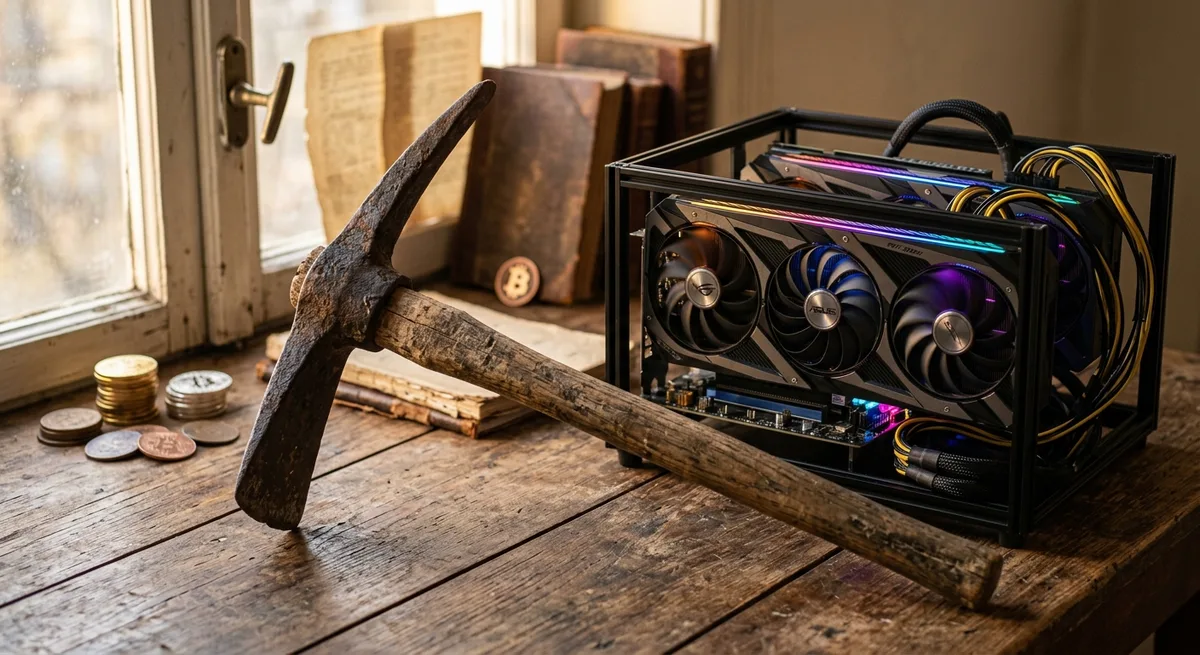
When Did Bitcoin Mining Start and End?
When Did Bitcoin Mining Start and End?
If you’re wondering when bitcoin miner started, the short answer is simple: Bitcoin mining started in January 2009, when Satoshi Nakamoto brought the network online and mined the first block.
The second part of the question is just as interesting. Bitcoin mining has not ended. It’s still running today, but it looks almost unrecognizable compared to where it started. What began as a small experiment on ordinary home computers has turned into a global industry with specialized hardware, massive energy demands, and serious competition.
That difference matters, because a lot of confusion comes from mixing up Bitcoin’s launch date, the first mining activity, and the assumption that mining will somehow stop one day. It helps to think of Bitcoin mining as a timeline rather than a single moment. If you need a broader foundation first, this guide on What Is Bitcoin? helps frame why mining existed in the first place.
So let’s start with the shortest answer, then build the full history from there.
The Short Answer: When Bitcoin Mining Began
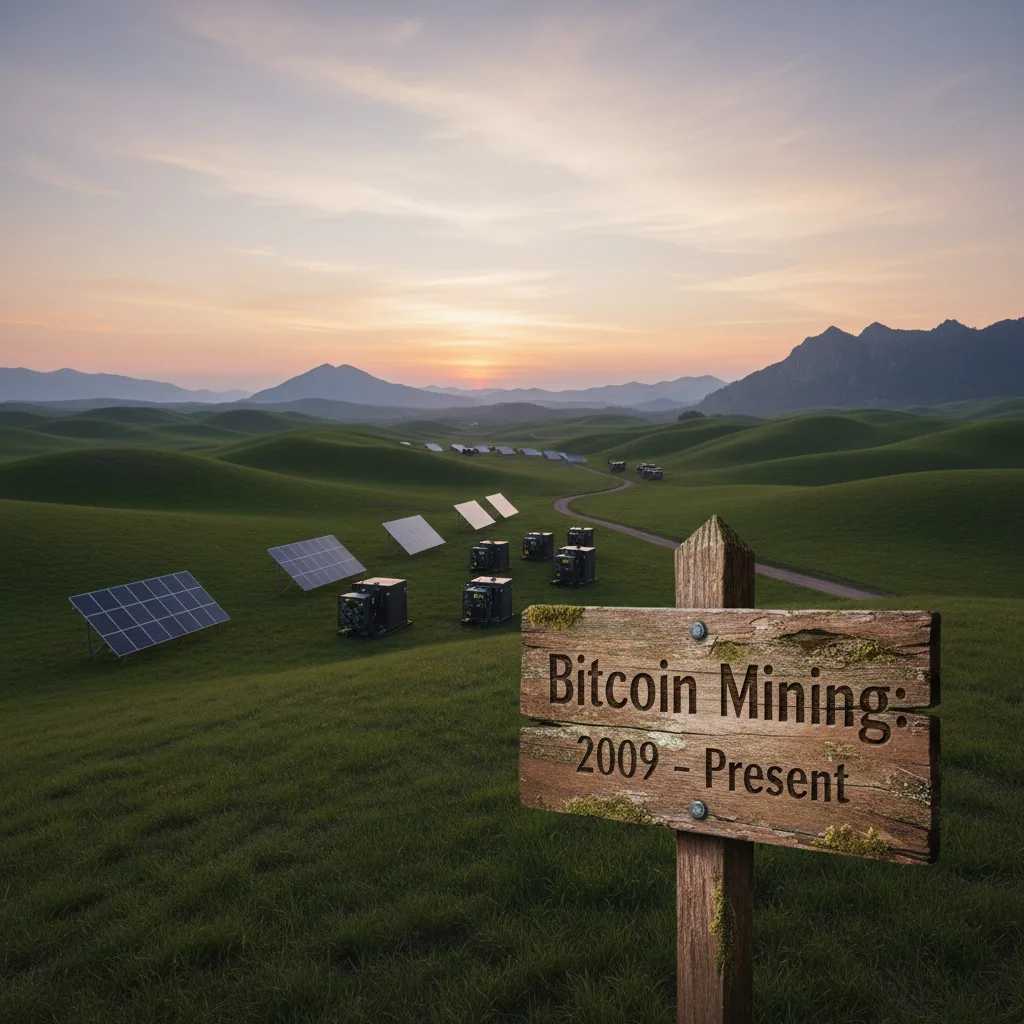
Bitcoin mining began in January 2009 when the network went live. The first mined block was the genesis block, also known as the first Bitcoin block, and it was created by Satoshi Nakamoto.
That is the key date. Mining did not start years later with mining farms or ASIC machines. It began at the exact moment the network launched, because mining was built into Bitcoin’s design from day one.
As for whether mining ended, it hasn’t. Blocks are still being mined roughly every ten minutes, and miners are still securing the network right now. For more background on the origin story, Bitcoin History and Founder adds useful context around Satoshi and the early launch period.
To understand why mining had to exist from the very start, it helps to look at what came before January 2009.
What Had to Happen Before Bitcoin Mining Could Start?
Before mining could begin, Bitcoin first had to be designed. That happened in late 2008, when Satoshi Nakamoto published the Bitcoin white paper, describing a system of peer to peer digital cash that could work without a bank or central authority.
This solved a longstanding problem. Digital money is easy to copy, so any decentralized payment system needs a reliable way to prevent double spending. Bitcoin’s answer was the blockchain network, a shared ledger where transactions are grouped into blocks and verified by participants following the same rules.
Mining was the mechanism that made those rules enforceable. Miners don’t just create new coins. They validate transactions, compete to add new blocks, and make it extremely difficult to rewrite transaction history. Without mining, there would have been no practical way to secure the ledger in a decentralized environment.
The white paper came first, but mining was what turned the idea into something that actually worked. If you want to read the original design principles, Bitcoin White Paper is the right place to start.
With that foundation in place, here’s what the first real phase of mining actually looked like.
The First Days of Bitcoin Mining in 2009
In the beginning, Bitcoin mining was almost laughably simple compared to today. The network was tiny, there were barely any users, and there was almost no competition. Early participants could run the software on a normal computer and mine blocks using a regular processor. This is known as CPU mining.
Imagine sitting at your desk in early 2009, running the Bitcoin client in the background while you went about your day. No cooling rigs, no industrial noise, no electricity bills that made you wince. Just a laptop doing something most of the world had never heard of.
There were no giant facilities, no industrial cooling systems, no race for cheap power contracts. The earliest miners were mostly curious developers, cryptography enthusiasts, and a small number of people who genuinely understood what Satoshi was trying to build.
The mining software release was bundled into the early Bitcoin client, so mining and running a node were closely connected. Download the software, join the network, and you were in. If you want a straightforward breakdown of the process itself, What Is Bitcoin Mining? explains the basics clearly.
Who Mined the First Bitcoin?
Satoshi Nakamoto is widely understood to have mined the earliest Bitcoin blocks, including the genesis block and many of the first blocks after launch. The available evidence strongly suggests Satoshi was the dominant miner at the beginning, though the exact number of coins associated with that early activity is still debated.
A small group of early network participants joined soon after. These were not mainstream investors or institutions. They were mostly technically minded people who saw value in experimenting with decentralized money before the rest of the world was paying attention.
So while Satoshi mined Bitcoin first, the network didn’t stay a one person operation for long. And that shift matters, because it leads directly to why mining was so accessible in those early months.
Why Mining Was Easy at the Start
Mining was easy for one simple reason: hardly anyone was doing it. With very few participants on the network, the low mining difficulty meant even a standard home computer had a realistic shot at finding blocks.
That made home computer mining genuinely viable in a way that sounds almost fictional today. No specialized hardware, no serious capital, no warehouse scale infrastructure. Just the software, some patience, and enough curiosity to try.
The low competition also meant rewards were much easier to earn. In those early months, mining felt less like a business and more like supporting an experiment. That didn’t last long, and the next stage shows just how quickly things shifted.
A Timeline of Major Bitcoin Mining Milestones
Bitcoin mining didn’t evolve all at once. It moved through clear phases, and each phase changed who could mine, what hardware mattered, and how competitive the whole thing became. For a broader technical walkthrough alongside this historical view, Bitcoin Mining Explained is a useful companion.
Here is a practical Bitcoin mining evolution timeline covering the major mining milestones and the Bitcoin network growth that shaped them:
| Period | Major shift | What changed | | — | — | — | | 2009 to 2010 | CPU mining era | Ordinary computers were enough for early adopters | | 2010 to 2013 | GPU transition | Graphics cards outperformed CPUs and raised competition | | 2013 to 2015 | ASIC takeover | Specialized chips made hobby mining far less viable | | 2016 to today | Industrial scale mining | Large mining farms and global operations came to dominate |
Each phase had its own logic, and understanding those shifts explains why mining today looks nothing like 2009.
2009–2010: CPU Mining and the Earliest Adopters
This was the era of the hobbyist. Hobbyist miners used regular computers and joined because they were genuinely interested in the idea of Bitcoin, not because mining was an established business.
The audience was tiny. Most participants came from cypherpunk circles, developer communities, and people already interested in digital privacy and monetary alternatives. Early Bitcoin adoption was still very niche, and mining reflected that reality.
Because the network was small, rewards were easier to obtain and there was almost no institutional presence. But once people realized hardware efficiency made a real difference, the next shift happened fast.
2010–2013: The Shift From CPUs to GPUs
Between 2010 and 2013, miners discovered that GPU mining was far more effective than CPU mining. Graphics cards could perform the required calculations faster and more efficiently, which changed the economics of mining almost immediately.
This raised mining competition in a way nobody had quite expected. Anyone still using a CPU was suddenly at a serious disadvantage. The barrier to entry was still relatively low compared to today, but it was no longer as casual as running the software on any old computer.
This period marks the beginning of mining as an arms race. Better hardware meant better odds, and that logic set up the next major leap.
2013–2015: ASICs Changed Everything
The arrival of ASIC mining changed Bitcoin mining more than any previous development. ASICs are chips built for exactly one purpose. In this case, mining Bitcoin as efficiently as possible.
Once specialized mining hardware entered the market, general purpose hardware simply couldn’t compete at scale. Mining shifted from enthusiast activity into something much more specialized and capital intensive. If you want to see how modern hardware setups compare, Bitcoin Mining Setup and Rigs breaks that down in practical terms.
After ASICs, mining stopped being a realistic side activity for most people. That paved the way for the industrial phase.
2016 to Today: Industrial Mining and Global Expansion
From 2016 onward, Bitcoin mining became increasingly dominated by mining farms and large operators. These businesses focused on scale, power costs, cooling, financing, and geographic advantage.
This is the era of industrial Bitcoin mining. The global hash rate expanded massively as more capital entered the space. Mining grew beyond a technical niche and became part of a global infrastructure race shaped by energy policy, regulation, and access to hardware.
That naturally leads to the question a lot of people have once they learn about Bitcoin’s fixed supply: does mining ever actually stop?
Did Bitcoin Mining Ever End?
No, Bitcoin mining has not ended. It is still active, and under the current design it is expected to continue as long as the Bitcoin network exists.
Many people search terms like is Bitcoin mining over, Bitcoin mining still active, or does Bitcoin mining end because they’ve heard about the 21 million coin limit. That creates confusion worth clearing up. Mining does not stop just because the creation of new Bitcoin slows down over time.
What changes is miner revenue. The block subsidy becomes smaller through scheduled halvings, and that affects profitability. But miners still have a role in validating transactions and securing the network. If you want to understand the money side of that in more detail, Bitcoin Mining Profitability and Rewards connects the incentives clearly.
Why People Think Bitcoin Mining Has an End Date
Bitcoin has a fixed 21 million Bitcoin supply. New coins are issued as part of block rewards, but that issuance decreases over time. Because of that, many people assume mining must eventually shut off completely.
What they’re usually thinking about is the point at which the final bitcoin mined enters circulation. That is expected far in the future, and even then, the network still needs miners or equivalent security providers to process transactions and maintain consensus.
The end date people imagine is really about new coin issuance, not the end of mining as a network function. That distinction becomes clearer when you look at what miners are expected to rely on later.
What Happens After All Bitcoins Are Mined?
After the block subsidy becomes extremely small, miners are expected to rely more heavily on transaction fees. Today miners earn a mix of new coin issuance and fees. Over time, the subsidy shrinks and fees become more important.
In practical terms, the block subsidy is designed to fade gradually, not disappear overnight. That gives the network a long transition period. Whether fee revenue alone will be sufficient in the very long term is a serious ongoing debate, but it is separate from the simpler claim that mining ends.
To see why mining became so much harder long before any of that future scenario plays out, we need to look at difficulty and competition.
How Bitcoin Mining Became Harder Over Time
Mining got harder because more people joined, hardware improved, and the network adapted automatically. As hash rate growth accelerated, the mining difficulty increase made it much harder for any individual to find a block with limited equipment.
That’s why early mining stories can sound misleading out of context. Yes, people mined Bitcoin on home computers. But they did so in a network that was tiny, immature, and barely competitive. Today, mining is shaped by serious mining economics, where hardware efficiency, electricity price, uptime, and access to capital all matter. For a focused explanation of the mechanism behind this, Difficulty Adjustment Explained is worth reading.
The system that kept Bitcoin stable through all of this is the difficulty adjustment.
The Role of Difficulty Adjustment
Bitcoin uses difficulty adjustment to keep block production on schedule. Roughly every two weeks, the network reviews how quickly blocks were mined in the previous period. If blocks came too fast, difficulty rises. If they came too slowly, difficulty falls.
This matters for network stability. Without that adjustment, rising participation and better hardware would speed up block creation unpredictably. Bitcoin avoids that by constantly recalibrating the work required to mine each block.
More competition doesn’t break the system. It just makes mining harder. If you want to explore the specific drivers behind this, What Affects Bitcoin Mining Difficulty covers them clearly.
That mechanism explains the system, but the practical difference is easiest to see when you compare solo miners with modern operations.
From Solo Mining to Professional Operations
In the early years, solo mining was realistic. A person with a home computer could participate directly and sometimes earn block rewards without joining any large coordinated setup.
Today, professional miners dominate. They operate with dedicated machines, custom cooling, power contracts, staff, monitoring systems, and large scale mining infrastructure. The margin for error is much smaller, and profitability depends on efficiency in ways that early miners never had to think about.
This shift wasn’t driven by hardware alone. Several major events changed miner behavior over time, and those deserve a closer look.
Key Events That Shaped Bitcoin Mining History
Bitcoin mining history isn’t just a story about faster machines. It’s also a story about changing Bitcoin mining rewards, shifting mining profitability, and growing regulatory pressure.
One of the biggest recurring events has been the halving. Every halving cuts the new Bitcoin issued per block, forcing miners to become more efficient or exit. If you want the mechanics explained simply, Bitcoin Halving Explained gives a good overview.
Beyond halvings, miners have had to react to market cycles, regional restrictions, and shifting public narratives around energy use. Those forces shaped mining just as much as hardware did.
How Halvings Changed Miner Incentives
Each block reward halving reduces the number of new bitcoins miners receive for finding a block. That directly affects revenue unless price, fees, or efficiency improve enough to compensate.
This changes miner incentives in a real way. Efficient operators become more resilient, while weaker ones may shut down or upgrade. Over time, halvings pushed the industry toward better machines, tighter margins, and more disciplined cost management.
Halvings didn’t end mining. They forced mining to grow up. That pressure became even more visible once geography and regulation entered the picture.
Why Geography and Regulation Started to Matter
As mining turned into a business, energy costs became critical. Cheap electricity can make the difference between profit and loss, so miners naturally moved toward regions with better power economics.
At the same time, mining regulation started to matter more. Some countries welcomed mining, others restricted it, and some changed course over time. That caused repeated waves of mining relocation, with hash rate shifting across borders rather than disappearing entirely.
These pressures helped shape the current landscape, which is much easier to understand through a direct comparison of then versus now.
Bitcoin Mining Then vs. Now
The clearest way to understand the past vs present mining landscape is to look at accessibility, cost, and competition side by side. Early Bitcoin mining was open, experimental, and easy to join. Modern Bitcoin mining is highly optimized, expensive, and difficult for casual participants to approach profitably.
That doesn’t mean mining is impossible today. It means mining accessibility has changed dramatically. The average person can still learn how mining works or experiment at a small scale, but competing with industrial operators is a completely different question.
Hardware, Cost, and Competition Compared
In the early years, a CPU and later a GPU were enough to participate. The mining hardware comparison was simple because there were fewer categories and less specialization. You’re standing there with a laptop and a downloaded client, and that was genuinely enough.
Today, ASICs dominate. Upfront costs are much higher, and electricity costs are often the single biggest variable in profitability. The competitive mining landscape now includes multinational operations, public companies, and large scale private firms.
Early miners competed against a handful of enthusiasts. Modern miners compete against specialized businesses built entirely around efficiency.
What Early Miners Could Do That Most People Can’t Today
Early participants could mine Bitcoin at home with basic equipment and still have a meaningful chance of earning rewards. That was realistic because competition was low and the network was just getting started.
Today, the mining barriers to entry are far higher. Hardware is specialized, noise and heat are significant, energy pricing matters enormously, and profitability usually depends on scale. For most people, home mining is no longer a simple plug in and earn activity.
That’s exactly why understanding the history matters. It shows you what changed, what stayed the same, and why the original launch date is still relevant today.
Conclusion
So, when did Bitcoin mining start? It started in 2009, right at the launch of the Bitcoin network, when Satoshi Nakamoto mined the first block. And despite what the title implies, Bitcoin mining did not end. It evolved.
The history of Bitcoin mining follows a clear path: early CPU mining, the GPU phase, the ASIC transition, and the rise of industrial operations. Each step changed who could participate and how mining worked in practice. That’s why Bitcoin mining today looks nothing like the early days, even though the core function remains the same.
If you came here asking when bitcoin miner started, the key takeaway is this: mining began with Bitcoin itself. It wasn’t added later as an extra feature. It was part of the system from the very first block. And if you want to understand Bitcoin seriously, knowing that history isn’t optional. It tells you how the network launched, how incentives developed, and why the system still works the way it does now.