

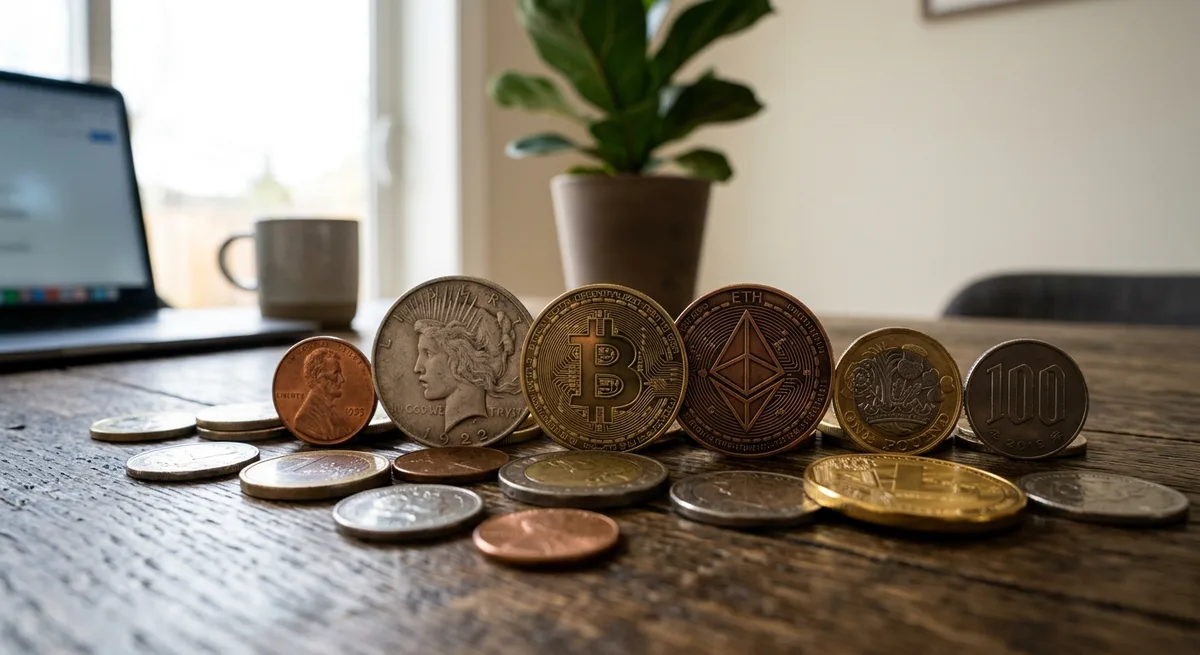
Crypto has a vocabulary problem. People throw around words like “coin”, “token”, “altcoin”, and “cryptocurrency” as if they all mean the same thing. They don’t. And if you’re trying to make sense of what you’re actually buying, holding, or researching, that confusion costs you more than you’d think.
This guide walks through the real difference between coins vs tokens. Not in a way that tries to convince you one is better than the other, but in a way that helps you read a project, understand what you’re looking at, and ask sharper questions before you spend a euro.
Introduction: Why Coins vs Tokens Confuses So Many Crypto Beginners
When you first step into crypto, almost everything gets called a “coin”. Bitcoin, a coin. Shiba Inu, a coin. That new project your friend won’t shut up about, also a coin. Technically, most of those aren’t coins at all. They’re tokens.
The terms get used loosely because most people, and even a lot of crypto media, don’t bother to separate them. That’s fine for casual conversation. It’s not fine when you’re putting money on the line.
Here’s the short version, and we’ll build on it from here. A coin lives on its own blockchain. A token lives on someone else’s. That single distinction shapes how it’s created, how it’s secured, what risks it carries, and what it can actually do. Once you see it clearly, a lot of cryptocurrency basics start to click into place.
Quick Answer: Coins vs Tokens in Simple Terms

If you only have thirty seconds: coins operate on their own blockchain. Tokens are created on top of existing blockchains using smart contracts.
Bitcoin runs on Bitcoin. Ether runs on Ethereum. Those are coins. USDC, UNI, LINK, and thousands of others are issued on top of Ethereum, Solana, or BNB Chain. Those are tokens.
| | Coin | Token | |—|—|—| | Blockchain | Has its own | Built on another | | Creation | Requires building or maintaining a chain | Created via smart contracts | | Primary purpose | Network fees, payments, security | Apps, governance, stablecoins, utility | | Examples | BTC, ETH, SOL, LTC | USDC, UNI, LINK, AAVE | | Common use cases | Paying gas, staking, mining, transfers | DeFi, DAOs, rewards, in-app utility |
If you want the foundation behind all of this, it helps to understand the underlying tech first. This What Is Blockchain? Explained for Beginners guide is a solid starting point.
What Is a Crypto Coin?
A crypto coin is a digital asset that’s native to its own blockchain. It exists because the blockchain exists, and the blockchain exists partly to support it. The two are tied together.
Coins are usually used to pay transaction fees on their network, reward miners or validators who keep the chain running, transfer value between users, and sometimes to stake or secure the system. They’re functional currency for the network they belong to.
Bitcoin is the textbook example. BTC isn’t issued by a company or built on top of another chain. It’s the asset of the Bitcoin network, full stop. If you want a deeper look at how that works, see What Is Bitcoin?.
Main Characteristics of Crypto Coins
A few traits show up consistently with coins:
- They’re native to a specific blockchain
- They’re used to pay network or “gas” fees
- They usually play a role in securing the network through mining or staking
- They’re central to the chain’s economic model and incentive structure
You’ll see this with BTC on Bitcoin, ETH on Ethereum, SOL on Solana, and LTC on Litecoin. Different networks, same basic principle.
Common Examples of Coins
Bitcoin is the cleanest example because Bitcoin the network only really does one thing: move and store BTC.
Ethereum is more interesting. ETH is a coin because it’s native to the Ethereum blockchain, but Ethereum also hosts tens of thousands of tokens built on top of it. So the chain is a platform, and ETH is the native coin that powers it. That dual nature is exactly where most beginners get lost. If you want to see how these two stack up side by side, this breakdown of Bitcoin vs Ethereum: Key Differences is worth a read.
Token Explained: What Is a Blockchain Token?
A token is a digital asset that doesn’t have its own blockchain. Instead, it’s created on top of one that already exists. Most tokens today live on Ethereum, BNB Chain, Solana, or other smart contract networks.
A blockchain token is essentially a smart contract that defines its rules: how much can be created, who owns what, how it can be transferred, and what it does inside its ecosystem. The host blockchain handles the heavy lifting like security and transaction processing. The token just sits on top and follows the rules its contract sets.
This is why tokens are everywhere. It’s far easier to write a smart contract than to launch a full blockchain. That makes innovation cheap, but it also makes garbage cheap. Both things are true. If you want to understand the economic design behind tokens, Tokenomics Explained for Beginners is a useful next step.
Main Characteristics of Crypto Tokens
Tokens depend on the underlying blockchain for security, settlement, and infrastructure. They don’t have their own validators. They don’t process their own transactions. They borrow all of that from their host chain.
What they bring is purpose. A token can represent utility inside an app, voting rights in a protocol, stable value pegged to a currency, ownership of a real-world asset, access to a service, or a claim on rewards. The flexibility is the point.
Common Examples of Tokens
Some of the most widely used assets in crypto are tokens, not coins. USDT and USDC are stablecoin tokens. UNI is the governance token of Uniswap. LINK powers Chainlink’s oracle network. AAVE is tied to the Aave lending protocol.
None of these have their own blockchain. All of them are used daily by millions of people. Being a token doesn’t make an asset minor or unimportant. It just describes how it’s structured.
Crypto Coins vs Tokens: The Key Differences
The crypto coins vs tokens comparison comes down to a few clear distinctions. The headline difference is the blockchain itself, but the practical implications go further than that.
| Aspect | Coins | Tokens | |—|—|—| | Blockchain | Own native chain | Built on another chain | | Creation | Requires chain development | Smart contract deployment | | Primary role | Powers the network | Powers an application or use case | | Risk profile | Network and adoption risk | Smart contract, project, and tokenomics risk | | Examples | BTC, ETH, SOL | USDC, UNI, LINK |
Let’s break those down.
Difference 1: Coins Have Their Own Blockchain, Tokens Use an Existing One
A coin is native infrastructure. BTC exists because Bitcoin exists. ETH exists because Ethereum exists. The asset and the chain are inseparable.
A token is built on top of someone else’s infrastructure. USDC, for example, is issued as a token on Ethereum, Solana, Base, and several other chains. The “same” USDC can live in many places because it’s not tied to a single blockchain. It’s a smart contract deployed in multiple environments.
Difference 2: Coins Often Power Networks, Tokens Often Power Applications
Coins do network-level work. You use them to pay transaction fees, reward validators, secure the chain through proof-of-work or proof-of-stake, and move value between users.
Tokens usually do application-level work. They might give you voting rights in a DAO, access to features inside a protocol, a share of trading fees, or just exposure to whatever the project is building. They’re closer to the surface, where users actually interact.
Difference 3: Coins Are Usually Harder to Create Than Tokens
Launching a new coin means building or maintaining a full blockchain. That’s developers, validators, consensus design, security audits, and ongoing maintenance. It’s not something a weekend project pulls off.
Launching a token is much simpler. On Ethereum, you can deploy a basic token contract in minutes. That’s not inherently bad, plenty of legitimate projects start that way, but it does mean the barrier to launching something dubious is also low. Easier creation doesn’t mean a token is bad. It just means due diligence matters more.
Difference 4: Coins and Tokens Can Have Different Risk Profiles
Coins carry network-level risk. If the chain stops being used, secured, or developed, the coin’s value erodes with it. Major coins also face competition, regulatory pressure, and technical limitations.
Tokens carry that risk plus their own. Smart contract bugs can drain a project overnight. Bad tokenomics can dilute holders silently. Liquidity can dry up. Teams can disappear. None of this is hypothetical. It happens regularly. The upside is real, but so is the downside, and the smart move is to treat them with equal seriousness.
Real-World Use Cases for Coins and Tokens
Once you separate coins from tokens, the use cases start to make a lot more sense. Different roles, different jobs.
Coins for Payments, Network Fees, and Security
Coins are the workhorses of their networks. You use BTC to send value across the Bitcoin network. You use ETH to pay gas when you swap on a DEX or mint an NFT. You stake SOL to help secure Solana and earn rewards.
If you’re transacting on a blockchain, you’re almost always touching a coin somewhere in that flow, even if it’s just to pay the fee.
Tokens for DeFi, Apps, Governance, and Rewards
Tokens live inside applications. In DeFi, you’ll find governance tokens that let holders vote on protocol changes, utility tokens that unlock features, reward tokens given out for providing liquidity, and LP tokens that represent your share of a liquidity pool.
Governance is one of the more interesting use cases, since it’s where token holders actually shape what a protocol does. If that part interests you, What Is On-Chain Governance? covers it well. Just keep your head straight: a governance token isn’t automatically valuable. Plenty have voting rights over decisions nobody cares about.
Stablecoins as a Practical Token Example
Stablecoins are probably the clearest example of how useful tokens can be. USDC and USDT are tokens designed to track the value of the US dollar. They’re used for trading, transfers, savings products, and as the base currency of most DeFi.
But they’re not risk-free. Stablecoins depend on the issuer, the reserves backing them, and the regulatory environment they operate in. Understanding How Stablecoins Maintain Their Value is one of those things every crypto user should know before holding meaningful amounts.
Wrapped Tokens and Cross-Chain Usage
Wrapped tokens are a clever workaround. They let you use a coin from one blockchain on a different blockchain by representing it as a token.
The most famous example is Wrapped Bitcoin (WBTC). BTC itself can’t run on Ethereum, so WBTC is a token on Ethereum backed 1:1 by actual BTC held in reserve. You get exposure to Bitcoin’s price while being able to use it in Ethereum’s DeFi ecosystem. Wrapped Bitcoin Explained gets into how that actually works.
This is also where the coin and token distinction starts to blur a little. Same underlying asset, different form, different chain.
How Tokens Are Created, Launched, and Funded
Tokens usually come into existence through a smart contract deployment. After that, projects need to actually distribute them. That’s where things get more complicated, and more risky.
Distribution can happen through public sales, private rounds, community airdrops, liquidity mining programs, or staking rewards. Each method has its own incentives and its own pitfalls.
ICOs and Token Fundraising
The Initial Coin Offering, or ICO, was the original way many token projects raised money. You’d buy tokens early, often with ETH or BTC, in exchange for the promise of future utility or upside.
The format created some legitimate winners. It also created a long list of projects that raised millions and delivered nothing. The structure itself isn’t the problem. The problem is when fundraising happens before there’s a real product, real utility, or real demand. If you want the full picture, How Crypto Projects Raise Funds: ICOs breaks it down.
Crypto Presales and Early Token Access
Presales work along similar lines: investors buy tokens before the public launch, usually at a lower price. The appeal is obvious. Get in early, ride it up.
The reality is messier. Presales often come with lockups, vesting schedules, opaque valuations, and very thin liquidity at launch. You might be locked in while early backers exit, or holding a token nobody trades. What Is a Crypto Presale? goes deeper into the trade-offs. It’s not that presales are bad, it’s that they need a very different lens than buying an established asset.
Where Tokens Trade and Gain Liquidity
A token’s price is only meaningful if you can actually buy and sell it. That’s where liquidity comes in.
Most established tokens trade on both centralized exchanges (like Binance or Coinbase) and decentralized exchanges. Newer tokens often start on DEXs and only later get listed on centralized platforms, if they ever do.
Decentralized Exchanges and Token Trading
Decentralized exchanges let users swap tokens directly from their wallets, without an intermediary holding their funds. That’s a real advantage in terms of access and control. Almost anyone can list a token on a DEX.
That openness cuts both ways. The same thing that makes DEXs great for legitimate new projects makes them a playground for scams, copycat tokens, and contracts that drain wallets. What Is a Decentralized Exchange? covers the mechanics and what to watch out for.
Liquidity Pools and Token Markets
DEX trading runs on liquidity pools. Instead of matching buyers and sellers like a traditional order book, users deposit pairs of tokens into a pool, and others trade against that pool.
If a pool is deep, you can trade large amounts with minimal price impact. If it’s shallow, even a modest trade can move the price significantly. That’s slippage. There’s also impermanent loss for liquidity providers, which is a topic of its own. What Is a Crypto Liquidity Pool? Explained Simply is a good place to dig in.
Advantages and Disadvantages of Crypto Coins
Coins aren’t automatically the “safe” choice. They have real strengths and real weaknesses, and ignoring either side leads to lazy thinking.
Advantages of Coins
Coins benefit from being foundational. They sit at the base of a network, which gives them direct utility (you need them to use the chain) and a clear role in the ecosystem.
Major coins like BTC and ETH have years of track record, deep liquidity, broad exchange support, and significant network effects. They’re harder to dismiss and harder to manipulate. They also tend to have more institutional infrastructure around them, from custodians to ETFs.
Disadvantages of Coins
Coins move slower. Changing how a blockchain works is hard by design, which means innovation at the base layer happens gradually. Fees can spike during periods of high demand, especially on networks like Ethereum.
Proof-of-work coins face ongoing debates about energy use. Smaller coins struggle with adoption, security budgets, and developer attention. And no coin is immune to losing relevance if a better alternative emerges.
Advantages and Disadvantages of Crypto Tokens
Tokens are where most of crypto’s innovation lives. They’re also where most of the failures live. Both are part of the same coin, so to speak.
Advantages of Tokens
Tokens are flexible. You can design one to do almost anything: govern a protocol, represent a real-world asset, distribute rewards, peg to a currency, unlock app features, or coordinate a community.
They’re fast and cheap to create, which means new ideas can get tested quickly. They plug into existing blockchain ecosystems, so they benefit from the security and infrastructure of established networks without having to build their own. Stablecoins, DeFi protocols, and most of the interesting use cases in crypto exist because tokens exist.
Disadvantages of Tokens
The same flexibility creates risk. A poorly designed token can have inflationary supply that quietly dilutes holders over years. Smart contracts can have bugs that get exploited. Teams can mint new tokens, change rules, or simply walk away.
Many tokens have vague or unconvincing utility. Others have utility but no real demand. Low-liquidity tokens are easy to manipulate. Rug pulls, where a team drains liquidity and disappears, are common in newer launches.
Supply mechanics matter more than people realise. Some projects use token burning to reduce supply over time, which can support price if demand is real. What Is Token Burning and Why Projects Use It? explains the logic, and the limits, of that approach. Burning alone doesn’t fix a broken project.
Coins vs Tokens for Investors: What Should You Check Before Buying?
Knowing whether something is a coin or a token tells you what kind of asset you’re dealing with. It doesn’t tell you whether it’s worth holding. That’s a separate question, and it needs separate work.
Here’s a practical checklist you can run through, split by asset type.
Checklist for Evaluating a Coin
When you’re looking at a coin, focus on the network itself:
- What is the blockchain actually used for, and by whom?
- How active is the network in terms of transactions, addresses, and developers?
- How decentralized is it? Who runs the validators or miners?
- What does the fee market look like, and is it sustainable?
- Has the network been attacked or compromised before? How did it recover?
- What’s the liquidity like across exchanges?
- Is real adoption growing, or is the price the only thing that moves?
A coin is only as strong as the network underneath it. If the network is quiet, the coin will be too.
Checklist for Evaluating a Token
For tokens, the questions shift toward the project and its design:
- What does the token actually do? Is it required, or just attached?
- What’s the supply schedule? How many tokens are circulating now, and how many will exist in two years?
- When do team and investor unlocks happen?
- Have the smart contracts been audited, and by whom?
- Is the team public and credible?
- Is there liquidity on more than one exchange?
- Does the token capture value from the protocol’s revenue or activity?
- Could the protocol work just as well without the token?
That last one is a useful gut check. If a token is unnecessary to what the project does, its long-term demand is probably weaker than the marketing suggests.
Common Mistakes Beginners Make With Coins and Tokens
Most early mistakes aren’t catastrophic. They’re avoidable. Spotting them in advance saves a lot of money and frustration.
Mistake 1: Thinking Every Crypto Asset Has Its Own Blockchain
This is the big one. When people say “I bought some coins”, they often mean tokens. Most assets you’ll come across in DeFi or on small exchanges are tokens, not coins.
It matters because it changes how you secure them, what risks they carry, and what’s actually backing their existence. A token without its host chain is nothing. Understanding that shapes every decision after it.
Mistake 2: Ignoring Tokenomics
You can love a project’s idea and still lose money if the tokenomics are bad. Supply, emission schedule, unlocks, vesting cliffs, and distribution all shape how a token behaves over time.
A token can have growing usage and falling price at the same time if new supply is hitting the market faster than demand can absorb it. That’s not bad luck, that’s design. Read the tokenomics before you read the marketing.
Mistake 3: Assuming a Token Is Valuable Just Because It Has Utility
“Utility” is one of the most overused words in crypto. A token can have a clear use and still have no real demand for it. The question isn’t “what does this token do?” but “who actually needs to buy this token, and why?”
If the answer is “speculators hoping the price goes up”, that’s not utility. That’s a feedback loop. Real demand comes from people who need the token to do something they actually care about doing.
FAQ About Coins vs Tokens
A few questions come up over and over. Quick, direct answers below.
Is Ethereum a Coin or a Token?
ETH is a coin. It’s native to the Ethereum blockchain. Ethereum the platform also hosts thousands of tokens, but ETH itself is the coin that powers the network.
Is Bitcoin a Coin or a Token?
Bitcoin is a coin. BTC is native to the Bitcoin blockchain and isn’t issued on top of any other chain. It’s the original example of a crypto coin.
Can a Token Become a Coin?
Yes, but it doesn’t happen automatically. A project that launches a token on, say, Ethereum can later build its own blockchain and migrate that token to its new chain, where it becomes the native coin. This is sometimes called a mainnet migration. It’s possible, but requires real engineering and ecosystem buy-in.
Are Tokens Riskier Than Coins?
On average, yes, but it’s not a blanket rule. Tokens are easier to create, easier to manipulate, and more dependent on a specific team executing well. That tends to mean higher risk. But mature tokens like USDC or LINK have years of real use behind them, while some smaller coins are very risky despite having their own chain. Always look at the specific asset, not just the category.
Do I Need a Different Wallet for Coins and Tokens?
It depends on the blockchain. Most modern wallets support both a chain’s native coin and the tokens built on it. MetaMask, for example, handles ETH and all Ethereum-based tokens in one place. The critical thing is choosing the right network when sending or receiving. Send a token to the wrong network and it can be lost permanently.
Conclusion: Understanding Coins vs Tokens Helps You Make Better Crypto Decisions
The core distinction is simple. Coins are native to their own blockchains. Tokens are built on top of existing ones. That’s it. Everything else, the creation process, the risk profile, the use cases, follows from that one structural difference.
Neither one is automatically better. Bitcoin is a coin and Tether is a token, and both are used by millions of people every day. What matters isn’t whether something is a coin or a token. It matters what role the asset plays, how it’s designed, who needs it, and whether real demand exists for what it does.
The coins vs tokens question is a starting point, not a conclusion. Once you can tell them apart, you can start asking the questions that actually move the needle: Is this network being used? Is this token necessary? What does the supply schedule look like in three years? Who’s holding it, and why?
That’s the kind of thinking that separates people who get lucky in crypto from people who stay in it long enough to make real decisions. Take the time to understand what you’re buying. The rest gets a lot easier from there.