

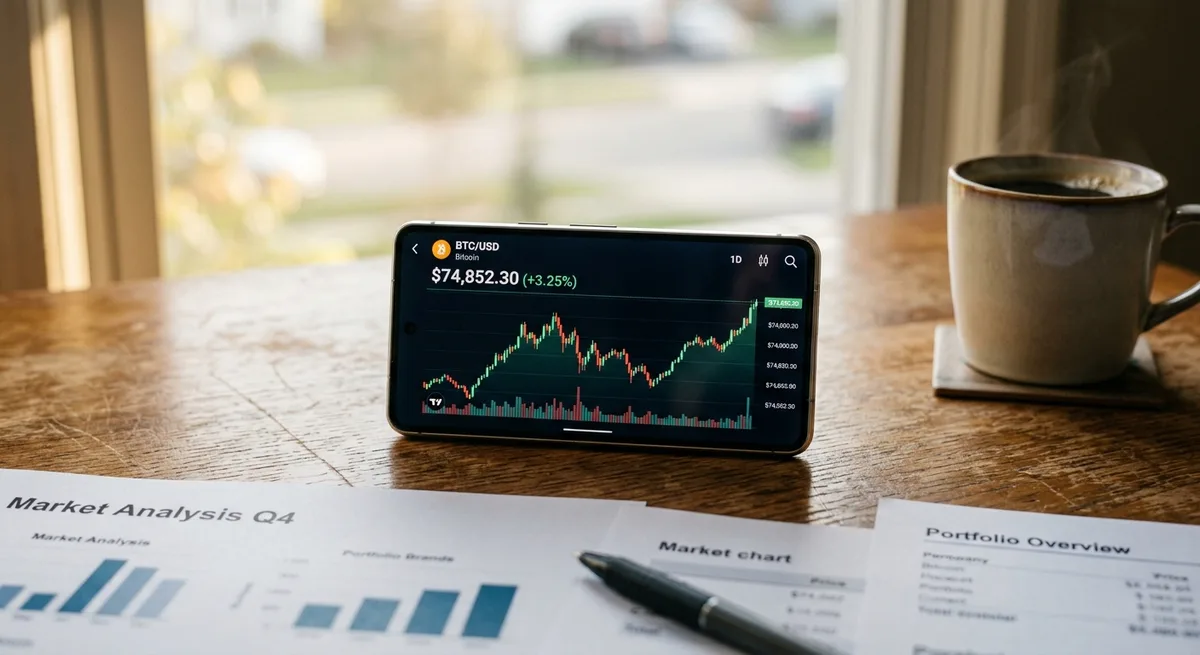
Bitcoin Volatility Explained: Why It Moves So Much
Bitcoin Volatility Explained: Why It Moves So Much
Bitcoin volatility is the tendency of Bitcoin’s price to move sharply and often within a short stretch of time. One day it climbs several percent, the next it gives a big chunk of that back. That is a very different experience from watching most major stocks, bonds, or fiat currencies.
If you have ever looked at a Bitcoin chart and felt like you were missing something, you are not. Bitcoin regularly reacts to demand shifts, news headlines, trader positioning, and broader crypto volatility faster than almost any other asset you can name. That makes it exciting for some people and genuinely stressful for others, especially if you do not know what is behind the moves.
Here is the thing though: these swings are not random. They tend to come from a handful of repeatable forces. Once you recognize those forces, Bitcoin starts to feel a lot less like chaos and a lot more like a market you can actually understand.
What Bitcoin Volatility Actually Means

Volatility just means how much and how fast an asset’s price moves. If Bitcoin goes from $60,000 to $63,000 and then back to $58,000 within a few days, that is high volatility. An asset that barely twitches over the same period has low volatility.
Bitcoin is well known for large price swings and strong daily movement. A 5 percent day is unremarkable here. In most traditional markets, that would be a headline event. Some analysts track a volatility index or similar tools to measure how intense recent moves have been and how much uncertainty the market is currently pricing in.
Why does this matter practically? Because volatility changes your decisions. If you are investing, it affects how much you should allocate and how long you need to hold your nerve. If you are trading, it shapes your entry timing, where you place stops, and how fast a setup can go wrong. For a deeper look at how prices actually form, this guide on how Bitcoin price is determined is worth your time.
Before going further, it helps to separate volatility from risk, because people often treat them as the same thing.
Volatility vs. Risk: They’re Related, but Not the Same
A volatile asset is not automatically a bad investment. Volatility tells you the price can move a lot. Risk is broader. It includes the chance of permanent loss, emotional mistakes, bad timing, and being forced to sell when you least want to.
That distinction matters more than it might seem. Bitcoin can be volatile and still make sense for someone who understands what they own, has a sensible time frame, and sizes their position carefully. Meanwhile, even a calm, stable asset can be risky if you buy it blindly.
In practice, volatility becomes damaging when your plan is weak. Too large a position, borrowed money, or dependence on short term results will make normal Bitcoin behavior feel unbearable. So the real question is not just that Bitcoin moves a lot. It is why it moves that way.
Why Is Bitcoin So Volatile?
Bitcoin is volatile because it sits at the intersection of scarce supply, shifting demand, powerful narratives, and a market structure that can react very quickly. It trades globally, around the clock, and it is still smaller and less entrenched than older financial markets. When buyers or sellers suddenly become aggressive, price moves hard.
Bitcoin demand can flip fast because different people use the asset for completely different reasons. Some treat it as digital gold. Some treat it as a risk asset like a tech stock. Some trade purely on momentum. That mixture creates unstable sentiment, particularly when the macro backdrop changes. You end up with a market where everyone has a strong opinion but not always the same one.
Liquidity plays a role too. Bitcoin is far more liquid than it was in its early years, but it is still not as deep or consistent as many traditional markets. That means large orders can push price further, faster. This explanation of Bitcoin liquidity and its importance for price adds useful context if you want to go deeper on that.
Breaking it into parts makes the picture clearer.
Limited Supply Meets Fast-Changing Demand
There will only ever be 21 million Bitcoin. That fixed supply cap is one of the asset’s defining features, and it also contributes directly to sharp price reactions.
When demand rises quickly and supply cannot expand to meet it, price shoots up. When enthusiasm fades or buyers step back, price can fall just as hard. Supply and demand in Bitcoin can become unbalanced almost overnight.
Traditional markets often have more flexibility. Supply can adjust. Demand is often more institutionalized and slower moving. With Bitcoin, you have a rigid supply meeting a market that can completely change its mood in a matter of hours. That creates sudden and sometimes dramatic repricing.
Even modest shifts in buying pressure can produce outsized moves. And that becomes more obvious once you understand how order books actually work.
Liquidity, Order Books, and Large Market Moves
Price does not move because the world agrees on a number. It moves because actual buy and sell orders interact in real time. If there is not much liquidity at a certain price range, a relatively large order can move Bitcoin more than most people expect.
Order book depth is what provides cushion. A deep book has enough buyers and sellers spread across many price levels to absorb large trades without too much disruption. A thin book has less of that cushion. When it is weak, price can jump or drop sharply with very little warning.
Whale activity amplifies this. A large holder entering or exiting, or a cluster of big orders hitting the market simultaneously, can trigger fast moves. Momentum traders often pile in after that, pushing price further still.
This is why some moves look exaggerated even compared with the news that triggered them. The market structure can stretch a move well beyond what the headline alone would suggest. And speaking of headlines, news is usually the next spark.
News, Regulation, and Macro Events
Bitcoin responds to new information quickly. Regulatory announcements, ETF approvals or delays, changes in tax treatment, exchange problems, government crackdowns: all of these can shift price in real time.
Macro factors matter just as much. Interest rates affect how willing investors are to hold risk assets. Inflation expectations shape demand for hard assets and alternatives to traditional stores of value. Broader risk appetite determines whether money flows toward speculative markets or out of them.
That is why Bitcoin sometimes trades like a high growth tech stock and other times like a safe haven narrative. It can react to a central bank comment one week and ETF optimism the next. That shifting identity adds another layer of unpredictability to crypto volatility.
Data alone does not drive markets though. How people feel about that data often matters just as much.
Trader Psychology and Emotional Reactions
Bitcoin is a market where emotion shows up clearly on the chart. Fear and greed are not just abstract concepts here. You can see them in sharp candles, late breakouts, panic selling, and sudden euphoric buying.
When price rises fast, people fear missing out and rush in. When it falls hard, many assume something is fundamentally broken and rush out. That herd behavior pushes the market far beyond what a rational short term level would suggest. You can almost feel it happening in real time.
This is especially visible in an asset that trades all day, every day, with global participation and heavy social media influence. Psychology tends to accelerate a move that already started for structural reasons.
If you want practical ways to stay grounded during these swings, this piece on how to survive market volatility is a useful companion.
A Quick Look at Bitcoin’s Historical Volatility
Bitcoin has always moved in large cycles. That is not a footnote in its history. It is one of its defining characteristics. Strong rallies have been followed by deep drawdowns, and deep drawdowns have been followed by strong recoveries, repeatedly.
Looking at a chart here is genuinely helpful because historical volatility is much easier to understand visually than through headlines alone. Longer time frames reveal patterns that short term noise completely hides.
For a broader overview of those long term moves, this breakdown of Bitcoin price history and growth provides useful context. The biggest lessons tend to come from a few major periods.
Major Bull Runs, Crashes, and Recoveries
Bitcoin has gone through several major bull runs, each followed by a significant correction. In earlier cycles, price surged as adoption narratives spread and speculation increased. Then came sharp crashes when leverage unwound, enthusiasm cooled, or external pressure hit the market.
One recurring pattern is that all time high excitement tends to attract late buyers right when risk is at its highest. When momentum breaks, the downside can be severe. That does not mean the asset is broken. It usually means the market got ahead of itself.
Recoveries have been just as dramatic. Bitcoin has repeatedly been declared finished and then gone on to set new highs in the next cycle. That does not guarantee anything about the future, but it does show that volatility cuts in both directions.
This guide to Bitcoin market cycles, bull vs bear adds important perspective on those repeating phases.
How Volatility Has Changed Over Time
Bitcoin has matured in some ways. It now has more institutional adoption, broader exchange access, more developed derivatives markets, and far greater public awareness than it did in its early years. That has smoothed out some of the wildest behavior.
But maturity has not removed volatility. It has changed its shape. The market may be larger now, yet it still reacts strongly to narratives, policy shifts, and changes in positioning. Compared with most traditional assets, Bitcoin remains highly reactive.
There are signs of growing asset maturity, yes. But that does not mean calm conditions are guaranteed. Sentiment can still move faster than fundamentals. That is worth keeping in mind when thinking about what triggers big price moves today.
What Triggers Big Bitcoin Price Moves Today?
Modern Bitcoin moves are usually caused by a mix of catalysts rather than one single event. The strongest reactions tend to happen when narrative, positioning, and liquidity all point in the same direction at the same time.
A positive catalyst might be strong ETF inflows, softer inflation data, a bullish policy signal, or renewed institutional interest. A negative price trigger might be a regulatory crackdown, exchange stress, higher than expected rates, or a wave of leveraged long liquidations.
Understanding these triggers will not let you predict every move. It will help you interpret them with more clarity when they happen.
Leverage, Liquidations, and Chain Reactions
Leveraged trading makes Bitcoin more explosive. When traders borrow capital to increase their position size, even a small adverse move can force a liquidation. That position gets closed automatically, adding more buying or selling pressure to an already moving market.
This creates a cascade effect. If many traders are positioned the same way, one move triggers another, and then another. A modest drop can turn into a sharp flush. A breakout can become a fast squeeze upward. It can happen in minutes.
That is why some moves look too fast to be fully explained by news. The real engine is often positioning. If you actively trade, this ultimate Bitcoin trading guide can help you think more clearly about fast market conditions.
Halving Events and Supply Narratives
Bitcoin halving events cut the rate at which new coins are issued. Roughly every four years, the reward miners receive is reduced by half. This changes the flow of new supply entering the market.
The direct effect is mechanical, but the market impact is usually narrative driven. Investors start anticipating tighter future supply, which shifts expectations well before the event itself. Sometimes price responds early. Sometimes it responds later. Sometimes the narrative does more work than the actual event.
That is why halving discussions can influence volatility even when no immediate supply change is visible on the chart. Expectations move markets as much as current reality does. This guide on how halving shapes market cycles goes deeper on that if you are curious.
Media Attention, Social Momentum, and Narratives
Bitcoin moves faster when attention spikes. Mainstream coverage, viral posts, influencer commentary, and large public debates all bring new buyers or sellers into the market quickly.
Social sentiment matters because retail investors often act on stories rather than valuation models. If the dominant narrative turns bullish, people chase. If it turns negative, people exit before they have really thought it through.
This does not mean media creates price from nothing. It means media can accelerate existing trends and pull in more participants at exactly the moment the market is already primed for a large move. Understanding that is not just academic. It has real consequences for anyone investing or trading.
Why Bitcoin Volatility Matters for Investors and Traders
Bitcoin volatility matters because it changes how you need to behave. The same price movement can be completely manageable for one person and genuinely destructive for another, depending on position size, time frame, and emotional discipline.
For investors, volatility tests conviction and shapes portfolio decisions. For traders, it affects execution quality and timing. In both cases, the main challenge is not just being right about direction. It is surviving the path that price takes to get there.
That path looks very different depending on whether you are holding for years or trading over days and hours.
For Long-Term Investors
If you are focused on long term investing, volatility tests your conviction more than your analysis. A solid thesis can still feel genuinely painful during a 20 or 30 percent drawdown. Sitting on a significant loss while your friends ask if Bitcoin is dead again is not easy, even when your reasoning is sound.
That is why risk tolerance matters so much. If your position is too large, normal Bitcoin behavior will feel unbearable. Many people say they can handle volatility until they actually live through it.
Long term investors usually do best with realistic expectations, moderate sizing, and a clear reason for owning Bitcoin in the first place. If your thesis depends on immediate gains, you are not really investing. You are hoping.
For Short-Term Traders
For short term trading, volatility creates opportunity because price moves enough to generate real setups. But that same volatility also increases slippage, fakeouts, and the likelihood of execution mistakes.
Stop loss placement becomes critical in fast markets. Too tight and normal noise takes you out. Too wide and losses can grow beyond what you planned for. Sizing matters just as much. Being too large in a volatile asset is often the real mistake, not the direction of your idea.
That is why the next step is not about predicting every move. It is about learning to handle them.
How to Handle Bitcoin Volatility Without Panicking
You do not need perfect forecasts to deal with Bitcoin well. You need structure. Risk management and emotional discipline matter far more than trying to outguess every candle.
A calm process beats reactive decision making every time. That means knowing why you are in the market, how much you can afford to lose, and what conditions would make you change your mind. If you are thinking about timing entries more carefully, this guide on Bitcoin price forecast and buy timing offers practical perspective.
Three habits tend to make the biggest difference.
Use Position Sizing and Time Horizons to Your Advantage
Position sizing is one of the simplest ways to reduce stress. If your allocation is small enough that a sharp drop does not damage your finances or your sleep, you are far more likely to make rational decisions when things get uncomfortable.
Your time horizon matters equally. Someone buying with a five year thesis should not react the same way as someone trading this week’s price action. Problems start when your strategy says one thing and your emotions say another.
When size and time frame are aligned, market swings become easier to absorb and interpret.
Avoid Chasing Pumps and Selling Into Fear
Most costly mistakes happen at emotional extremes. People chase pumps because they convince themselves the move will continue forever. They sell into fear because they assume the market will never recover.
FOMO and capitulation are two sides of the same problem. In both cases, emotion replaces process. The solution is not to eliminate emotion entirely. It is to recognize it before you act on it.
A useful question to ask yourself: am I following my plan, or am I reacting to the last few candles? That pause alone can prevent a lot of expensive decisions.
Build a Plan Before the Market Tests You
A trading plan or investment plan needs to exist before volatility hits, not during it. That means defining entry and exit strategy in advance, knowing your allocation limits, knowing where you would add or reduce, and knowing what would genuinely invalidate your thesis.
If you cannot explain those points clearly before opening a position, you are more exposed to panic and impulse than you realize.
Preparation does not make you inflexible. It makes you ready. And being ready is what turns Bitcoin volatility from a source of confusion into something you can navigate with some confidence.
Is Bitcoin Volatility Decreasing or Here to Stay?
The honest answer is probably both, to some degree. Bitcoin may become less volatile over time as adoption broadens, liquidity deepens, and the market continues to mature. More institutional participation and better infrastructure can reduce some of the most chaotic conditions.
At the same time, Bitcoin is still a relatively young asset tied to narratives, macro shifts, and evolving regulation. It is global, always open, and emotionally charged. Those features are not disappearing anytime soon.
Volatility may moderate at the edges. It is unlikely to vanish. Anyone entering this market should assume significant price swings are still part of the deal. That is exactly why understanding them matters.
Conclusion: Understanding Bitcoin Volatility Helps You React Smarter
Bitcoin volatility is not a mystery, even when it feels like one in the middle of a sharp move. It comes from a combination of fixed supply, fast shifting demand, thinner market structure than traditional assets, leverage, headlines, and human behavior all feeding into each other.
That is why bitcoin volatility can look extreme compared with other markets, and why strong moves happen in both directions. For investors, that means using realistic sizing and maintaining patience. For traders, it means respecting risk and avoiding emotional execution.
The goal is not to predict every swing. It is to make informed decisions with a clearer picture of what is actually happening. If you understand what tends to drive Bitcoin, you are far less likely to panic when it moves hard. And in this market, reacting smarter is usually worth more than reacting faster.