


Can Bitcoin Replace Banks? A Realistic Look at Bitcoin and the Future of Banking
The question sounds simple, but it isn’t. Can Bitcoin actually replace banks, or is it more likely to reshape how banking works behind the scenes? Both options carry weight, and the honest answer sits somewhere between the loud headlines on either side. In this article we’ll compare what Bitcoin actually does, where it still falls short, and where it’s already quietly winning. No hype, no doom. Just a clear look at the strengths, the limits, and the real-world use cases.
Introduction: Why People Are Asking If Bitcoin Can Replace Banks
If you’ve ever had a transfer flagged for “review,” watched your savings lose buying power, or read a headline about another bank failure, you already understand why people ask whether Bitcoin can replace banks. Trust in the traditional financial system isn’t what it used to be. And once you discover that you can hold money without anyone’s permission, control your keys, and send value across the world in minutes, the appeal becomes obvious.
That’s the emotional starting point. The practical one is different. Bitcoin offers something banks structurally cannot: a neutral, open, 24/7 monetary network. But banks offer something Bitcoin doesn’t: an entire ecosystem of credit, support, and consumer protection built up over centuries.
So the real question isn’t whether you want Bitcoin to replace banks. It’s whether it actually can, for what, and for whom.
Quick Answer: Can Bitcoin Replace Banks?
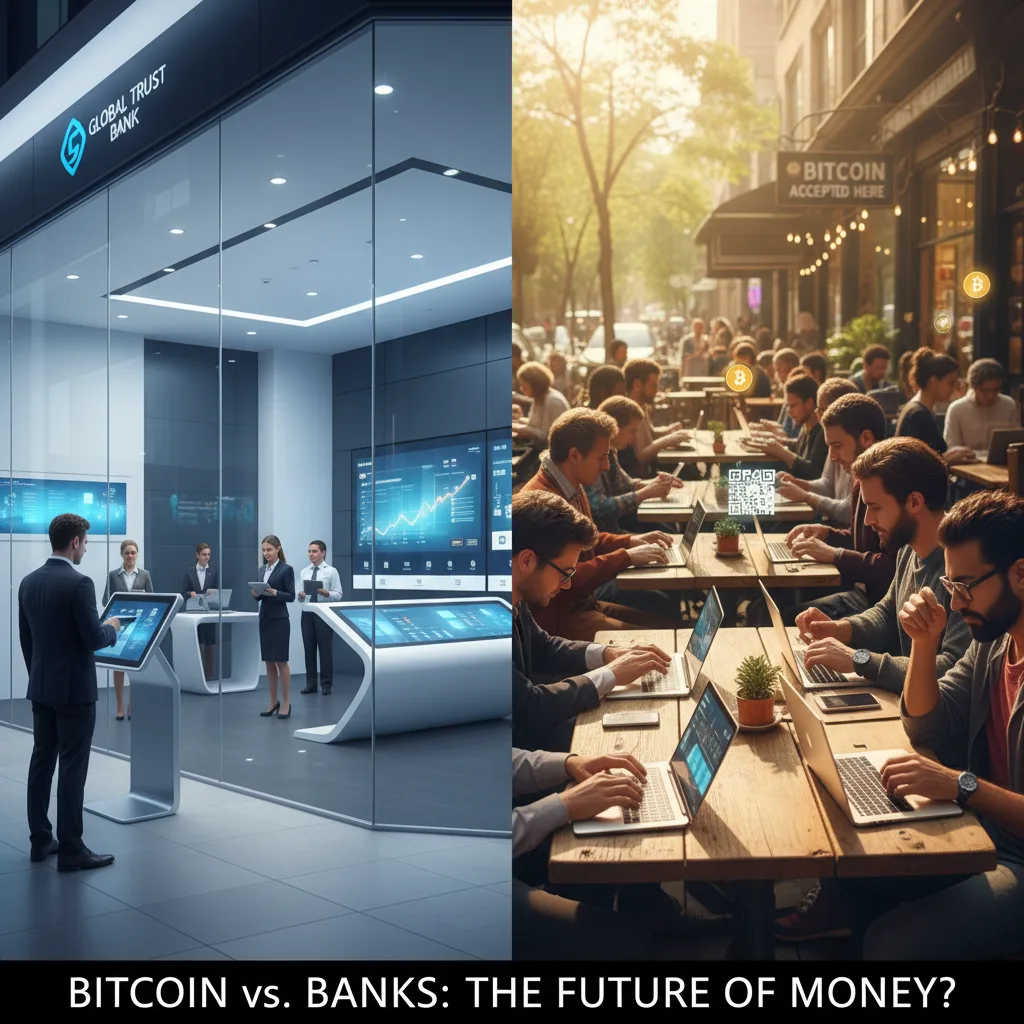
Short version: Bitcoin can replace some banking functions for some people, but it cannot fully replace the entire banking system today.
It does a strong job at storing value, transferring money across borders, and giving people direct ownership of their funds. It struggles with lending at scale, consumer protection, day-to-day spending in most countries, and the kind of regulatory cooperation that modern economies are built on.
If you’re looking for a single sentence: Bitcoin is more likely to reshape banking than to erase it.
What Bitcoin Actually Does Differently From Banks
To understand why this matters, you have to look at what Bitcoin actually is at its core. Not the price, not the memes, but the network itself.
Bitcoin is a decentralized monetary system. There’s no CEO, no head office, no customer service line. It’s a global network of computers agreeing on who owns what. That’s it. If you want a cleaner introduction to the basics, our guide on What Is Bitcoin? breaks it down step by step.
The key difference with a bank is structural. A bank is a trusted intermediary. Bitcoin removes that intermediary entirely.
Bitcoin as a Peer-to-Peer Money Network
When you send money through your bank, you don’t actually move money. You send an instruction. Your bank updates its database, talks to another bank, and eventually the receiving bank updates its database. There can be delays, holds, fees, and rejections along the way.
Bitcoin works differently. You send value directly from your wallet to someone else’s wallet. The network confirms it. No bank in the middle, no approval needed, no opening hours. If you want to see exactly how this works under the hood, our explainer on How Bitcoin Works Explained covers it without drowning you in jargon.
For a beginner this feels strange. For someone who’s ever waited three business days for a transfer to “clear,” it feels like a quiet revolution.
Bitcoin vs Bank Money: Ownership, Control, and Access
Money in your bank account isn’t really yours in the strictest sense. It’s a claim on the bank. If the bank freezes your account, restricts withdrawals, or runs into trouble, your access can disappear overnight. It rarely happens to most people, but it happens often enough to matter.
Bitcoin flips that. When you hold Bitcoin in a wallet you control, no one can freeze it, no one can block your transfer, and it doesn’t care whether it’s 3 a.m. on a Sunday. That’s the same network, available everywhere, all the time.
The trade-off is responsibility. There’s no “forgot password” button. We dig deeper into this comparison in Bitcoin vs Fiat Currency: The Real Difference, because the differences go well beyond control.
That structural freedom is powerful. But it’s only half the story.
What Traditional Banks Still Do Better Than Bitcoin
It’s easy to forget that banks aren’t just places that store your money. They issue credit, run payroll for businesses, settle international trade, finance mortgages, provide fraud protection, and act as the legal financial backbone of most economies. Replacing all of that with a blockchain isn’t a small task.
Banks Offer Consumer Protection and Dispute Resolution
If someone steals your debit card and drains your account, you can usually call the bank, file a dispute, and get your money back. If you fall for a scam wire transfer, there’s at least a chance of recovery. If you forget your password, you can prove your identity and regain access.
With Bitcoin, none of that exists by default. Transactions are irreversible. Lose your seed phrase and the funds are gone. Send Bitcoin to the wrong address and there’s no support team that can reverse it. That’s not a flaw in the system, it’s the design. But it shifts the entire burden of responsibility onto the user, and a lot of people aren’t ready for that.
For some, that’s empowering. For others, especially older users or those new to technology, it’s a real barrier.
Banks Provide Credit, Mortgages, and Business Financing
This is where things get harder for Bitcoin. The modern economy runs on credit. Mortgages, car loans, small business financing, working capital lines, all of it depends on identity, risk assessment, collateral, and legal enforcement. Banks are good at this because they have data, regulatory frameworks, and courts behind them.
Crypto has its own answer, sometimes called crypto lending, and it works through collateralized loans on platforms or DeFi protocols. Our breakdown of How Crypto Lending Platforms Work shows what’s possible and where it’s still rough around the edges.
The short version: Bitcoin can serve as collateral, but it cannot replace the entire credit infrastructure of a modern economy. Not yet, anyway.
Bitcoin Banking Future: Which Banking Functions Can Bitcoin Replace?
Instead of asking “will Bitcoin kill banks?”, a more useful question is: which specific functions can it already do well? The bitcoin banking future probably won’t be all-or-nothing. It’ll be uneven, function by function.
Store of Value: Can Bitcoin Replace a Savings Account?
Bank savings accounts are stable in value but often lose to inflation. Bitcoin is volatile in price but has, historically, gained purchasing power over long time horizons. That’s a real trade-off, not a slogan.
If you’re saving for next month’s rent, Bitcoin is a bad choice. If you’re saving over five or ten years and you can stomach the swings, it becomes more interesting. The mistake people make is treating Bitcoin like a savings account when they’re really speculating, or treating it like a speculation when they’re actually saving long-term. Be honest with yourself about which one you’re doing.
Payments: Can Bitcoin Replace Debit Cards and Bank Transfers?
For international transfers, Bitcoin can be faster and cheaper than wire transfers. For domestic card payments, it’s usually slower, more expensive, and less convenient than just tapping your card. That’s the reality today.
Merchant acceptance is improving, but it’s still patchy. If you want a practical look at where you can actually use it, our guide on Bitcoin Payments: Where and How to Use Bitcoin is a good place to start.
Everyday Transactions: Where Bitcoin Still Struggles
Imagine paying for your morning coffee with Bitcoin. The price might shift between when you order and when the transaction confirms. The barista might not know how to handle it. In some countries, you’d have to log that as a taxable disposal. That’s a lot of friction for a €3 cappuccino.
This is the honest gap between Bitcoin’s potential and its current daily use. The comparison in Bitcoin vs Visa: Crypto vs Traditional Payments makes the throughput and usability gap really clear.
Scaling Payments With the Lightning Network
This is where Lightning comes in. It’s a second layer on top of Bitcoin designed to make small payments fast and cheap. Send a few cents, settle in seconds, pay almost nothing in fees. It’s promising, especially for everyday use and international micropayments.
It’s not magic, though. It still requires setup, channel management, and good wallet software. Our piece on What Is the Lightning Network? Bitcoin Scaling Explained walks through the practical side without overpromising.
Lightning is one of the most important pieces in the puzzle of whether Bitcoin can ever compete with daily card payments.
Decentralized Finance and Banking Disruption Crypto: Where Bitcoin Fits In
Bitcoin is one piece of a much larger movement. Decentralized finance, or DeFi, takes the idea of removing intermediaries and applies it to lending, trading, derivatives, and more. This is where the banking disruption crypto narrative really lives.
But Bitcoin itself is conservative compared to most of DeFi. That’s by design.
Bitcoin vs DeFi Platforms
Bitcoin is focused on being decentralized, secure money. It doesn’t try to be a global computer or a yield platform. DeFi protocols, mostly built on other chains, try to recreate banking services like loans and exchanges in code.
The trade-off is real. Bitcoin’s simplicity is part of its strength. DeFi’s complexity introduces smart contract risk, exploits, and rapid changes. One isn’t strictly better than the other. They serve different needs. Many serious investors hold Bitcoin for stability and exposure to the underlying thesis, and use DeFi sparingly for specific use cases.
Crypto Payment Gateways and Merchant Adoption
For Bitcoin to replace bank-based payment rails, merchants need easy ways to accept it. Crypto payment gateways solve this by handling the technical side and often converting Bitcoin into local currency instantly, so the merchant doesn’t have to worry about volatility.
If you’re curious how this actually works in practice, Crypto Payment Gateways Explained covers the setup, settlement, and the realistic concerns merchants have. This kind of infrastructure is quietly more important than most price charts.
Financial Freedom: Why Bitcoin Appeals to People Who Distrust Banks
Underneath all the technical comparisons sits a simpler motivation: financial freedom. The idea that you can hold and move your own money without asking permission. For people who have lived through capital controls, hyperinflation, account freezes, or political instability, this isn’t theoretical. It’s survival.
For everyone else, it’s more of a principle. A way to opt out, at least partially, of a system you don’t fully trust. That’s a real and valid reason to use Bitcoin, but it shouldn’t be confused with a guarantee of wealth or safety.
Self-Custody: The Power and Responsibility of Holding Your Own Money
Self-custody is what makes Bitcoin different from money sitting at an exchange or on an app. You control the private keys, which means you control the funds. Nobody can freeze, seize, or block them. That’s the upside.
The downside is equally direct: if you lose the keys, you lose the money. Period. We explain why this matters so much in Self-Custody: Why Your Keys Matter. It’s worth reading before you take this step seriously.
Bitcoin Wallets: The New “Bank Account” for Crypto Users
A Bitcoin wallet is your interface to the network. It holds your keys, signs your transactions, and shows your balance. There are custodial wallets, where a company holds the keys for you, and non-custodial wallets, where you do.
Custodial feels like a bank. Non-custodial feels like a vault you alone control. Each has trade-offs around convenience, security, and responsibility. Our walkthrough in Bitcoin Wallets Explained helps you figure out which one suits where you are right now.
That choice, between convenience and control, is essentially the choice between a bank and Bitcoin in miniature.
The Risks of Replacing Banks With Bitcoin
This is the part most hype-driven articles skip. Replacing your bank with Bitcoin sounds great until you hit the first real obstacle. There are several worth taking seriously.
Volatility Makes Bitcoin Difficult as a Full Banking Replacement
Imagine being paid your salary in Bitcoin on the first of the month. By the fifteenth, it could be worth 20% more or 20% less. Try planning rent, groceries, and bills around that. It’s possible, but it’s stressful, and for most people impractical.
Volatility is the single biggest reason Bitcoin isn’t ready to be a complete daily replacement for banking. It can be a great long-term asset and a useful payment rail in specific contexts, but as a unit of account for your monthly budget, it’s still rough.
Security Mistakes Can Be Expensive
Phishing emails, fake wallet apps, malware that swaps clipboard addresses, exchanges that collapse, seed phrases written on a sticky note. These aren’t rare stories. They’re common, and they’re often unrecoverable.
Bitcoin gives you full ownership. It also gives you full responsibility. There’s no fraud department. The freedom is real, but so is the learning curve. People who treat Bitcoin like a normal bank account are usually the ones who get hurt.
Privacy Is Not the Same as Complete Anonymity
A common myth is that Bitcoin is anonymous. It isn’t. Every transaction is recorded on a public ledger that anyone can analyze. With the right tools, transactions can often be traced back to identities, especially once funds touch regulated exchanges.
We get into the details in How Governments Track Cryptocurrency Transactions. The takeaway: Bitcoin offers more privacy than a bank wire in some ways, but it is not invisibility. Plan accordingly.
Regulation: The Biggest Barrier to Bitcoin Replacing Banks
Even if Bitcoin solved volatility, usability, and credit tomorrow, there’s a bigger obstacle: regulation. Governments are not going to quietly hand over monetary control. They never have, and they probably never will.
The legal landscape is evolving fast, and it varies hugely by country. Our overview in Is Bitcoin Legal? Global Overview shows just how different the rules can be depending on where you live.
Why Governments Care About Banking Control
Banking isn’t just commercial infrastructure. It’s how governments collect taxes, enforce sanctions, monitor financial crime, run monetary policy, and protect consumers. A fully unregulated parallel financial system threatens all of that.
This isn’t a conspiracy. It’s the basic logic of state power. Expecting governments to allow Bitcoin to fully replace banks is, frankly, naive. Expecting them to regulate, tax, and shape it is realistic.
CBDCs: A Government Response to Bitcoin and Crypto
One of the most direct government responses to crypto is the central bank digital currency. CBDCs are essentially digital versions of national money, issued and controlled by the central bank.
They’re often pitched as modernizing payments, but they also give governments tools that cash never offered: programmability, traceability, expiration dates, conditional spending. Our piece on CBDCs Explained: Governments’ Digital Currency covers the trade-offs, especially compared with Bitcoin’s open, decentralized model.
CBDCs and Bitcoin are not the same thing. In some ways they’re opposites.
Real-World Bitcoin Adoption: Is the Shift Already Happening?
Step back from the theory and the picture changes. Adoption is happening, just unevenly. Institutional investors hold it. Public companies put it on their balance sheets. Countries with unstable currencies use it for savings. Payment apps integrate it. The trend isn’t loud, but it’s steady.
Our overview in Bitcoin Adoption Growth Explained tracks where adoption is real and where it’s mostly marketing.
Where Bitcoin Makes the Most Sense Today
There are specific situations where Bitcoin already competes with, and often beats, traditional banking:
- Cross-border transfers, especially to countries with expensive remittance corridors
- Long-term savings in regions with high inflation or unstable local currencies
- Censorship-resistant payments for individuals or organizations cut off from banking
- Self-custody savings for people who don’t trust the local banking system
In these use cases, Bitcoin isn’t a luxury or a speculation. It’s a practical tool.
Where Banks Still Remain More Practical
For most people in stable economies, banks remain the path of least resistance. Salary deposits, mortgages, business accounts, tax reporting, credit cards, fraud protection. The infrastructure is mature, the user experience is familiar, and the consumer protections are real.
For the average user in a country with a functional banking system, Bitcoin is more likely a complement than a replacement. At least for now.
Possible Future Scenarios for Bitcoin and Traditional Banking
Predicting one specific future is a sucker’s game. Instead, here are several realistic scenarios that could play out, sometimes in combination.
Scenario 1: Bitcoin Becomes a Parallel Financial System
In this scenario, Bitcoin coexists with banks as a separate rail. People use banks for daily life and Bitcoin for savings, international transfers, or hedging against monetary policy. The two systems run alongside each other, each serving different needs. This is arguably what’s already happening at small scale.
Scenario 2: Banks Integrate Bitcoin Services
Rather than being replaced, banks adapt. They offer Bitcoin custody, trading, settlement, and lending services. This is already starting. Major banks now offer crypto products to clients who would otherwise leave. In this scenario, the “Bitcoin vs banks” framing fades because banks simply absorb the parts they can profit from.
Scenario 3: Bitcoin Remains a Niche but Powerful Alternative
Maybe Bitcoin never becomes mainstream daily money. Maybe it stays a powerful tool for specific groups: people in unstable economies, long-term savers, international workers, activists, businesses needing censorship-resistant payments. That would still make it valuable, just not universal.
Scenario 4: Regulation Limits Bitcoin’s Banking Role
In a stricter regulatory future, KYC requirements expand, self-custody is discouraged or restricted, and taxes make daily use painful. Bitcoin still exists, but its ability to compete with banks gets boxed in. This is a real possibility in some jurisdictions and worth taking seriously.
The honest expectation is probably a blend of these. Some integration, some parallel use, some regulation, some niche dominance. Reality rarely fits neatly into one narrative.
Expert Perspective: The Balanced Answer Investors Should Consider
If you zoom out, Bitcoin is one of the most significant financial innovations of the last several decades. It’s also not a complete replacement for the financial system. Both things can be true at the same time.
Replacing banks entirely would require solving volatility, mainstream usability, credit creation, consumer protection, and regulatory cooperation. None of these are impossible, but none are around the corner either. The smarter approach is to treat Bitcoin as a powerful tool with specific strengths, not as a one-size-fits-all replacement.
Questions Readers Should Ask Before Using Bitcoin as a Bank Alternative
Before you decide to lean on Bitcoin instead of a bank, run through these honestly:
- Do you actually understand how wallets and self-custody work?
- Can you handle 30% drawdowns without panicking?
- Do you have a backup plan for your seed phrase?
- Do you need customer support, dispute resolution, or fraud protection?
- Are you using Bitcoin for savings, payments, or speculation, and are you honest about which?
- Do you understand the tax rules in your country?
If you can’t answer most of these clearly, you’re probably not ready to replace any banking function yet. That’s fine. It just means there’s more to learn first.
Conclusion: Can Bitcoin Replace Banks, or Will It Force Banks to Evolve?
So, can Bitcoin replace banks? Probably not entirely, and probably not for everyone. But that was always the wrong framing. Bitcoin doesn’t need to replace banks to matter. It only needs to do certain things better, force banks to adapt, and give individuals an alternative when they need one.
For long-term savings, cross-border transfers, financial independence, and protection against bad monetary policy, Bitcoin is already a serious option. For mortgages, daily spending in stable economies, business banking, and consumer protection, traditional banks still win on convenience.
The most likely future isn’t Bitcoin defeating banks. It’s banks being pushed to become more open, faster, and more user-controlled because Bitcoin exists. That alone is a meaningful shift.
Take your time. Keep learning. Make decisions based on what you actually understand, not what someone louder tells you to believe. That’s how you stay grounded in a market that constantly tries to pull you in extreme directions.