

How Has Bitcoin Increased in Value? A Clear Look at Bitcoin Price History and Growth
Introduction: What this article will help readers understand
If you’ve ever asked how Bitcoin has increased in value, the short answer is: scarcity, rising demand, market cycles, and a steady expansion in who could buy it and why they wanted to.
The longer answer is more useful.
Bitcoin’s price history isn’t just a story of one asset going up. It’s a record of changing trust, better infrastructure, stronger liquidity, shifting macro conditions, and repeated tests of whether the market still believed in it after major crashes. That’s why simple price comparisons often miss the real point.
We’ll walk through Bitcoin’s biggest price milestones, what changed in each phase, and which forces pushed valuation higher over time. The goal isn’t hype, and it’s not to promise what comes next. It’s to give you a grounded framework so you can understand the asset more clearly. If you want to start from first principles, it also helps to understand what gives Bitcoin value.
That foundation matters before you look at the timeline.
Bitcoin at a glance: Why its price history matters

Bitcoin’s price history matters because it shows how a new asset class moves from obscurity to global relevance. For beginners, it answers a basic question: how has the value of Bitcoin changed over time, and why did those changes happen so dramatically? For active investors, it offers context for cycles, risk, and market behavior.
What makes Bitcoin different from many traditional assets is that its valuation has always been shaped by several forces at once. Scarcity is part of it. Adoption is part of it. Market sentiment, regulation, liquidity, macro policy, and technological trust all play a role too. That’s why price never moves in a clean, predictable line.
Bitcoin has gone through long stretches of explosive growth, followed by painful drawdowns that shook out weak conviction. That volatility isn’t a side note. It’s part of the asset’s history and part of how the market discovered what Bitcoin was worth at different stages of maturity.
That’s also why valuation is never just about one number on a chart. It helps to view Bitcoin through multiple lenses, including network growth, supply dynamics, and market behavior, which is where Bitcoin valuation models become useful.
With that in mind, the clearest way to answer the value question is to walk through the timeline itself.
A timeline of Bitcoin price growth from the early years to today
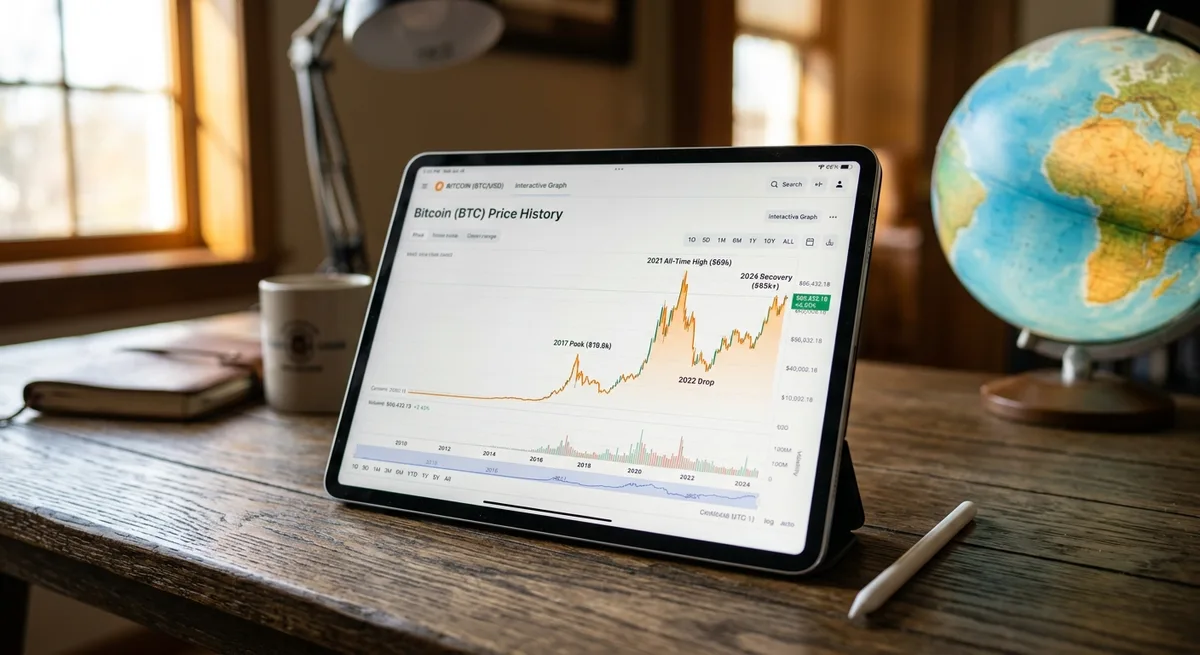
The easiest way to understand how much Bitcoin has increased in value is to break its history into phases. A historical price chart helps, but the real insight comes from knowing what changed during each stretch.
Bitcoin didn’t grow because price randomly climbed. It grew because the market gradually priced in better access, stronger infrastructure, wider awareness, and higher demand. If you want to compare historical moves more precisely, a Bitcoin to USD conversion tool can help put old prices into a clearer frame.
Here’s how it unfolded.
2009 to 2013: From almost worthless to early market recognition
Bitcoin launched in 2009 with no meaningful market price. In the beginning, it was mostly a technical experiment shared among developers, cypherpunks, and a very small online community. Nobody was assigning it value in the way we think about today.
One of the earliest real-world references came in 2010, when 10,000 BTC were used to buy two pizzas. That transaction gets mentioned a lot because it showed Bitcoin could function as money, even if its market value was still tiny.
As exchanges started to appear, Bitcoin moved from being an abstract idea to something that could actually be priced. Liquidity was thin, the user base was small, and awareness was extremely limited. That meant price could swing sharply even on modest buying or selling activity.
By 2013, Bitcoin had gone from virtually worthless to trading in the hundreds of dollars, with a major rally eventually pushing above 1,000 dollars on some exchanges. That early surge reflected first-wave recognition, speculative interest, and the start of a broader narrative around digital scarcity.
Still, this was a fragile market with weak infrastructure and limited trust, which is exactly why the next phase became so important.
2014 to 2016: Recovery, infrastructure growth, and a more serious market
After the 2013 surge, Bitcoin went through a major correction. The collapse of Mt. Gox damaged trust badly and reminded the market that early crypto infrastructure was still immature. Prices fell hard and sentiment cooled quickly.
But this period matters more than many people realize.
From 2014 to 2016, Bitcoin didn’t disappear. It stabilized, matured, and slowly built the foundation for later growth. Exchanges improved. Custody solutions got better. More people learned what Bitcoin was. Investors who weren’t ready to buy yet started paying attention.
For anyone wondering how much Bitcoin’s value has grown since 2014, this is the starting point for one of the clearest long-term comparisons. Bitcoin spent much of 2014 and 2015 under pressure, trading well below previous highs. Yet by 2016, the market had become more liquid and structurally more resilient than before.
This phase also included the 2016 halving, which reduced the rate of new Bitcoin issuance. If you want the mechanics behind that, here’s a clear guide to Bitcoin halving explained.
That slower, less exciting period quietly set up the conditions for what followed.
2017: The breakout year that brought Bitcoin into the mainstream
For many people, 2017 is the year Bitcoin first became impossible to ignore.
If you ask what Bitcoin was worth in January 2017, the answer is roughly 1,000 dollars. By December of that same year, it had climbed to nearly 20,000 dollars on some platforms. That move transformed Bitcoin from a niche internet asset into a global headline almost overnight.
Retail demand exploded. Media attention surged. Exchange signups spiked. People who had never looked at crypto suddenly wanted in. Initial coin offering speculation also fueled broader enthusiasm, and Bitcoin benefited from being the most recognizable name in the space.
It also became a bit self-reinforcing. Rising prices attracted attention, and attention attracted more buyers. That kind of reflexive momentum is common in high-growth assets, especially when liquidity is still relatively thin compared with traditional markets.
For many readers, 2017 remains the reference point for what a full Bitcoin bull market looks and feels like. It also shaped how people think about timing, which is why topics like Bitcoin price forecast and buy timing still get so much attention.
Every major expansion eventually meets reality, though.
2018 to 2019: Correction, consolidation, and market reset
After peaking near 20,000 dollars in late 2017, Bitcoin fell hard through 2018. By year’s end it had dropped more than 80 percent from the highs. This wasn’t a small pullback. It was a full reset.
Speculation had outrun fundamentals. Once momentum reversed, many short-term participants exited fast, and prices came down with them. The market had to rebuild from a much more realistic base.
For those asking what Bitcoin’s price looked like in 2019: it started near the low thousands, rallied above 10,000 dollars midyear, and then pulled back again. Not a straight recovery. More like a year of attempted stabilization mixed with uncertainty.
This phase also highlighted Bitcoin’s role relative to the rest of the crypto market. When capital rotated, Bitcoin often regained attention as the benchmark asset. If you want to understand that dynamic better, it helps to know how Bitcoin dominance affects the market.
That reset laid the groundwork for the next major shift, which came from outside crypto as much as inside it.
2020 to today: Institutional adoption, macro shifts, and new all-time highs
From 2020 onward, Bitcoin entered a different stage of maturity.
The pandemic era changed behavior across asset classes. Massive monetary stimulus, inflation concerns, and historically low interest rates pushed investors to look more closely at scarce assets. Bitcoin landed squarely in that conversation.
At the same time, institutional participation became much more visible. Public companies added Bitcoin to their treasury reserves. Large funds started offering access. Regulated products expanded. ETF-related developments later brought even more legitimacy and easier entry for mainstream investors.
Bitcoin then moved through another powerful cycle: new all-time highs, another deep bear market, and eventually a recovery as macro expectations and product access evolved again.
What stands out in this period isn’t just price appreciation. It’s who’s now participating. Bitcoin is still volatile, still sentiment-driven at times, and still sensitive to policy shifts. But compared with its early years, it now sits much more firmly inside the broader financial conversation. For ongoing context, it helps to follow the latest Bitcoin news.
Once you see the timeline clearly, the next question matters more: what actually caused that long-term appreciation?
What actually drove Bitcoin’s value higher over time?
Bitcoin’s long-term growth didn’t come from one single catalyst. It came from several forces reinforcing each other across different cycles. Some of those forces are structural, like fixed supply. Others are behavioral, like market psychology. Others depend on the outside world: interest rates, regulation, financial stress.
To understand Bitcoin’s price trends over the years, it helps to separate these drivers rather than treating all price movement as the same thing.
Scarcity and fixed supply
Bitcoin has a maximum supply of 21 million coins. That’s one of the clearest foundations of its valuation.
Unlike fiat currencies, which can be expanded by central banks, Bitcoin’s issuance follows a transparent schedule. That doesn’t automatically create value, but it does create scarcity. If demand rises while supply growth stays constrained, price pressure can build over time.
This is one reason Bitcoin is often compared to digital gold. The supply rules are known in advance. That predictability matters, especially when investors are worried about currency debasement or long-term inflation. Scarcity alone isn’t enough, though. It only means something if people actually want the asset, which brings us to adoption.
Adoption and network growth
Bitcoin’s value rose as more people, platforms, and institutions decided it was worth holding, using, or tracking.
In the early years, access was limited and confusing. Over time that changed. More exchanges entered the market. Wallets improved. Custody tools got better. Educational content became easier to find. The whole experience of buying and storing Bitcoin got less intimidating.
As the network grew, Bitcoin became easier to access and easier to understand. That increased the pool of potential demand. Adoption doesn’t require every person to use Bitcoin directly. In many cases, price responds simply because more participants recognize it as a relevant asset. That shift in perception has been one of the biggest drivers of Bitcoin’s market value changes over time.
Adoption also interacts closely with Bitcoin’s issuance schedule, which is why halvings get so much attention.
Halving cycles and supply reduction
Roughly every four years, Bitcoin’s block reward is cut in half. Fewer new coins enter circulation each day.
Historically, these events have often been followed by major market cycles, though not in a simple or guaranteed way. The logic is straightforward: if new supply is reduced while demand stays stable or grows, the market may eventually reprice higher.
Stay realistic here. Halvings don’t force immediate rallies, and markets often price in expectations well in advance. Still, they’ve been a meaningful part of how Bitcoin’s price evolved since 2014 and beyond. If you want the pattern in more detail, this overview of Bitcoin halving cycle frequency is worth reading.
Even with a strong supply story, price can move much faster or slower depending on sentiment and liquidity.
Market sentiment, speculation, and liquidity
Some of Bitcoin’s biggest moves have been driven by emotion as much as fundamentals.
When confidence rises, more buyers step in, momentum builds, and price can overshoot. When fear takes over, the reverse happens fast. Leverage, liquidations, and thin liquidity can amplify both directions.
This is why Bitcoin can rally hard before fundamentals fully improve, and crash hard even when the long-term thesis remains intact. Greed and fear aren’t side effects in crypto markets. They’re major drivers of short-term price behavior. For anyone doing Bitcoin value growth analysis, this matters because not all gains are equally durable. Some moves reflect deeper adoption. Others reflect temporary excess.
That brings in the final layer, which often acts as the trigger for major regime changes.
Regulation, macroeconomics, and global events
Bitcoin doesn’t trade in isolation. It reacts to the world around it.
When interest rates are low and liquidity is abundant, risk assets often perform well. When central banks tighten aggressively, speculative assets usually come under pressure. Inflation scares, banking stress, currency weakness, and geopolitical uncertainty can all shift demand for Bitcoin.
Regulation matters too. Supportive regulatory signals improve confidence and access. Restrictive policy or enforcement pressure can reduce participation and create uncertainty. ETF developments have been especially significant because they change how mainstream capital can enter the market.
If you want to stay close to the factors currently shaping price behavior, following Bitcoin today and latest updates helps add real-time context.
With the main drivers covered, it’s worth looking at the specific moments that changed Bitcoin’s valuation most dramatically.
Key moments that changed Bitcoin’s valuation
Bitcoin’s long-term growth becomes easier to understand when you tie price action to real events. Markets don’t move randomly forever. They respond to changes in access, trust, supply, and relevance.
Here are some of the moments that mattered most.
Exchange launches and easier access to buying Bitcoin
A major reason Bitcoin gained value was simply that buying it became easier.
In the beginning, access was a real barrier. You needed technical knowledge just to get started. As exchanges improved and fiat on-ramps expanded, more people could participate. Better interfaces, faster verification, and improved custody solutions lowered the friction significantly.
That matters because an asset can’t attract broad capital if most people can’t buy it conveniently or safely. Improved access increased liquidity, widened participation, and made price discovery more efficient.
Institutional entry and ETF-related developments
Institutional involvement changed the narrative around Bitcoin in a meaningful way.
When public companies, asset managers, and regulated investment products entered the picture, Bitcoin looked less like a fringe experiment and more like an asset serious capital was willing to consider. ETF-related progress also reduced the operational burden for investors who wanted exposure without directly managing coins.
This didn’t eliminate volatility, but it did improve legitimacy. In practical terms, it expanded the size and type of demand that could influence the market.
Crashes, recoveries, and what they reveal about long-term growth
Bitcoin’s growth story only makes sense if you include the crashes.
It has repeatedly fallen by 50 percent, 70 percent, or more. Yet after several of those collapses, it eventually recovered and reached new highs. That doesn’t prove future outcomes, but it does show that Bitcoin’s long-term price milestones were built through repeated cycles of excess, correction, and rebuilding. The recoveries were never guaranteed in the moment. They only looked obvious in hindsight.
The key lesson: long-term appreciation and severe short-term volatility can exist at the same time. Ignoring either side gives you a distorted picture of the asset.
How to interpret Bitcoin’s growth without falling for hype
Bitcoin’s historical returns look extreme, and they are. But percentages can be misleading when something starts from a near-zero base.
Going from pennies to dollars, then to hundreds, then thousands, produces eye-catching numbers. That’s real growth, but it doesn’t mean the same rate can repeat forever. A much larger asset needs far more capital to keep compounding at the same pace.
This is where many readers get tripped up. They see past gains and assume the future must follow the same script. A more grounded approach is to use history as context, not prophecy. For a more forward-looking framework, you can compare historical behavior with a broader Bitcoin value outlook.
Why past performance is useful but not enough
Past performance helps because it reveals patterns in volatility, adoption, market cycles, and how price responded to halvings, macro stress, and surges in public attention.
But it doesn’t guarantee repetition.
Bitcoin today is not the same market it was in 2013, 2017, or even 2020. The participant base is broader, regulation is more visible, and access is easier. Old patterns can rhyme without repeating exactly. Use historical price appreciation as one input, then combine it with current macro conditions, valuation context, market structure, and your own risk tolerance.
Common mistakes readers make when judging Bitcoin growth
One common mistake is focusing only on all-time highs. That hides the drawdowns and creates unrealistic expectations about how smooth the ride actually was.
Another is confusing speculation with durable adoption. A fast rally may be driven by momentum rather than lasting demand.
A third is comparing Bitcoin to traditional assets without proper context. Bitcoin is smaller, more volatile, and structurally different from stocks, bonds, or gold. Comparison isn’t useless, but context matters.
And the last major mistake is treating historical returns as a promise. Bitcoin’s investment potential is still debated, and future performance depends on conditions that are always changing.
The most useful takeaway from price history isn’t excitement. It’s perspective.
What Bitcoin’s price history means for beginners and active investors
Bitcoin’s history offers a practical lesson for both new and experienced market participants: price growth came with deep volatility, long waiting periods, and repeated narrative shifts.
If you only look at the final result, you miss the actual experience of holding through the cycles. Understanding that helps you make better decisions and avoid reacting emotionally when the market moves fast.
For beginners: focus on understanding cycles before buying
If you’re new, your first job isn’t to predict the next rally. It’s to understand how Bitcoin behaves.
Study the boom and bust phases. Look at how long corrections lasted. Notice how sentiment changed at tops and bottoms. Learn why scarcity matters, but also why liquidity and macro conditions can override simple narratives in the short term.
That kind of preparation matters far more than trying to chase a perfect entry after reading one bullish headline.
For experienced readers: use history as context, not a shortcut
If you already follow crypto closely, history can help you frame probability, not certainty.
It can sharpen your sense of risk, help with position sizing, and improve your view of cycle behavior. It can also help you separate structural change from temporary noise. But it shouldn’t make you overconfident. Every cycle has looked obvious in hindsight and genuinely messy in real time. Experienced investors usually do better when they treat historical context as one tool among many rather than a shortcut to conviction.
Conclusion: Bitcoin’s growth story is real, but it has never been simple
So, how has Bitcoin increased in value?
Through a combination of fixed supply, rising adoption, halving-driven supply reductions, stronger infrastructure, growing institutional participation, and repeated macro conditions that pushed more people toward scarce digital assets. At the same time, sentiment, speculation, and liquidity often accelerated both the upside and the downside.
That’s why Bitcoin’s history matters. The biggest lesson isn’t just how much Bitcoin has increased in value, but how and why those gains happened. The path was never smooth, never guaranteed, and never separated from real risk.
If you take one thing from Bitcoin’s price history, let it be this: understanding the drivers behind the moves is more useful than being impressed by the chart alone. That kind of clarity will help you think better, whether you’re just getting started or already deep in the market.