

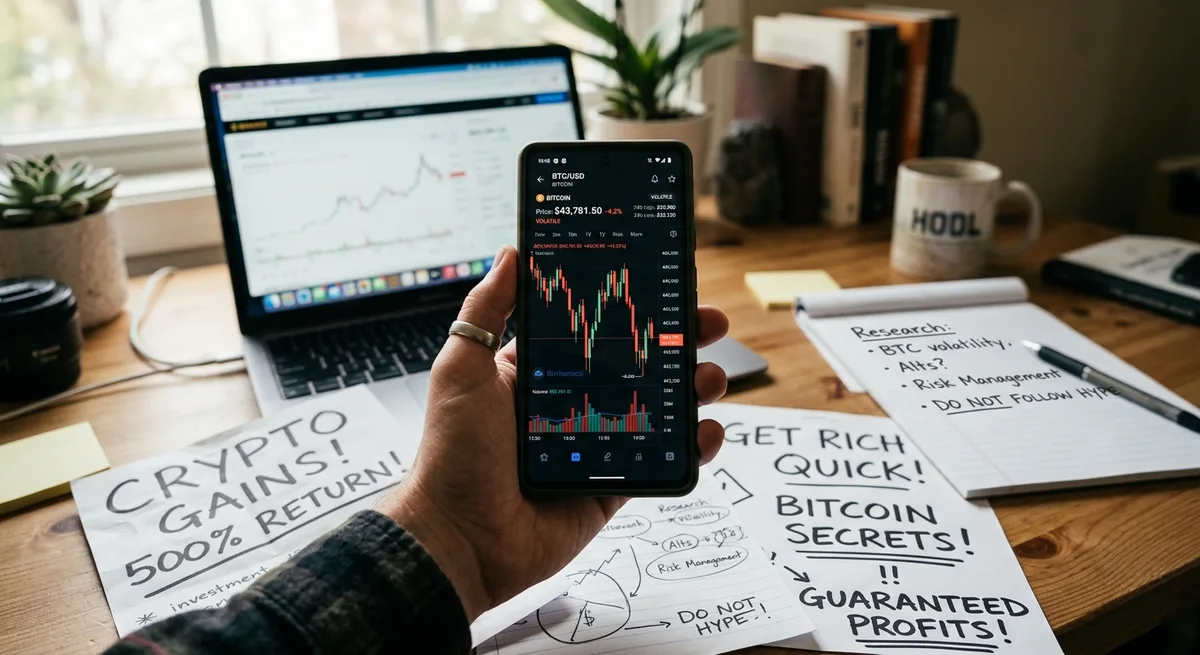
How to Spot Bitcoin Scams (Before It’s Too Late)
Why learning to spot bitcoin scams matters now
If you spend enough time around crypto, you will eventually run into someone selling certainty. That is usually where the trouble starts.
The market keeps pulling in two groups at once: new users chasing opportunity and bad actors looking for easy targets. It does not matter whether you are buying your first small amount of Bitcoin or already moving funds between wallets and exchanges. Scammers are not only after beginners. They go after anyone who moves too fast, trusts too easily, or skips basic checks.
The good news is that most scams leave clues. Unrealistic returns, fake urgency, impersonation, blocked withdrawals, copied websites, requests for sensitive information no real platform would ever need. These patterns show up again and again. The problem is not that the clues are invisible. The problem is that scams are specifically designed to make you ignore them in the moment.
This article will help you spot bitcoin scams before money leaves your wallet. We will break down how these schemes work, what warning signs to look for, and what practical habits actually protect you. If you want a broader overview of recurring fraud tactics, this guide on Bitcoin scams and common frauds to avoid is worth reading alongside this one.
It helps to start with a simple question: what actually counts as a Bitcoin scam?
What counts as a Bitcoin scam?
A Bitcoin scam is not just any bad outcome in crypto.
If Bitcoin drops after you buy, that is market risk. If you invest in a weak project that fails, that is a poor decision. If you send funds to the wrong address, that is user error. A scam is different. A scam involves deliberate deception.
Most cryptocurrency fraud includes one or more of these elements: fake identities, false claims, manipulated evidence, hidden terms, social pressure, or direct attempts to access your funds. The scammer wants you to believe something that is not true so you will send Bitcoin, connect a wallet, reveal credentials, or trust a fake investment opportunity that only benefits them.
That distinction matters because it changes how you protect yourself. You cannot remove normal market risk from crypto, but you can reduce your exposure to fraud by learning the patterns behind deception.
Before looking at the main scam types, it helps to understand why Bitcoin draws so much of this attention.
Why Bitcoin attracts scammers
Bitcoin attracts scammers because it combines real value with fast-moving decision making.
Transactions are generally irreversible. Once funds are sent, getting them back is extremely difficult. Wallets are pseudonymous, which makes it easier for scammers to move money without tying it to a real identity. None of that means Bitcoin is built for crime, but it does mean scam tactics often take advantage of how the system works.
There is also a constant stream of new users entering the market. Some are curious. Some are chasing returns. Some are trying to understand wallets, exchanges, and security basics for the first time. Scammers know this. They build fake offers around confusion, greed, urgency, and misplaced trust.
And creating a convincing scam is not that hard. A polished website, a fake social profile, a copied dashboard, or a paid review campaign can look legitimate for just long enough to steal deposits.
Now let’s look at the scam categories you are most likely to encounter.
The most common types of Bitcoin scams
Most bitcoin scams are not especially original. They just keep changing their packaging.
One year it is a fake trading platform. The next it is an influencer giveaway. Then it becomes a mining contract, a support impersonation message, or a wallet app clone. The language changes, but the goal stays the same: get you to send money or hand over access.
Once you know the main categories, spotting fraud becomes much easier.
Fake investment platforms and guaranteed return schemes
This is one of the oldest patterns in crypto.
A website or promoter claims you can deposit Bitcoin and earn fixed daily, weekly, or monthly returns. Sometimes it is framed as AI trading. Sometimes arbitrage. Sometimes private access to a profitable strategy. The message is always similar: low risk, high returns, easy money.
That pitch is the core red flag.
A bitcoin investment scam often sounds calm and professional. It might show dashboards, profit histories, account managers, or fake licenses. But if a platform promises guaranteed returns no matter what the market does, slow down immediately. Real crypto markets do not offer certainty. Legitimate investing involves risk, drawdowns, and uncertainty.
Scammers rely on the fact that many people want passive income without fully understanding where the profits would actually come from. If the revenue model is vague but the returns are specific, that mismatch should bother you.
Another version of this scam shows fake profits inside your account. You may think you are earning money, but the dashboard is just numbers on a screen. The real test comes when you try to withdraw. That is usually when the excuses begin.
Impersonation scams on social media, email, and messaging apps
Impersonation works because trust travels faster than verification.
You receive a message from what looks like exchange support, a well-known trader, a project admin, or a public figure offering a giveaway. The profile picture looks real. The language sounds convincing. The timing may even line up with something happening in the market. But the account is fake.
A classic crypto giveaway scam tells you to send Bitcoin first so you can receive more back. Another version claims your account is at risk and asks you to verify details through a link. Fake support accounts are especially dangerous because they often appear right after users post a public complaint or question online. You are standing there frustrated, someone slides into your messages offering help, and it feels almost reasonable.
The manipulative pattern is simple: gain trust, create urgency, move the conversation into direct messages where pressure is easier to apply. If you want a broader look at scam and hack risks affecting other coins too, this guide on securing XRP investments from hacks and scams covers similar warning patterns.
Many impersonation scams eventually lead to a fake site or app, which makes the next category especially important.
Phishing websites, fake apps, and wallet theft
Phishing is one of the most effective ways to steal crypto because it targets ordinary habits.
You click a link, land on a site that looks almost identical to a real exchange or wallet, and enter your login or recovery phrase. That is enough. In other cases, the scam comes through a fake app that copies the branding of a legitimate wallet. Once installed, it captures credentials or tricks you into approving malicious activity.
A phishing attack may involve only tiny visual differences. A missing letter in the domain. A slightly altered logo. A login page that loads from the wrong URL. These small details can lead to serious losses.
The most dangerous version is the seed phrase scam. If anyone asks for your recovery phrase, assume the goal is theft. That phrase is the master key to the wallet. Once it is exposed, your Bitcoin is no longer under your control.
If you want a clearer understanding of how wallets actually work and why self-custody comes with real responsibility, read this guide on Bitcoin wallets explained.
Cloud mining and mining-related scams
Cloud mining sounds attractive because it promises mining income without buying hardware, managing electricity, or dealing with technical setup.
That simplicity is exactly why scammers use it.
A cloud mining scam typically offers contracts with clean numbers, attractive returns, and dashboards showing steady output. But the business model often falls apart under scrutiny. Fees are hidden. Contract terms are unrealistic. The mining operation cannot be verified. Sometimes there is no mining happening at all.
Users can deposit easily but struggle to withdraw. Or the site survives just long enough to collect fresh deposits before disappearing. If you are exploring this area, start with this breakdown of how to avoid cloud mining scams.
Knowing the scam types helps, but recognition gets much stronger when you have a consistent pre-transfer checklist.
How to spot bitcoin scams before you send money
If you want to spot bitcoin scams consistently, you need a process.
The best defense is not trying to guess whether something feels legitimate. It is running through the same checks every single time before you sign up, connect a wallet, approve a transaction, or transfer funds. Good fraud detection is usually boring, and that is exactly why it works.
Work through these checks before acting on any offer.
Check for unrealistic promises
Start with the claim itself.
Does the offer promise guaranteed profits, zero risk, fixed income, insider access, or fast doubling of your Bitcoin? If yes, treat it as suspicious immediately. Too-good-to-be-true offers keep working because they are designed around what people want to hear, not what reality supports.
Real crypto investing is volatile. Even strong assets and solid strategies come with uncertainty. Anyone removing that uncertainty through marketing language is usually hiding the real risk or inventing the opportunity entirely.
This first filter alone lets you reject a lot of scams before you waste time researching them.
Verify the company, platform, or person behind the offer
Do not rely on what the project says about itself.
Check the website carefully. Look for a real team, clear contact details, consistent branding, and a business model that makes sense. Search the domain age. Review social media activity. Look for independent discussions, not just testimonials embedded on the site. A polished homepage means very little on its own.
Ask basic questions. Who runs it? Where is it registered? Has it existed longer than a few weeks? Are reviews organic or repetitive? Does the team appear anywhere beyond their own marketing channels?
Independent verification matters more than project-controlled proof. This is where many scams fall apart if you take ten extra minutes.
Look for pressure, urgency, and emotional manipulation
Urgency is one of the strongest scam tools in crypto.
A message says the deal expires in one hour. A support agent tells you your wallet is compromised. A trader says a private opportunity is almost full. Someone warns you not to discuss the offer publicly because it is exclusive. That is classic urgency-driven manipulation.
Scammers want speed because speed reduces scrutiny.
When someone pushes you to act fast, asks you to keep things quiet, or leans hard on fear of missing out, pause. In crypto, moving slower is not a weakness. It is often the reason you keep your money.
Review payment methods and withdrawal rules carefully
Payment friction tells you a lot.
If you are being pushed to send Bitcoin directly to a personal wallet, use an unfamiliar app, or pay a fee to unlock your own funds, stop and reassess. A withdrawal scam pattern often only appears after the deposit is made. Suddenly you need to pay tax first, confirm with another deposit, or reach a minimum balance to access your money. Classic stalling tactics.
Always read the withdrawal terms before depositing anything. If the rules are vague, hard to find, or seem to shift over time, that alone is a warning sign. It also helps to compare contract structures carefully, especially with mining products. This guide on cloud mining contract comparison shows how misleading terms often hide in the details.
Watch for security red flags on websites and apps
You can often identify a fake crypto website just by slowing down and looking carefully.
Check the URL character by character. Look for:
- Spelling mistakes or awkward domain names
- Broken pages or copied legal text
- Missing company details or inconsistent branding
- Strange popups or login pages that feel slightly off
On apps, review the publisher name, ratings pattern, and comment quality. A flood of generic five-star reviews posted close together is not reassuring.
Also check security basics. Is there a clear official domain? Does the platform support proper authentication? Are support channels consistent across platforms? Weak website security can signal either negligence or outright fraud. For a broader look at the kinds of vulnerabilities that put users at risk, see this guide on hidden crypto security flaws.
Once you practice these checks regularly, you start noticing the same warning patterns across very different scams.
Real-world red flags that show up again and again
The goal is not to memorize every scam format. That is impossible.
The real goal is pattern recognition. Bitcoin scam red flags tend to repeat because scammers keep exploiting the same human shortcuts: trust, greed, urgency, and confusion. When you train yourself to see the pattern, you become harder to manipulate even when the presentation looks new.
Here are three of the most common repeat signals.
Anonymous teams and vague business models
An anonymous crypto project is not automatically fraudulent.
Crypto has a history of pseudonymous founders, and anonymity alone does not prove bad intent. But anonymity becomes much riskier when it is paired with vague operations, unclear revenue, and bold promises. If a project claims it can generate stable returns, ask where the money actually comes from.
If the explanation is fuzzy, technical-sounding, or constantly shifting, that is a problem. You do not need to understand every detail, but the business should still make sense in plain language.
When transparency is weak, scammers usually try to fill the gap with social proof.
Screenshots, testimonials, and fake proof of earnings
Scammers know people trust visuals.
That is why they use profit screenshots, edited dashboards, fake withdrawal confirmations, paid comments, and suspiciously detailed success stories. Fake testimonials are easy to produce and hard to verify in the moment. A Telegram group full of happy users can be bought. A dashboard showing impressive gains can be coded over a weekend.
Treat these materials as marketing, not evidence.
What matters is independent proof. Can the business model be verified? Can actual users describe the process consistently outside the company’s own channels? Are there credible third-party discussions that are not obviously promoted?
One request should override all other signals immediately.
Requests for private keys or seed phrases
This is a hard rule with no exceptions.
No legitimate wallet provider, support team, exchange employee, or recovery service should ever ask for your private key or seed phrase. Not once. Not for any reason.
Private key theft happens when users are convinced that sharing sensitive access information is part of account recovery, support verification, or wallet synchronization. It is not. The moment someone asks for that information, assume malicious intent and end the conversation immediately.
That one rule alone can protect you from some of the most damaging losses in crypto.
How to avoid crypto scams with a simple safety routine
Recognition is useful, but habits are better.
If you want to avoid crypto scams over the long term, you need a repeatable routine that works even when you are tired, distracted, or excited about an opportunity. You do not need a complex security setup. You need a few practical habits that reduce avoidable mistakes.
Use trusted wallets, exchanges, and security basics
Stick to known providers whenever possible. Use official websites, verified apps, strong unique passwords, and two-factor authentication. If you hold meaningful amounts, consider a hardware wallet. Keep your device updated and avoid installing random browser extensions or wallet tools found through ads.
These basics are not flashy, but they cut off a lot of common attack paths. If you are exploring mining services or remote platforms, it also helps to understand the broader risk landscape. This guide on cloud mining security risks is a useful next step.
Test small amounts before making larger transfers
Before sending a large amount, send a small amount first. Confirm the address is correct, the receiving platform works as expected, and the funds can actually be accessed or withdrawn. This will not catch every scam, but it can reveal problems before the damage becomes serious.
It also forces you to slow down, which is honestly one of the most effective protections in crypto.
Pause and verify with independent sources
Crypto due diligence is mostly about resisting speed.
Before acting, check the official website directly. Compare social accounts. Search for warnings. Read community discussions, but use judgment because communities can also be manipulated. Cross-reference the offer with trusted resources rather than relying on a single source.
This habit matters beyond scams too, because security risks often overlap with broader network and platform vulnerabilities. For more context on external threats and system exposure, read this guide on how safe your network is from attacks.
Even with good habits, you may still come across something suspicious. When that happens, fast damage control matters.
What to do if you think you’ve found a Bitcoin scam
If you think you are dealing with a scam, focus on control, not hope.
Do not waste time arguing with the scammer or trying to outsmart them. The priority is to stop further damage, secure what you still have, and preserve evidence. If funds are already gone, recovery may be difficult, but your actions still matter.
Stop sending funds and secure your accounts immediately
Stop all transfers right away.
If you connected a wallet to a suspicious site, disconnect it and review recent approvals. Change passwords on affected accounts. Enable or tighten security settings. Move funds to a safer wallet if you believe access may be compromised. End all communication with the suspected scammer.
Treat any information you shared as potentially exposed. If you entered credentials, assume they were captured. If you shared a seed phrase, treat that wallet as compromised and stop using it.
Save evidence and report the scam
Collect screenshots, wallet addresses, transaction IDs, emails, usernames, URLs, chat logs, and timestamps. Save copies before websites disappear or messages get deleted. This evidence trail may help exchanges, wallet providers, investigators, or other users avoid the same trap.
Report the scam through the relevant platform if an exchange, wallet app, social network, or messaging service was involved. You can also report through applicable fraud channels in your region. Do not expect this to recover funds, but it can support investigations and limit further harm.
FAQ: Common questions about Bitcoin scams
Can Bitcoin transactions be reversed if I get scammed?
Usually no.
A confirmed Bitcoin transaction generally cannot be undone once it is on the network. That is why prevention matters so much. In limited cases, an exchange may be able to help if funds were sent within its own system or if law enforcement becomes involved quickly, but reversal should never be your fallback plan.
Are all anonymous crypto projects scams?
No, but the risk is higher.
Anonymous projects become significantly more dangerous when anonymity is combined with weak transparency, vague business models, aggressive marketing, and unrealistic claims. Some legitimate builders stay pseudonymous but still provide clear documentation, public history, and verifiable product activity. The question is not whether a name is public. It is whether trust is earned through real evidence.
Is a high return always a scam?
Not always.
Volatile markets can produce outsized gains, especially over short periods. That is speculation. A scam is different. The line is usually crossed when returns are guaranteed, unusually consistent, or presented without any meaningful downside. High upside can be real. Certainty in crypto almost never is.
Conclusion: Stay skeptical, move slower, and protect your Bitcoin
The best way to spot bitcoin scams is not to become paranoid. It is to become methodical.
Most scams rely on the same pressure points: urgency, guaranteed returns, fake authority, fake proof, and requests that no legitimate service would ever make. If you slow down, verify claims independently, check how money moves, and treat pressure as a warning sign, you will avoid a large share of avoidable losses.
Safe bitcoin investing is less about finding perfect opportunities and more about refusing bad setups. You do not need to be the smartest person in the room. You just need better habits than the person scammers are counting on you to be.
Stay skeptical. Move slower. Protect your keys, your wallet, and your attention.