

Introduction: Why Cross Chain Swaps Matter in Crypto
Most blockchains live in their own little world. Bitcoin doesn’t naturally know what’s happening on Ethereum. Solana doesn’t read messages from Avalanche. Each network has its own rules, its own tokens, and its own community. That worked fine when crypto was small, but the market has outgrown that isolated setup.
Today, the assets you want, the apps you use, and the opportunities you spot are scattered across dozens of networks. So the question becomes practical: how do you actually swap crypto between blockchains without sending everything to a centralized exchange first?
That’s where cross chain swaps come in. They let you move value between ecosystems in a more direct way, without spending half a day clicking through deposit screens. They’re not magic, and they’re not without risk. But understanding how they work puts you in a much better position than the average user pressing buttons and hoping for the best.
This guide walks you through the mechanics, the trade-offs, and the things I’d personally check before trusting a protocol with real money.
What Are Cross Chain Swaps?
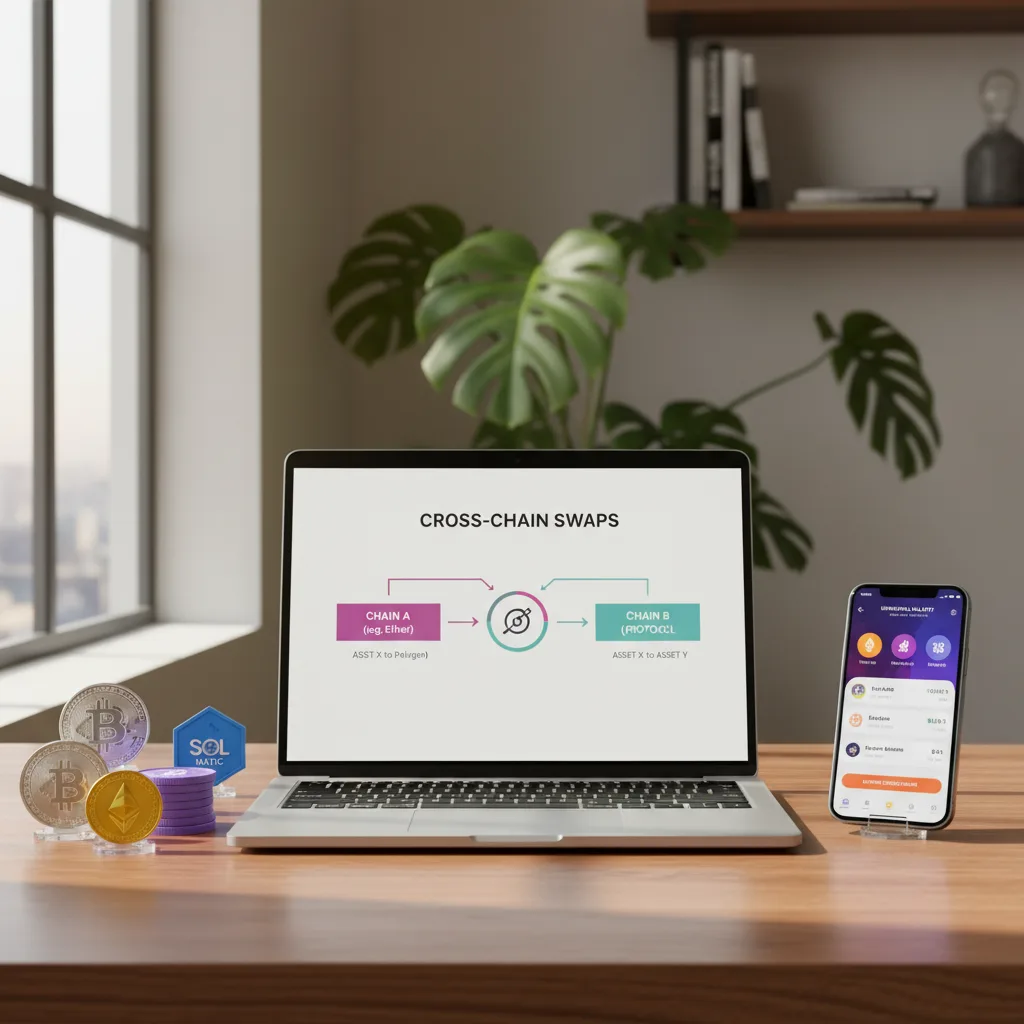
A cross chain swap is when you exchange a crypto asset on one blockchain for a different asset on another blockchain, ideally in a single flow. You start with, say, USDC on Ethereum and end with SOL on Solana, without manually bridging, wrapping, and trading on three different platforms.
That’s the user-facing definition. Behind the scenes, multiple systems are coordinating to make it feel like one smooth transaction. Liquidity providers, smart contracts, bridges, and sometimes oracles all play a role. To you, it should look like a swap. Under the hood, it’s quite a bit more.
Cross chain trading exists because people don’t want to be stuck on one network. If the best yield is on Arbitrum but your stablecoins are sitting on BNB Chain, you want a way to move without unnecessary friction.
Cross Chain Swaps vs Regular Crypto Swaps
A regular swap usually happens inside one blockchain. You go to a decentralized exchange, pick two tokens that live on the same network, and trade. Both assets exist in the same environment, so a single smart contract can handle the whole thing.
Cross chain swaps are different. You’re dealing with two separate networks that don’t share state, don’t share blocks, and don’t know about each other’s transactions. That means you need an additional layer of coordination. Something has to confirm that the asset on chain A was actually locked or paid, before the asset on chain B is released.
It sounds like a small detail. It isn’t. That extra layer is where most of the complexity, fees, and risk live.
Why Blockchains Do Not Naturally Talk to Each Other
Each blockchain is essentially a self-contained ledger. Ethereum has no built-in way to read Bitcoin’s blockchain. Bitcoin can’t query a smart contract on Avalanche. They were built independently, with different goals and different consensus rules.
This is what people mean when they talk about blockchain interoperability. Networks don’t share a common language, so we need translators. Bridges, messaging protocols, and swap aggregators are all attempts to solve that translation problem in different ways.
It’s a bit like having ten banks that don’t communicate with each other. To move money, someone has to manually coordinate things. That’s the gap cross chain technology is trying to close.
How Cross Chain Swaps Work Step by Step
Let’s break down what actually happens when you initiate a cross chain swap. The exact steps vary by protocol, but the core flow looks roughly the same everywhere.
Step 1: You Choose the Assets and Blockchains
You start by selecting four things: the asset you’re sending, the chain it currently lives on, the asset you want to receive, and the destination chain. For example, USDT on Polygon to ETH on Arbitrum.
This sounds basic, but it’s where a lot of people slip up. The same token can exist in multiple versions across chains, and they’re not always interchangeable. Picking the right combination is the first real decision you make when you swap crypto between blockchains.
Step 2: A Protocol Finds Liquidity
Once you confirm the pair, the protocol needs liquidity to actually fulfill the trade. That liquidity might come from a liquidity pool, from market makers, or from a network of solvers competing to give you the best price.
Cross chain trading depends heavily on this layer. If liquidity is thin on either side of the swap, you’ll see worse pricing, more slippage, and sometimes failed transactions. Good protocols pull from multiple sources to keep things smooth.
Step 3: Smart Contracts Lock or Verify the Assets
Your source asset doesn’t just teleport. It gets locked, burned, or sent into a contract on the source chain. A smart contract handles this part, acting as the rule enforcer.
The contract makes sure the swap conditions are met before anything is released on the other side. If something goes wrong, ideally the funds can be refunded. The strength of that contract is one of the biggest factors in how safe a cross chain swap actually is.
Step 4: The Destination Asset Is Released
Once the protocol has confirmation that your source-side action is complete, the destination asset is released to your wallet on the target chain. This might come from a liquidity pool, from a market maker’s inventory, or from a minted wrapped version of the asset.
To you, it looks like a single click. In reality, you’ve just used a system designed to swap crypto between blockchains in a way that hides most of the moving parts.
Step 5: The Transaction Is Confirmed on Both Networks
Both chains need to confirm their side of the transaction. That’s why cross chain swaps can take anywhere from seconds to several minutes, depending on the networks involved. Bitcoin-based swaps are usually slower because Bitcoin blocks are slower. Layer 2 networks are often faster but still depend on bridge confirmations.
This dual-confirmation requirement is part of what makes blockchain interoperability harder than it looks. Speed, fees, and reliability are all tied to how each network finalizes transactions.
The Main Technologies Behind Cross Chain Swaps
There isn’t just one way to do cross chain swaps. Different protocols use different approaches, and each comes with its own trade-offs.
Atomic Swaps
Atomic swaps are peer-to-peer trades where either both sides happen or neither does. They use a clever cryptographic mechanism (usually hash time-locked contracts) to make sure no one can run off with funds halfway through.
They’re elegant on paper. In practice, they require both parties to be online, agree on terms, and use compatible setups. That makes them powerful for certain cross chain trading scenarios but rarely the first choice for casual users who just want a quick swap.
Crypto Bridges
Crypto bridges work by locking an asset on one chain and minting a representation of it on another. Send 1 ETH into the bridge on Ethereum, get 1 bridged ETH on Arbitrum. Burn or return the bridged version, and the original ETH unlocks.
It’s a workable solution for blockchain interoperability, but bridges have also been the most exploited part of the crypto stack. The locked assets sit in contracts that attackers love to target, which is something to keep in mind before moving large amounts.
Wrapped Assets
Wrapped tokens are closely related to bridges. They’re representations of an asset from another chain, designed to behave like the original within a new ecosystem. The clearest example is wrapped Bitcoin, which lets BTC value participate in Ethereum-based DeFi.
When you swap crypto between blockchains, you’re often dealing with wrapped assets without realizing it. The wrapper is what makes the original asset “usable” on a chain it wasn’t designed for.
Cross Chain Messaging and Oracles
Some systems need reliable information about events on other chains. Did this transaction confirm? Is this contract balance correct? That’s where messaging protocols and oracles come in.
Networks like Chainlink provide the data feeds and cross chain messaging that many interoperability systems depend on. Without that trusted layer, swaps would either need to trust a single party or rely on slower verification methods.
Cross Chain Swaps vs Crypto Bridges
People mix these two up constantly. They’re related, but not the same thing.
When You Would Use a Cross Chain Swap
You use a cross chain swap when you want to exchange one asset for a different asset across chains. You start with USDC on Ethereum and want SOL on Solana. That’s two different tokens on two different networks, handled in a single flow. The goal is the trade itself, and cross chain trading is what gets you there.
When You Would Use a Crypto Bridge
You use a crypto bridge when you mostly want to move the same asset (or a wrapped version of it) from one chain to another. ETH on Ethereum to ETH on Arbitrum, for example. You’re not really changing what you hold. You’re changing where you hold it.
In practice, many cross chain swap platforms use bridges under the hood. The difference shows up in what you see on the surface: a swap interface gives you a trade, a bridge interface gives you a transfer.
Benefits of Cross Chain Swaps
There’s real utility here, but I’d rather frame it honestly than oversell it.
More Flexibility Across Blockchain Ecosystems
You’re not locked into one network. If a new chain launches with interesting apps, you can move into it without selling everything for fiat first. That kind of blockchain interoperability is what makes the broader crypto market feel less fragmented over time.
Better Access to Tokens, DeFi Apps, and Opportunities
Different networks specialize in different things. Ethereum has deep DeFi liquidity. Solana focuses on speed. Cosmos chains have their own ecosystem of apps. Cross chain trading lets you reach assets, liquidity pools, and decentralized applications wherever they live. If you want to understand more about the liquidity side, this breakdown of crypto liquidity pools is worth a read.
Less Dependence on Centralized Exchanges
You don’t have to deposit on a centralized exchange every time you want to move between networks. That’s a meaningful shift for anyone who prefers self-custody. Cross chain swaps give you a way to stay in your own wallet while still moving between ecosystems. Just keep in mind that “less centralized” doesn’t automatically mean “safer.” It just changes which risks you’re exposed to.
Risks and Limitations of Cross Chain Swaps
This is the part most marketing pages skip. I won’t.
Smart Contract Risk
Every cross chain swap runs on code. Code has bugs. The more complex the system, the more places something can go wrong. Even audited contracts have been exploited. If you’re moving meaningful capital, the quality and history of the underlying contracts matter more than the marketing.
Bridge and Protocol Exploits
Bridges have lost billions of dollars to hacks over the past few years. The reason is simple: they often hold huge pools of locked assets, which makes them juicy targets. Any protocol that depends on bridges or cross-chain validators inherits some of that risk. Blockchain interoperability is improving, but the attack surface is still wider than a single-chain swap.
Slippage, Fees, and Delays
Cross chain trading involves multiple networks, multiple gas fees, and sometimes multiple liquidity sources. Prices can move while you wait for confirmations. Liquidity can dry up unexpectedly. The number you see at the start isn’t always the number you get at the end.
User Error
Honestly, this might be the most common cause of lost funds. Sending tokens to the wrong chain, picking the wrong wrapped version, ignoring the gas token needed on the destination network. These mistakes happen all the time, and protocols can’t really protect you from them. When you swap crypto between blockchains, slow down and double-check everything.
How to Do a Cross Chain Swap Safely
A short checklist I’d use myself before clicking confirm.
Check the Supported Networks and Tokens
Make sure the platform actually supports the exact networks and token versions you want. “USDC” on one chain isn’t always the same “USDC” on another. Some platforms only support specific bridge versions of an asset. Verify before you commit.
Review Fees Before Confirming
Look at network fees on both chains, protocol fees, and any spread baked into the price. For cross chain trading, the total cost can be noticeably higher than a regular swap. If a quote looks suspiciously good, check what’s hidden in the route.
Start With a Small Test Transaction
If it’s your first time using a protocol, send a small amount first. Yes, you’ll pay fees twice. That’s cheaper than learning the hard way that you typed the wrong address or picked the wrong destination chain. For any cross chain swap into unfamiliar territory, a test transaction is the simplest insurance there is.
Verify the Protocol’s Reputation and Security
Read about audits. Check how long the protocol has been live. Look at whether it’s been exploited in the past, and how the team handled it. Community feedback, documentation quality, and transparency about the security model tell you more than any landing page will. Crypto bridges in particular deserve extra scrutiny.
Cross Chain Swap Platforms: What to Compare Before Using One
There’s no single “best” platform. There’s the right one for your specific use case.
Supported Blockchains
The number and quality of supported chains matter. A platform that connects 20 networks isn’t useful to you if your two networks aren’t among them. Strong blockchain interoperability across the major ecosystems (Ethereum, Layer 2s, Solana, BNB Chain, Cosmos, and so on) is usually a green flag.
Liquidity and Pricing
Deeper liquidity means better prices and less slippage. Some platforms aggregate from multiple sources, which generally improves the cross chain trading experience. Run a few quotes across different platforms before committing, especially for larger amounts.
Security Model
How does the platform actually move value? Pure smart contracts? Validator networks? Liquidity pools? External bridges? Each model has different trust assumptions. If the platform can’t clearly explain how it works, that’s information too. Many cross chain systems depend on crypto bridges in the background, even when they don’t advertise it.
User Experience
Cross chain swaps already have more moving parts than regular swaps. A clean interface that clearly shows the route, the fees, and the expected outcome reduces the chance of mistakes. When you swap crypto between blockchains, clarity is worth more than fancy features.
Real-World Use Cases for Cross Chain Swaps
Let’s make this concrete.
Moving Capital Between DeFi Ecosystems
You’re earning yield on one chain. A better opportunity opens up on another. Instead of withdrawing to a centralized exchange and re-depositing, you swap directly across chains. That kind of blockchain interoperability is what lets active DeFi users move with the market.
Trading Assets Across Different Networks
Some tokens only exist (or only have meaningful liquidity) on certain networks. Cross chain trading lets you reach those assets without giving up self-custody. A trader on Ethereum can grab a token that mostly trades on Solana, without bouncing through multiple intermediaries.
Reducing Friction When Managing a Multi-Chain Portfolio
If you hold assets across five or six networks, rebalancing is annoying. Cross chain swaps make it easier to shift exposure without constantly routing through centralized exchanges. It’s not free or instant, but it’s a lot less painful than the old way to swap crypto between blockchains.
Visual Explainer: Cross Chain Swap Flow
A simple diagram can make all of this click much faster than text alone.
Suggested Diagram Elements
A useful infographic for cross chain swaps would include:
- The source blockchain on the left
- The user’s wallet, initiating the transaction
- The swap protocol or aggregator layer in the middle
- A liquidity layer (pools, market makers, or solvers)
- A bridge or messaging layer connecting the two chains
- The destination blockchain on the right
- The final received asset landing in the user’s wallet
Arrows showing the flow of value, the role of crypto bridges, and the confirmation steps on both networks would help readers visualize how it all connects when they swap crypto between blockchains.
Trending Developments in Cross Chain Technology
The space is moving fast. A few things worth watching:
Stronger security models are slowly replacing the old “trusted multisig bridge” designs. Light clients, zero-knowledge proofs, and shared security models are making cross chain swaps less reliant on small groups of validators. ZK rollup technology in particular is shaping how chains verify each other’s state more efficiently.
Better intent-based systems are also emerging, where you describe what you want (the final outcome) and solvers compete to deliver it. That’s quietly reshaping how blockchain interoperability looks in practice. Less manual routing, more abstraction.
Whether all of this delivers on its promise is another question. The direction is clear though.
Common Mistakes Beginners Make With Cross Chain Swaps
Most lost funds in this space come from a small set of repeated mistakes.
Ignoring the Destination Chain’s Gas Token
You swap to a new chain and suddenly realize you have no native token to pay for the next transaction. Your assets are there, but you can’t move them. Some platforms offer a small gas top-up during the swap. Many don’t. When you swap crypto between blockchains, always check whether you’ll be able to actually use the funds on the other side.
Assuming Every Wrapped Asset Is the Same
“USDC” might mean five different things depending on which bridge minted it. The same goes for wrapped ETH, wrapped BTC, and many other assets. Different crypto bridges create different versions, and they’re not always interchangeable in DeFi apps. Verify the exact token contract before you assume anything.
Chasing Speed Without Checking Security
A protocol that’s fast and cheap but unaudited isn’t a deal. It’s a gamble. I’ve seen plenty of users pick a route purely because it had the best quote, only to lose funds when the bridge underneath got exploited. Cross chain trading rewards patience more than speed.
FAQ About Cross Chain Swaps
Are Cross Chain Swaps Safe?
It depends on what you’re using. Cross chain swaps can be reasonably safe when the protocol has solid audits, a real track record, transparent design, and enough liquidity. They become risky when any of those are missing. Your own behavior also matters: test transactions, double-checking addresses, and not rushing all reduce risk.
Are Cross Chain Swaps the Same as Bridges?
No, but they’re closely related. Crypto bridges generally move the same asset (or a wrapped version) from one chain to another. Cross chain swaps exchange one asset for a different asset across chains. Many swap platforms use bridges in the background, which is why the line between the two can feel blurry.
Can I Swap Bitcoin to Ethereum Using a Cross Chain Swap?
Yes, but with caveats. Native BTC and native ETH live on completely different networks, so most “BTC to ETH” flows involve wrapped assets, bridges, or specialized atomic swap protocols. The end result is that you swap crypto between blockchains, but the actual route may include several steps that the interface abstracts away.
Do Cross Chain Swaps Require KYC?
Most decentralized cross chain swap protocols don’t ask for KYC, since they’re non-custodial and permissionless. Hybrid or centralized platforms may require it. Rules also vary by jurisdiction, so cross chain trading regulations are something you’ll want to check based on where you live. Not legal advice, just a heads-up.
Why Do Cross Chain Swaps Sometimes Take Longer?
Several reasons. The source network might have slow block times. The bridge or messaging layer might require multiple confirmations. Liquidity on the destination chain might be tight. Network congestion adds delays on top of that. Because blockchain interoperability depends on coordinating multiple systems, the slowest link sets the pace.
Conclusion: Cross Chain Swaps Are Useful, but Not Risk-Free
Cross chain swaps are one of the more useful tools to come out of the push for blockchain interoperability. They make crypto feel less like a bunch of isolated islands and more like a connected market. You can move assets, chase opportunities, and manage a multi-chain portfolio with much less friction than before.
But the technology is still maturing. Crypto bridges get exploited. Smart contracts have bugs. User errors are common, and fees stack up when you’re not paying attention. The convenience is real, but so are the risks.
My honest take: learn how the mechanics work, start small, use protocols with a clear security track record, and never assume that “decentralized” means “safe by default.” If you treat cross chain swaps as a powerful but imperfect tool, you’ll get the benefits without walking into the obvious traps. That’s the kind of approach that tends to keep your capital intact while the rest of the market figures things out.