

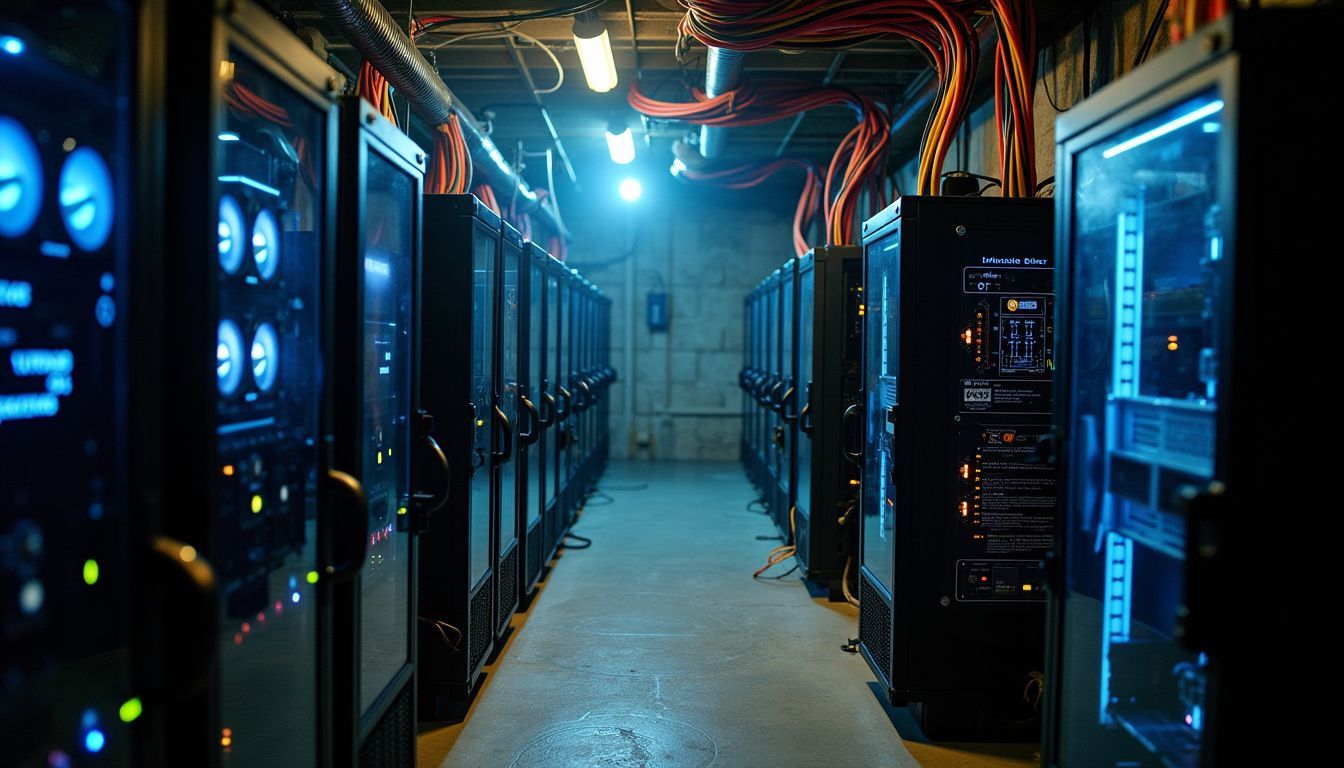
Is your electric bill skyrocketing due to cryptocurrency mining? Mining difficulty has a direct impact on how much energy miners like you use. This article breaks down the tough questions about mining difficulty and energy cost, offering real insights.
Stay tuned; it’s worth your time!
Key Takeaways
- Higher mining difficulty means miners use more power. Bitcoin mining in the U.S. can use between 25 TWh and 91 TWh per year.
- Renewable energy options like solar, wind, and hydro can cut costs and help the environment. Examples include using solar panels in Arizona or wind farms in Texas.
- High mining difficulty secures blockchain networks by making it hard for hackers to take control. This trust helps keep cryptocurrencies like Bitcoin safe.
- Efficient hardware is key to reducing energy use. New machines like ASICs perform better with less electricity.
- The network adjusts difficulty every two weeks depending on miner activity. This keeps block creation steady around ten minutes even with changes in active miners.
Understanding Cryptocurrency Mining Difficulty

Mining difficulty is how hard it is to solve puzzles in crypto mining. As more miners join, it gets harder and uses more power.
How Mining Difficulty Is Calculated
The network sets mining difficulty. It looks at how many miners are active. If more miners join, the difficulty goes up. Fewer miners make it easier. This keeps block times steady around 10 minutes.
Bitcoin uses a process called “Proof of Work” (PoW). Miners solve complex puzzles to add a new block. Tougher puzzles need more computing power and time. The network adjusts every two weeks or after 2,016 blocks to keep things balanced.
Factors Influencing Mining Difficulty
Mining difficulty changes with miner competition. More miners increase the complexity of solving blockchain puzzles. This ensures a steady rate of bitcoin block production.
Hash rate also affects mining difficulty. A higher hash rate means more computational power in the network, making it harder for each individual miner to find new bitcoins. Miners follow these rules due to their financial investment and desire for profit.
External factors like electricity prices impact mining profitability, too. Higher costs can push some miners out of the game, reducing overall competition temporarily until difficulty adjusts downwards again.
Altcoin Mining: Which Coins Have the Toughest Difficulty?
Curious about which altcoins pose the toughest mining challenges? You’re in the right place. Check out this summary to get the full scoop.
| Altcoin | Mining Difficulty Level | Highlights |
|---|---|---|
| Bitcoin | One of the highest | Most secure, high energy use |
| Ethereum (Pre-2.0) | Very high | Transitioned to Proof-of-Stake |
| Litecoin | Moderate to high | Faster block time, Scrypt algorithm |
| Zcash | High | Privacy-focused, Equihash algorithm |
| Monero | High | Privacy-centric, RandomX algorithm |
| Dash | Moderate | Focused on quick transactions |
| Dogecoin | Lower | Popular for tipping, merge-mined with Litecoin |
Considering altcoin mining can be challenging. Some coins demand more effort and energy, making them tough nuts to crack. Bitcoin, for instance, stands as a giant in mining difficulty due to its secure network and high energy consumption. Ethereum, before shifting to Proof-of-Stake, also had a high difficulty level.
Litecoin, though not as tough, uses the Scrypt algorithm and has faster block times, making it a popular choice. Zcash and Monero follow closely, with a focus on privacy and their respective algorithms, Equihash and RandomX, which add to their mining challenges.
Dash aims for quick transactions and holds a moderate difficulty. Dogecoin, on the other hand, is easier to mine and often merged-mined with Litecoin.
Understanding these nuances can save you time and energy in your crypto mining journey. Choosing the right coin is crucial for balancing effort and reward. Happy mining!
The Impact of Mining Difficulty on Energy Consumption
Higher mining difficulty means more energy use. To learn more about this, let’s dig deeper into the details.
Increased Energy Demand with Higher Difficulty
The difficulty of cryptocurrency mining goes up. This means miners need more power to solve complex problems. Bitcoin mining now uses between 25 TWh and 91 TWh in the U.S. That’s a lot of energy!
Higher difficulty levels drive electricity use even higher. Some facilities can consume as much as 10,275 MW. More power means higher costs and greater environmental impact. Use this knowledge to understand your energy needs better.
Next, let’s explore how to estimate energy use in crypto mining.
Methods for Estimating Energy Use in Cryptocurrency Mining
Estimating energy use in cryptocurrency mining can be complex. But here are some key methods to get a clearer picture:
- Energy Consumption Models
Calculate the total power used by your mining rigs. Multiply the power draw (in watts) of each rig by the number of hours it runs daily.
- Top-Down Approach
Examine country-level data. The Cambridge Bitcoin Electricity Consumption Index (CBECI) offers estimates like an average global electricity use of 19 GW and an upper bound of 44 GW for Bitcoin mining.
- Bottom-Up Approach
Measure individual facilities’ energy use, then aggregate these figures for a total estimate. This allows for site-specific accuracy.
- Device-Level Analysis
Check the wattage on different components like GPUs or ASICs in your mining rig. Application Specific Integrated Circuits (ASICs) are more efficient than general-purpose CPUs and GPUs.
- Monitoring Software
Use tools and software that provide real-time data on power consumption such as MinePeon or Minerstat, which offer detailed breakdowns.
- Local Utility Bills
Analyze your electricity bills if you run small-scale operations from home or rented spaces to understand monthly consumption patterns.
- Mining Pools Data
Look at data from mining pools you join. Often, these pools provide statistics on collective energy usage, helping you gauge your contribution.
- Comparative Studies
Observe studies comparing non-renewable vs renewable sources like solar-powered setups to understand costs and benefits better in both environmental and economic terms.
These methods ensure you get precise numbers while keeping tabs on both economic costs and environmental impacts in cryptocurrency mining activities.
Economic and Environmental Costs of High Mining Difficulty
High mining difficulty leads to more electricity use. This can have big costs for both the wallet and the planet.
Tracking Electricity Consumption from U.S. Cryptocurrency Mining Operations
The U.S. government plans to gather monthly data on Bitcoin mining from February through July 2024. This study will help understand the electricity use of this sector, which might range from 25 TWh to as much as 91 TWh annually.
The Energy Information Administration (EIA) has identified 137 mining sites across the country. Out of these, they have detailed capacity and location data for only 52 sites. The total possible power usage for up to 101 facilities could be around a massive 10,275 megawatts (MW), indicating a significant impact on energy resources and cost analysis.
Comparative Costs: Renewable vs. Non-renewable Energy Sources
After tracking the electricity consumption from U.S. cryptocurrency mining operations, it’s crucial to analyze the comparative costs of renewable and non-renewable energy sources.
| Aspect| Renewable Energy| Non-renewable Energy |
|——————————-|———————————|———————————|
| **Initial Investment**| High. Solar panels, wind turbines. | Moderate. Fossil fuel plants. |
| **Operational Costs** | Low. Minimal maintenance. | High. Regular fuel purchases.|
| **Energy Source Costs** | Free. Sun, wind.| High. Coal, natural gas. |
| **Environmental Impact**| Low. No emissions.| High. Greenhouse gases.|
| **Scalability** | High. Expandable with more units.| Limited. Dependent on fuel supply. |
| **Power Consistency** | Variable. Weather-dependent.| Stable. Consistent fuel supply.|
| **Government Incentives** | Strong. Tax credits, subsidies. | Moderate. Fewer incentives.|
| **Long-term Savings** | High. Low recurring costs.| Low. High ongoing expenses.|
| **Popularity in Mining**| Growing. Sustainable choice.| Common. Easy setup.|
Renewable energy might cost more upfront, but it saves money and the planet in the long run. Non-renewable energy looks cheaper initially but piles up costs and pollution over time. Make a smart choice for both your wallet and the Earth.
Technological Innovations to Reduce Energy Consumption
Technology is bringing cool ways to cut down on energy use in mining. Better hardware and green power options help lower costs and carbon footprints.
Advances in Mining Hardware Efficiency
Mining hardware has come a long way. Today, machines like Antminer and FPGA are more energy efficient than older models. These devices use less electricity but give better performance.
Many miners now choose renewable energies to power their operations. Hydropower, especially in regions like Sichuan Province, is popular due to its low cost and reliable supply. Using renewables helps lower the carbon footprint of mining activities.
Adoption of Renewable Energy in Mining Operations
Switching to renewable energy in cryptocurrency mining is a growing trend. It’s good for the planet and can save money too.
- Solar Power: Mining operations use solar panels to tap into the sun’s energy. This reduces electricity costs, especially in sunny locations like Arizona or Southern California.
- Wind Energy: Wind turbines convert wind into electricity. For example, Texas has many wind farms that supply power to mining rigs, making them eco-friendly.
- Hydroelectricity: Water-based energy is common in places with big rivers or lakes. Canadian Bitcoin miners often use hydro power from local dams, cutting down on carbon emissions.
- Geothermal Energy: This involves using Earth’s heat. Countries like Iceland have a lot of geothermal plants. Miners there take advantage of this clean and steady power source.
- Renewable Energy Contracts: Some miners sign agreements with green energy providers. They get fixed-cost power from sources like wind or solar, providing budget stability.
- Advanced Hardware Efficiency: New mining hardware uses less power but performs better. Devices like ASICs (Application-Specific Integrated Circuits) are more efficient than old graphics cards.
- Energy Storage Solutions: Batteries store excess renewable energy for later use. This ensures miners have enough power even when it’s cloudy or the wind isn’t blowing.
Using renewables makes mining sustainable and helps meet climate goals. It’s a win-win for everyone involved!
The Broader Impact of Mining Difficulty
Mining difficulty affects the security of blockchain networks. It also shapes the value and trends of cryptocurrencies like Bitcoin.
Impact on Blockchain Network’s Security
High mining difficulty makes blockchain networks more secure. Miners spend money on electricity to solve complex problems. This effort secures the network by making it harder for bad actors to take control.
You must understand that financial investments drive miners to follow blockchain rules. They don’t want their investment in energy and equipment wasted. Honest mining keeps transactions safe and verified on the bitcoin network.
Increased difficulty also means a higher hash rate, which protects against fraud and double spending. As a crypto lover or beginner, knowing this helps you see how mining supports the whole system’s trustworthiness and safety.
Influence on Crypto Value and Market Dynamics
Mining difficulty has a big impact on crypto value. When difficulty rises, miners need more energy and better hardware to mine coins. This higher cost can make mining less profitable for some.
As fewer miners participate, the supply of new tokens drops, pushing prices up.
On the flip side, when many people mine and add more computing power (hash rate), it balances out market forces. More participants can mean lower transaction fees but also higher security for the blockchain network.
These changes in supply and demand affect market sentiment and ultimately drive crypto values up or down.
Adjustments of Mining Difficulty
Are you curious about how mining difficulty changes? This section will break down the network’s response to different hash rates and planned adjustments.
Network Response to Changes in Hash Rate
The network adapts to changes in hash rate. If more miners join, the mining difficulty goes up. This ensures blocks are mined at a steady pace.
On the flip side, if many miners leave, the difficulty drops. By adjusting this way, the network remains secure and transactions stay reliable. This balance keeps everything running smoothly on the blockchain network.
Scheduled and Unscheduled Adjustments
Scheduled and unscheduled adjustments in mining difficulty are crucial. They help maintain network stability and security.
- Scheduled Adjustments
- These happen at regular intervals.
- Bitcoin adjusts its difficulty every 2,016 blocks or roughly every two weeks.
- This keeps the block creation time around ten minutes.
- Purpose of Scheduled Adjustments
- They keep mining balanced.
- High hash rate can increase competition.
- Low hash rate can slow down transactions.
- Unscheduled Adjustments
- These occur due to sudden changes in network hash rate.
- Major events like a mass miner exodus or hardware failures can trigger them.
- Why Unscheduled Adjustments Matter
- They ensure smooth operation even with unexpected changes.
- Network stays secure from attacks during fluctuating times.
Understanding these adjustments prepares you better for knowing how cryptocurrency mining evolves over time. Next, let’s explore the impact of these difficulties on energy use and costs.
Conclusion
So, is mining worth the energy cost? It depends. High difficulty means more energy and money spent. But it also secures the network, like Bitcoin. Efficient hardware and renewable power can help cut costs—both economic and environmental.
In the end, miners need to weigh their potential gains against these hefty expenses.
FAQs
1. What is the energy cost of mining Bitcoin?
Mining Bitcoin consumes a lot of electricity, measured in kilowatt-hours (kWh). The process involves using computing devices to solve complex problems. This high energy use can lead to significant costs.
2. How does Proof of Work (PoW) affect energy efficiency?
Proof of Work (PoW) requires miners to perform heavy computations, which uses a lot of power. While it keeps the network secure, it also increases energy costs and has negative externalities like higher carbon emissions if coal-electricity is used.
3. Why do cryptocurrency miners continue despite high energy expenditure?
Miners keep going because they believe the rewards outweigh the costs. They consider factors like break-even price and economies of scale. Some even look for cheaper sources of energy or more efficient hardware like FPGAs.
4. Can blockchain technology become more energy-efficient?
Yes, newer consensus mechanisms are being explored to reduce power consumption while maintaining security and decentralization in blockchains.
5. How do different sources of electricity impact mining economics?
Using renewable sources can lower environmental impacts and potentially reduce overall expenses compared to traditional coal-based power plants.
6. Is there any benefit from these high-energy requirements for Bitcoin transactions?
High-energy usage helps maintain network security by making attacks costly and difficult, ensuring trust in the distributed ledger system known as the bitcoin blockchain.


