

How Does Bitcoin Mining Work?
If you’ve ever wondered how does bitcoin mining work, here’s the short version: miners use specialized computers to verify transactions, secure the Bitcoin network, and compete for newly issued bitcoin. It’s not a magic machine that prints free money. It’s a system built around rules, real costs, and carefully designed incentives.
That matters because mining sits at the center of everything Bitcoin does. Without it, there’s no reliable way for a global network of strangers to agree on who owns what. Mining is what keeps the ledger updated and hard to manipulate.
For beginners, the topic sounds more complicated than it actually is. Once you break it into steps, the logic clicks fairly quickly. So let’s start with the foundation.
What Bitcoin Mining Actually Is
A simple bitcoin mining definition: mining is the process of validating Bitcoin transactions and adding them to the blockchain. In return, miners may receive newly created bitcoin and transaction fees.
Why does it exist? Because Bitcoin has no bank, company, or central operator approving payments. Someone still needs to verify transactions, prevent double spending, and maintain a shared record of ownership. Mining does that job.
New coins aren’t printed whenever someone wants them either. They’re released on a fixed schedule through mining, according to Bitcoin’s protocol rules. That schedule is transparent and predictable, which is the whole point.
If you want a broader foundation before going further, this guide on What Is Bitcoin Mining? is a useful starting point.
The key idea is this: mining is less about creating coins and more about keeping the system honest. Once that clicks, the next question is obvious.
Why Bitcoin Needs Mining in the First Place
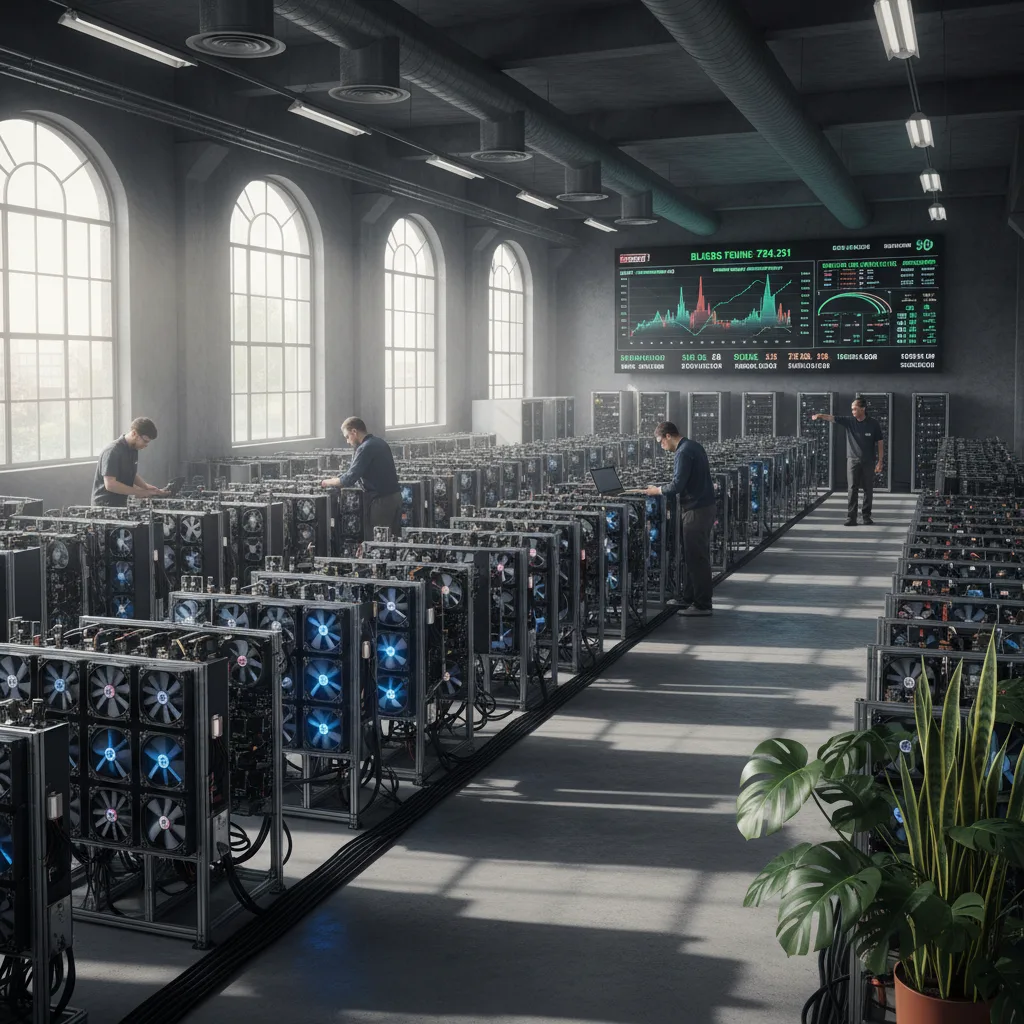
Bitcoin operates as a decentralized network with no central server deciding which transactions are valid. Instead, the network relies on rules and economic incentives to reach agreement. That’s where mining comes in.
In traditional finance, you trust a bank to update balances correctly. Bitcoin takes a different approach. It aims to be a trustless system, meaning participants don’t need to trust each other personally. They only need to trust the protocol and the incentives built around it.
Mining is part of Bitcoin’s consensus mechanism. It helps the network agree on a single transaction history. If two conflicting versions appear, the chain backed by the most accumulated work becomes the valid one. That makes cheating expensive and difficult. Not impossible, but painful enough that it rarely makes sense.
If blockchain still feels a bit abstract, this article on What Is Blockchain Explained for Beginners helps connect the pieces.
How Does Bitcoin Mining Work Step by Step?
Think of mining as a repeated cycle. Transactions wait to be confirmed, miners bundle them into a block, hardware performs massive numbers of calculations, and eventually one miner finds a valid result the network accepts.
Picture it as a kind of flowchart: transactions enter a waiting area, miners build a candidate block, machines run hash attempts nonstop, one winner finds a valid result, and the network checks everything before adding the block to the chain.
Miners aren’t solving math puzzles with creativity or insight. They’re performing a proof of work process by running repeated computations until one output meets the current network requirement. That output is called a cryptographic hash.
Pending transfers first sit in a queue called the mempool. Miners then select transactions from that queue, usually favoring those with higher fees, and assemble a candidate block. The hardware starts hashing that block data again and again, with tiny adjustments each time, until it finds a valid hash below the current target.
When a miner succeeds, the block gets broadcast to the network for verification. Other nodes check whether the transactions and the block itself follow Bitcoin’s rules. If everything holds up, the block is added to the blockchain.
Difficulty is a major part of this picture, because the network constantly adjusts how hard it is to find a valid block. If you want to go deeper on that, read Difficulty Adjustment Explained: What Every Miner Needs to Know.
Here’s how the whole sequence breaks down.
Step 1: Transactions Are Grouped Into a Block
Every time someone sends bitcoin, that payment joins a pool of pending transactions waiting for confirmation. They sit in the mempool until a miner picks them up.
Miners don’t choose transactions at random. They’re financially motivated, so transaction fees matter. If two transactions are equally valid, the one with the higher fee is more attractive. That’s just how the incentive works.
A block is basically a package of transaction data plus some extra metadata needed for the mining process. The exact contents affect the hash output, so miners build this package carefully.
Once the block is ready, the competition begins.
Step 2: Miners Compete to Solve a Hash Puzzle
This is the part most people picture. Miners take the block data and run it through Bitcoin’s hashing algorithm, trying to produce a hash that falls below the current target.
A hash is a fixed-length output created from input data. What makes it useful here is that even a tiny change to the input produces a completely different result. Miners keep adjusting a value called a nonce and hashing again. You can picture it as billions of dice rolls per second, all happening simultaneously across warehouses full of machines.
There’s no shortcut. No clever thinking gets you there faster. The only practical method is brute-force computation, trying enormous numbers of combinations as fast as possible. That’s why mining has become an industrial activity.
When one miner finally hits a valid result, the process shifts from competition to verification.
Step 3: The Winning Block Is Broadcast to the Network
After finding a valid hash, the miner broadcasts the block to the rest of the network. That doesn’t mean they automatically win. Other nodes still check everything.
They verify that the block follows the rules, that the transactions are valid, and that the proof of work is genuine. If the block passes, it gets accepted and added to the blockchain.
At that point, block reward distribution happens. The successful miner receives the block subsidy plus the transaction fees from that block. If two miners find competing blocks at nearly the same time, the network may briefly split, but it usually resolves quickly as the longer valid chain gains more work behind it.
The Role of Proof of Work in Bitcoin Mining
Proof of work is the security engine behind Bitcoin mining. It forces miners to spend real computational effort and real energy to participate in block creation.
That matters because it makes attacks genuinely costly. If someone wanted to rewrite Bitcoin’s history or fake ownership records, they’d need to outcompete the honest network in total computing power. That’s where proof of work security comes from: it ties digital consensus to physical resource costs.
So when people ask how bitcoin mining secures the blockchain, the answer is that mining makes fraud economically painful. You’re not just editing a database. You’d need enormous hardware capacity, sustained energy access, and coordination to overpower the network. For a system as large and mature as Bitcoin, that becomes extremely difficult.
It doesn’t make Bitcoin invincible, but it makes manipulation far harder than most newcomers assume.
What Hardware and Software Do Miners Use?
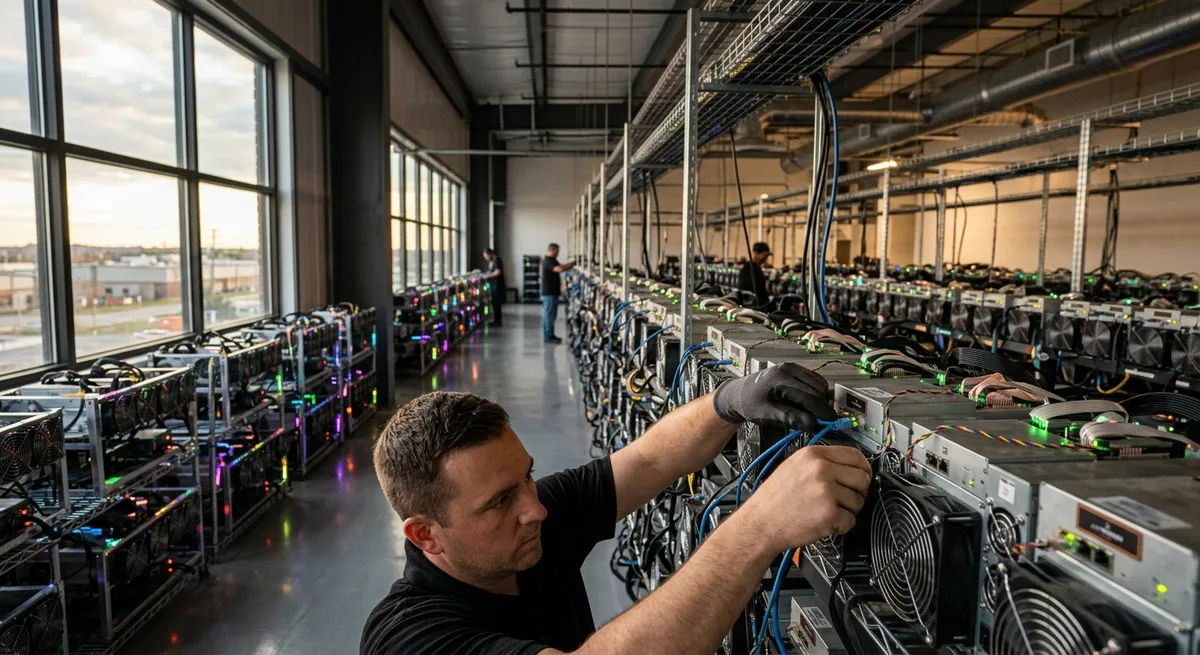
Modern Bitcoin mining is dominated by ASIC miner machines. ASIC stands for application-specific integrated circuit, meaning the hardware is built for one job: running Bitcoin hashes as efficiently as possible.
In Bitcoin’s early years, people used regular computers. Then CPU mining gave way to GPU mining, and eventually ASICs took over because they were dramatically faster and more efficient. Today, serious mining is almost entirely ASIC-based.
A typical setup includes the ASIC unit, a power supply, a cooling system, a stable internet connection, and proper ventilation. You also need mining software to connect the machine to the network or a pool, plus a bitcoin wallet so you have somewhere to receive payouts.
For a practical guide to the equipment side, Bitcoin Mining Setup Rigs covers the basics in more detail.
The main thing to understand as a beginner: mining is no longer something you casually run on a spare home computer and expect meaningful returns from.
Can You Mine Bitcoin With an Old Computer?
Technically yes. Practically, almost never in a way that makes sense.
When people ask how to mine bitcoin with old computer hardware, it helps to separate possibility from profitability. Old CPU or GPU setups can still run the software, but outdated hardware limitations are severe. Modern ASICs are vastly more powerful and efficient.
Your old machine is essentially competing against purpose-built industrial equipment. Even if it contributes some hash power, the output is tiny. Add electricity costs, heat, and wear on the hardware, and the economics fall apart quickly.
The same goes for mining on a laptop. You can try, but laptops aren’t designed for continuous high-load operation. They overheat, throttle performance, and degrade faster than you’d want.
If your goal is learning, an old computer can help you understand the concepts. If your goal is earning, it’s not a realistic path.
Solo Mining vs Pool Mining
There are two main ways to participate in mining.
With solo mining, you run your own operation and keep the full reward if you find a block. The upside is obvious. The problem is probability. Unless you control very large hash power, your chances of finding a block consistently are low. You could run machines for months without hitting one.
Pool mining works differently. Many miners combine their hash power and split rewards based on contribution. You give up the chance of keeping an entire block reward, but in return you get steadier, more predictable payouts.
For most smaller miners, pool mining is the more realistic option. If you want a beginner-focused breakdown, New to Mining? Here’s Your Complete Guide to Pool Mining for Beginners is worth reading.
The tradeoff is simple: rare large wins versus smaller regular payouts.
Who Should Consider Solo Mining?
Solo mining mainly makes sense for large operators, miners with very low electricity costs, or people experimenting for educational reasons. For small home setups, it’s usually not ideal.
The reason is variance. Even if your machines are working perfectly, you might go a very long time without finding a block. That makes cash flow unpredictable and frustrating, especially if you’re covering real operating costs every month.
For those who want to understand the process from the ground up, Step-by-Step Solo Mining Setup Guide: Start Earning Today provides a practical look.
What Affects Bitcoin Mining Difficulty?
Mining difficulty measures how hard it is to find a valid block hash. It exists to keep Bitcoin’s block production close to its intended pace, roughly one block every ten minutes.
If more miners join and hash rate rises, blocks would be found too quickly without an adjustment. So the network raises difficulty. If miners leave and total hash power drops, difficulty can fall. The system constantly adapts so the issuance schedule stays predictable.
That means even if your machine stays exactly the same, the environment around it changes. Some months you’re producing more than others, purely because of shifts in the broader network.
For a deeper breakdown, What Affects Bitcoin Mining Difficulty? explains the major drivers.
How Do Miners Earn Money From Bitcoin Mining?
Miners earn from two sources: the block subsidy and transaction fees. Together, these make up mining revenue.
The block subsidy is the newly issued bitcoin granted when a block is successfully mined. On top of that, miners collect the fees attached to the transactions in that block.
But revenue isn’t the same as profit. To understand how to earn money from bitcoin mining, you have to subtract real operating costs: electricity, hosting, cooling, repairs, and administration. Mining can look attractive on paper and disappoint in practice. That gap is where a lot of beginners get caught out.
For a more numbers-driven view, Bitcoin Mining Profitability is the right place to continue.
Why Profitability Changes So Much
Mining outcomes are highly sensitive to changing inputs. Bitcoin’s price is one factor, but far from the only one.
Electricity cost per kWh can make or break an operation. A miner with cheap power may stay profitable while another running the same machine loses money. Miner efficiency matters too, since newer models often deliver more hash power for less energy.
Then there’s maintenance, downtime, cooling, and rising competition. If network difficulty climbs, your machine earns a smaller share of total rewards unless your own capacity improves. That creates constant profit margin volatility that no calculator can fully predict.
A bitcoin mining profitability calculator helps, but it’s only a snapshot. It can’t guarantee future returns.
How Bitcoin Halving Changes Mining Economics
The bitcoin halving is a programmed event that cuts the block subsidy in half. It happens roughly every four years and reduces the rate of new bitcoin issuance.
For miners, this is a significant economic shift. Operations that were barely viable before a halving can become unprofitable after it. Efficient miners with lower costs are better positioned to survive. Weaker operators often shut down.
Over time, this increases the importance of transaction fees. The network is designed so that new issuance declines gradually, which means miners have to adapt to a changing reward structure.
If you want the full background, Bitcoin Halving Explained: Why It Matters walks through it clearly.
Environmental Impact and Energy Use
Bitcoin mining energy use is high because proof of work is designed around real resource expenditure. That energy consumption isn’t an accidental side effect. It’s part of the security model.
This is where the carbon footprint debate begins. Critics focus on total consumption and emissions. Supporters argue the conversation should also include energy source mix, use of stranded or curtailed energy, grid balancing, and efficiency improvements over time.
The truth is more nuanced than either extreme. Mining does consume significant power. But not all energy is equal. A machine powered by curtailed hydro or excess natural gas has a different environmental profile from one running on high-carbon grid electricity.
It’s worth looking at this topic carefully rather than reacting emotionally in either direction. Bitcoin Mining Energy & Environmental Impact offers a balanced view of the tradeoffs.
Common Challenges New Miners Underestimate
New miners often focus on rewards and underestimate the operational side. That’s usually where the surprises come in.
Noise is a real one. ASIC miners are loud. Not mildly annoying loud. Industrial machine loud. If you’re planning to run one at home, your housemates will have opinions about it.
Heat is another issue. Mining hardware throws off substantial heat, and cooling requirements matter more than many people expect. Then there’s upfront cost, repair risk, payout variability, internet stability, and local regulation. Tax implications of mining earnings can also get complicated depending on where you live.
This is why learning how to start bitcoin mining should involve more than buying a machine. You need a realistic view of cost, risk, and ongoing management before you commit.
Is Bitcoin Mining Still Worth Learning About?
Yes, genuinely.
Even if you never plan to run a miner, understanding mining helps you understand Bitcoin itself. It gives you real insight into network economics, miner incentives, issuance, security, and why the system works the way it does.
For investors, this knowledge helps when evaluating network strength and long-term sustainability. For students and researchers, it connects game theory, economics, and distributed systems. For beginners, it builds a solid foundation that makes the rest of the Bitcoin ecosystem easier to follow.
So if you’re wondering how to get into bitcoin mining or how to learn about it, you don’t need to start by buying equipment. Start by understanding the process, the tradeoffs, and the incentives. That foundation is more valuable than rushing into hardware.
Conclusion
How does bitcoin mining work? Miners collect pending transactions, package them into blocks, and use specialized hardware to perform proof of work until one finds a valid hash. The network then verifies that block, adds it to the blockchain, and rewards the miner with newly issued bitcoin and fees.
That’s the core of it. Mining secures Bitcoin, validates transactions, and distributes new coins according to fixed rules. It also comes with real tradeoffs: high competition, changing profitability, energy use, and operational complexity that beginners often don’t see coming.
If you want to keep learning, the smartest next step is to go one level deeper into whatever matters most to you, whether that’s setup, profitability, or broader blockchain basics.