

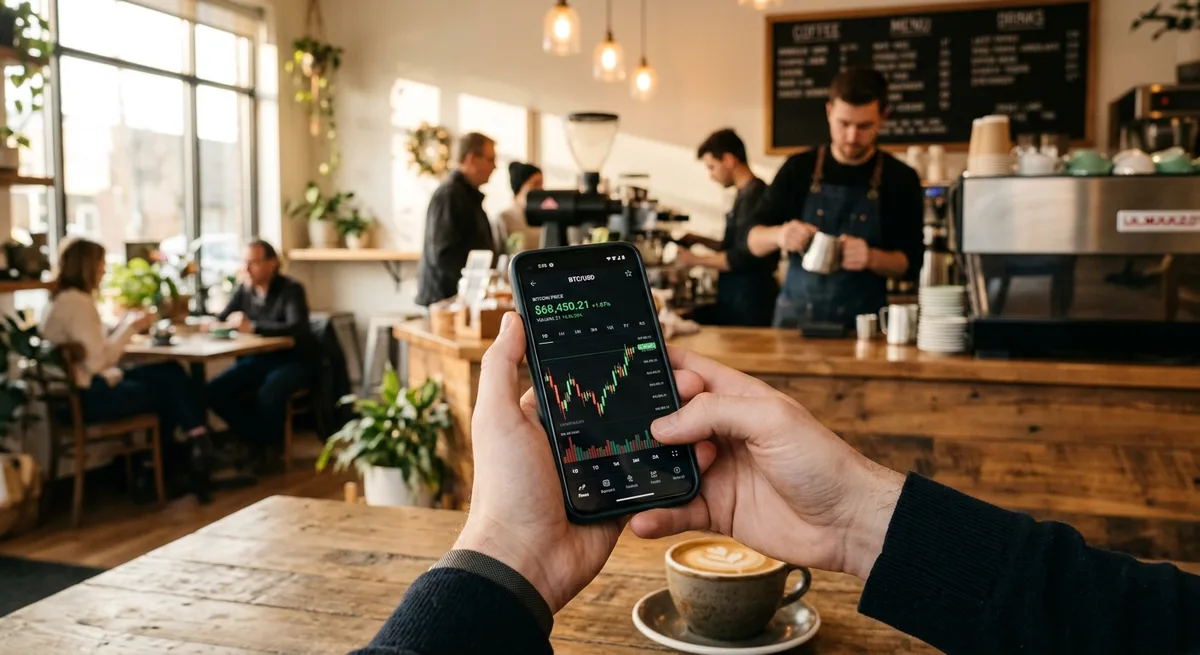
Current Bitcoin Price and Value
What Is Bitcoin Price?
If you’re asking what is bitcoin price, the short answer is simple: it’s the amount buyers and sellers are currently agreeing on in the market. Right now. Not yesterday, not a fixed number somewhere in a database.
Bitcoin trades 24 hours a day, 7 days a week, so the price can shift within seconds. That means what’s the latest price of bitcoin depends entirely on the moment you check and the platform you’re using.
A straightforward way to think about it:
Bitcoin price = the current market value of 1 BTC at this exact moment
So when someone asks what is value of bitcoin today, they’re usually after the live market price, most often shown in US dollars.
If you want a quick live overview before going deeper, check the latest market updates here: Bitcoin today latest updates.
That gives you the immediate number. But understanding what the price of 1 Bitcoin actually means in USD is the more useful next step.
What Is the Price of 1 Bitcoin Right Now in USD?

When people ask what is 1 bitcoin current value in usd, they’re usually talking about the spot price. That’s the current trading price of one Bitcoin on the open market, plain and simple.
In practical terms, what is the price of 1 bitcoin means: how many US dollars it takes to buy 1 BTC right now.
You’ll also hear it phrased as:
- what is the price of one bitcoin in dollars
- what is the value of 1 bitcoin
- what is a bitcoin worth in usd
All the same question, really. They’re all asking for the current exchange rate between Bitcoin and the US dollar.
One thing worth knowing: the price is rarely identical everywhere. One exchange may show a slightly different number than another at the exact same moment. That happens because of differences in trading activity, liquidity, platform fees, and the timing of price refreshes. For casual price checking, the gap is usually small. For active traders, it can matter more.
If you want a clearer view of how Bitcoin translates into dollars, this guide helps: Bitcoin to USD conversion.
Once you know what one Bitcoin is worth in USD, the next real question is where to check that number reliably.
Where to Check Bitcoin Price Reliably
If you want to know where to check bitcoin price without getting buried in noise, stick to sources that offer live data, broad market coverage, and clear charts. Not all price trackers are equal, and some are more promotional dashboard than actual tool.
A reliable Bitcoin price source should show:
- Real-time or near real-time updates
- Trading volume
- Price data from multiple exchanges
- A chart with different timeframes
- Open, high, low, and recent movement
- Fast refresh frequency
This matters because when people ask what are the price of bitcoin or what’s bitcoin’s value, they want a clean, trustworthy answer. Not a delayed number or a site that doesn’t explain where its data comes from.
A good platform should let you do three things quickly: see the current Bitcoin price today in USD, compare short-term movement, and convert BTC into your preferred currency or amount. If the site hides the chart or refreshes slowly, it’s not the right tool.
For a simple and practical option, use this Bitcoin to USD converter. It’s useful when you want fast value checks without jumping between multiple platforms.
Once you know where to look, it becomes much easier to understand why the number keeps moving in the first place.
Why Bitcoin Price Changes Every Second
Bitcoin’s price changes because buyers and sellers are constantly placing orders around the world. There’s no central authority setting one official number. The market decides it in real time, continuously.
So if you ask what is bitcoin’s value or what is value of bitcoin, the most accurate answer is: whatever the market is willing to pay at that moment.
Here are the main forces behind price changes:
Supply and demand If more people want to buy Bitcoin than sell it, the price rises. If selling outweighs buying, it falls. That basic dynamic never stops.
Order books Exchanges show buy and sell orders at different prices. When large orders get filled, the market price moves.
Trading volume Higher volume often means stronger price discovery. Low volume can make the market more reactive to sudden moves.
Market sentiment News, fear, optimism, ETF headlines, regulation, macro events. Any of these can shift demand fast. Sometimes surprisingly fast.
Global nonstop trading Bitcoin never closes. Unlike stock markets, it trades all day and night, which means price can react immediately to events anywhere in the world. There’s no waiting for the opening bell.
If you want a more detailed breakdown of the mechanics, this guide explains it well: How Bitcoin price is determined.
The Role of Liquidity in Bitcoin Price
Liquidity affects how easily Bitcoin can be bought or sold without causing a big price swing. This matters if you’re wondering what is the cash value of bitcoin on a specific platform. The number on screen is one thing. The price you actually get when placing an order can be slightly different.
High liquidity generally means tighter spreads between buy and sell prices, less slippage on larger orders, and more stable pricing overall. Low liquidity tends to mean wider spreads, more slippage, and bigger differences between platforms. That’s why two exchanges can show slightly different Bitcoin prices at the same time. One may have deeper order books and more active traders than the other.
If you want to understand this more clearly, read: Bitcoin liquidity explained and why it matters for price.
Why Market Cap Matters for Price Context
Market cap is calculated by multiplying Bitcoin’s current price by the total amount of Bitcoin in circulation. It gives you a sense of Bitcoin’s overall size in the market, not just what is the dollar value of bitcoin at a single moment.
A higher market cap generally suggests a larger, more established asset. But market cap doesn’t directly set the trading price. It’s context, not a price-setting mechanism.
If you want a simple explanation of how this works, see: Bitcoin market cap explained.
Bitcoin Price Today vs Open and Close
The live price alone doesn’t tell the full short-term story. It helps to compare it with where Bitcoin opened and where it closed on a given timeframe. Imagine you check the price and it looks high, but without knowing the open, you have no idea if you’re looking at a recovery or a continuation.
That’s where questions like what price did bitcoin open up at, what price did bitcoin close at today, and what is the value of a bitcoin now become useful.
Here’s the basic idea:
Open price The price at the start of the selected period, typically the start of the day on a daily chart.
Current price The live market value right now.
Close price The final price at the end of the selected period.
Why this matters: if the current price is above the open, short-term momentum may be positive. If it’s below, there may be selling pressure. If Bitcoin closes near the daily high, buyers likely stayed in control. Near the daily low, sellers probably had the upper hand.
For traders, these figures help identify direction and intraday strength. For regular investors, they offer quick context without needing deep technical analysis.
If you want to compare live price against earlier market levels, this resource helps: Bitcoin price history and growth.
What Is the Average Bitcoin Price and What Does It Tell You?
When someone asks what is the average bitcoin price, they’re not asking for the latest trade. They’re asking for a smoothed view over time. That’s different from asking what is bitcoin worth in usd right now.
The current price tells you what the market is paying this second. The average price tells you what Bitcoin has traded around over a selected period, such as the last 7 days, the last 30 days, the last 200 days, or a full calendar year.
Raw price movement is noisy. Average values can show trend direction more clearly, which is why a lot of traders use them as reference points rather than staring at the live ticker all day.
Two common ways to think about average price:
Time-based average A simple average of prices over a chosen period.
Moving average A rolling average that updates continuously and is often plotted on charts.
Average price is useful for filtering out short-term volatility, checking whether Bitcoin is trading above or below trend, and adding more context than a single snapshot can give you. The downside is that it can lag behind fast market moves and won’t tell you what price you can actually buy or sell at right now. So it’s a tool for context, not for immediate execution.
If you want a broader perspective on how current price compares with longer-term outlook, read: Bitcoin value outlook.
Bitcoin Value in Other Amounts and Currencies
A lot of people aren’t just checking the price of 1 BTC. They’re trying to understand portfolio value, position size, or what things look like in their local currency.
For example, if you ask what is the value of 5000 bitcoin, the structure is straightforward:
5000 BTC × current Bitcoin price = total value
So if Bitcoin is trading at 60,000 USD, then 5000 BTC is worth 300 million USD. The total moves directly with the current market price.
This also answers questions like what is value of bitcoin in us dollars or what’s the price of a bitcoin in us dollars. They’re all asking for the same thing: Bitcoin’s current USD exchange value.
For readers outside the US, local currency matters more. If you’re asking what is value of bitcoin in indian rupees, the process is similar. You take the live BTC price in USD and convert it using the current USD to INR rate, or use a platform that offers direct BTC to INR pricing.
Bitcoin value can look different depending on your local currency, current exchange rates, the platform you use, and any local market premiums or discounts. That’s why regional price checks can be genuinely useful for people managing capital across markets.
If you’re also thinking about timing beyond just current value, this adds useful context: Bitcoin price forecast and buy timing.
What Moves Bitcoin Price in the Short Term?
If you’ve been checking what is the value of bitcoin in us dollars multiple times a day, you’ve probably noticed how quickly it can move. Short-term price action tends to be driven by a fairly consistent set of factors.
Macro news Interest rate expectations, inflation data, recession fears, central bank comments. These move risk assets broadly, and Bitcoin is no exception.
ETF flows Large inflows into spot Bitcoin products can push demand up. Large outflows can do the opposite, sometimes sharply.
Regulation A major government announcement or legal development can shift sentiment fast. Good news or bad, the market reacts.
Whale activity Large holders can influence short-term price through visible on-chain transfers, exchange deposits, or heavy buying and selling. When a big wallet moves, people notice.
Leverage and liquidations Crypto markets often involve leverage. When price moves sharply, forced liquidations can amplify the move further. This is why short-term swings can feel exaggerated.
Sentiment shifts Sometimes price moves simply because participants collectively become more optimistic or defensive, even before any hard data confirms the direction.
The key is not to treat every short-term move as meaningful. Bitcoin is volatile, and not every candle tells a story worth acting on.
For a broader framework on how to think about value beyond today’s movement, revisit Bitcoin value outlook.
FAQ About Bitcoin Price
Here are quick answers to common questions about Bitcoin price, valuation, and tracking.
If you’re trying to understand what is the cash value of a bitcoin, the most practical answer is this: it’s the amount you could currently sell 1 BTC for on a live market, minus any fees and possible slippage. The displayed price and the price you actually execute at are not always identical. That distinction matters more than most beginners expect.
Is Bitcoin Price the Same on Every Exchange?
No, and small differences are completely normal.
Each exchange has its own order book, trading activity, liquidity, and participant flow. That means one platform may show a slightly higher or lower Bitcoin price than another at the same moment. For most users the gap is small. For larger trades, it matters more.
Why Does Bitcoin Price Change So Fast?
Bitcoin trades globally all day, every day.
There’s no market close, no opening bell, and no pause when news breaks. Buyers and sellers react immediately, and price adjusts in real time. That’s why Bitcoin can move within seconds. You go make a coffee, come back, and the number has shifted. That’s just how it works.
Can I Check Bitcoin Price in My Local Currency?
Yes.
Most major platforms let you view Bitcoin in USD, INR, EUR, GBP, and many other currencies. If direct local currency pricing isn’t available, the platform may still show a converted value based on the latest exchange rate.
Conclusion
If you came here asking what is bitcoin price, the clearest answer is that it’s a live market value that changes constantly based on buying, selling, liquidity, sentiment, and broader market conditions. No single number should ever be viewed in isolation.
To make sense of Bitcoin price, it helps to use reliable live sources, compare the current price with open and close levels, understand average price over time, and know how value shifts across currencies and position sizes.
A live Bitcoin quote is useful, but context is what turns that quote into something you can actually act on. Check the latest number, understand why it may differ across platforms, and avoid making decisions based on one snapshot alone.
Whether you’re checking the current value of Bitcoin in dollars, comparing today’s price in USD, or just trying to understand what one Bitcoin is worth right now, working from a fuller picture always beats reacting to a single data point.