

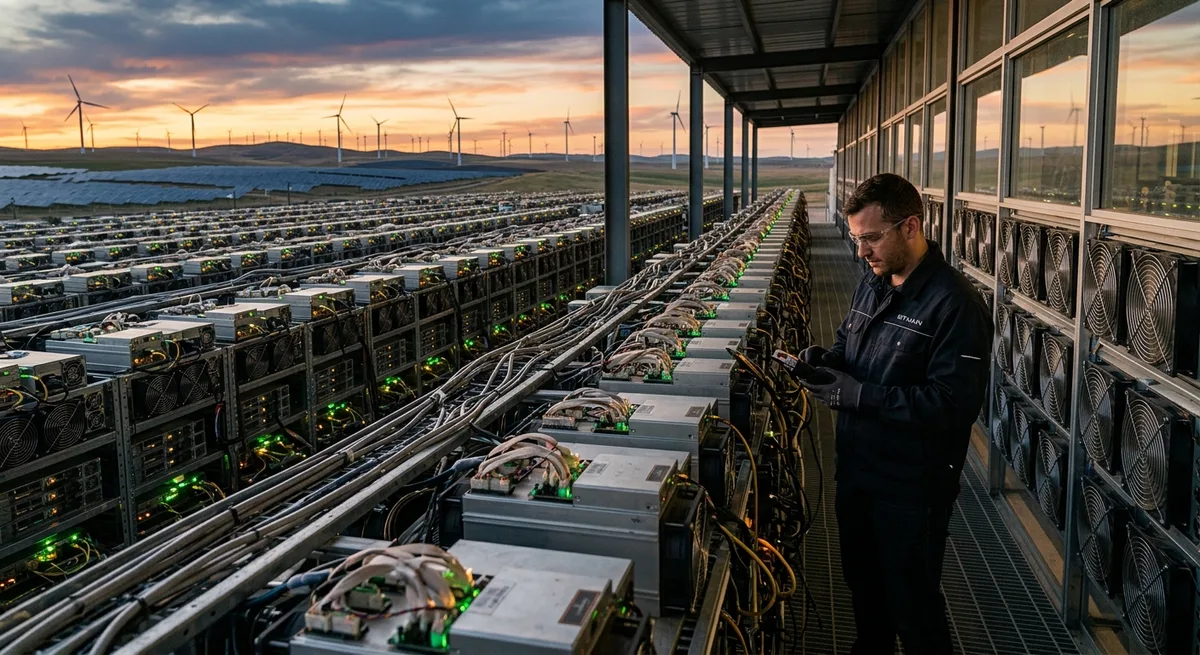
Bitcoin Mining Energy and Environmental Impact
H1: Why Does Bitcoin Mining Use Electricity?
Short answer: miners run powerful machines around the clock to secure the Bitcoin network, verify transactions, and compete for the right to add the next block to the blockchain.
That competition is not passive. It requires real computing work, and computing work requires power. The more miners compete, the more electricity the network can consume overall. That’s also why bitcoin mining keeps drawing attention from investors, regulators, and anyone with half an eye on energy headlines.
But the one-line answer only gets you so far. To actually understand the energy debate, you need to know what mining does, why it’s designed this way, and how electricity use connects to environmental impact. That’s what this article gets into.
H2: What Bitcoin Mining Actually Does
Bitcoin mining is often misunderstood as just a way to create new coins. That’s not quite right.
Mining is the process that keeps Bitcoin functioning without a central authority. Miners collect pending transactions, organize them into blocks, and compete to add those blocks to the blockchain. Successful miners receive newly issued bitcoin plus transaction fees.
This gives Bitcoin something essential: a way to agree on the state of the ledger without needing a bank, payment company, or government database to settle disputes. Instead of trusting one institution, the network relies on rules, code, and distributed participants.
That’s why mining matters. It’s not just about rewards. It’s about maintaining a decentralized system that can verify ownership and transfer value globally. To understand why electricity becomes essential, it helps to look at what miners are actually doing under the hood.
H3: Mining Confirms Transactions and Secures the Network
When you send bitcoin, your transaction doesn’t become final instantly. It first enters a pool of unconfirmed transactions. Miners select batches of those transactions and attempt to package them into a valid block.
Once a block is accepted by the network, those transactions gain confirmation. With each additional block added afterward, reversing them becomes harder. This is what prevents double spending, where someone tries to use the same bitcoin twice.
In simple terms, miners do the work that keeps the ledger honest. They make fraud expensive and difficult. That security model is one of the biggest differences between Bitcoin and systems that rely on trusted intermediaries. For a clearer overview of how this compares with other approaches, this guide on proof of work vs proof of stake is worth reading.
Once you understand that miners secure the ledger through active competition, the next question becomes obvious: why does that competition need so much power?
H3: Why Competition Between Miners Matters
Bitcoin mining is a race. Thousands of miners around the world are all chasing the same opportunity to add the next block. Only one wins each round. Everyone else still spent energy trying.
That’s one of the core reasons electricity demand stays high. The system isn’t designed around one computer checking transactions occasionally. It’s designed around constant, global competition.
This also scales with incentives. When Bitcoin’s price rises, mining can become more profitable. More participants join, more machines come online, hashrate increases, and total power use can climb further. If you want a closer look at how rising difficulty affects the economics, this breakdown of the energy cost of mining difficulty adds useful context.
That brings us to the core of the issue: the technical and economic reasons Bitcoin mining uses so much electricity.
H2: Why Bitcoin Mining Uses So Much Electricity
Bitcoin uses a system called proof of work. Under this model, miners must repeatedly perform computational work to compete for block rewards. The work is intentionally difficult. That’s what makes attacking the network costly and what helps keep Bitcoin decentralized.
Electricity use comes from several connected factors: machines run nonstop, they perform enormous numbers of calculations, mining hardware is optimized for speed and output, and difficulty adjusts as competition changes. Because miners have financial incentives, they keep pushing toward more efficient and larger scale operations.
So the energy consumption of bitcoin mining is not accidental. It’s built into the economics and security model of proof of work. Here are the biggest drivers behind it.
H3: Proof-of-Work Requires Constant Computing
Proof of work depends on repeated attempts to solve a difficult puzzle. Miners generate massive numbers of guesses every second, looking for one result that meets the network’s required target.
Think of it less like solving a math problem and more like a machine trying combinations at extremely high speed until one valid answer appears. That repeated guessing process is called hashing, and it’s what makes bitcoin mining electricity usage so significant in practice: more guesses require more computation, and more computation requires more power.
There’s no shortcut. Miners can’t simply think harder and use less energy. Their advantage mostly comes from running better hardware and accessing cheaper electricity. This also feeds into a wider debate about blockchain design, which this article on which consensus mechanism will shape the future covers in some depth.
That technical foundation leads directly to the hardware side of the story.
H3: Specialized Mining Hardware Is Built for Performance, Not Low Energy Use
Bitcoin is no longer mined efficiently on laptops or home desktops. Most serious mining uses ASICs, application specific integrated circuits. These machines are built for one task: performing Bitcoin hashes as fast and efficiently as possible.
They are more efficient than older hardware on a per unit basis, but they still consume significant electricity. And when thousands of these machines operate together in mining farms, total demand becomes substantial.
Here’s the part people often miss. Better hardware efficiency doesn’t automatically mean lower overall network power use. If mining stays profitable, operators tend to deploy more machines. That can offset efficiency gains at the network level entirely.
The electricity costs involved also shape where miners choose to operate. Access to cheap power can be the difference between profit and loss, which is why this guide on the best electricity sources for crypto mining is worth a look if you’re thinking about the real world side of operations.
H3: Mining Difficulty Adjusts as More Miners Join
Bitcoin aims to produce a new block roughly every ten minutes. To maintain that pace, the network automatically adjusts mining difficulty.
If more miners join and total computing power rises, difficulty increases. Finding a valid block becomes harder. If miners leave and hashrate drops, difficulty decreases.
This mechanism is essential for Bitcoin’s stability, but it also ties profitability and energy use together tightly. When price rises or operating conditions improve, more miners may enter. Competition increases, difficulty rises, and more total computational work may be required across the system.
That’s one reason bitcoin mining power consumption statistics shift over time. Electricity use is not fixed. It responds to incentives, hardware efficiency, regulations, and market conditions.
At this point, the technical picture is fairly clear. The harder question is whether that energy use should be seen as waste or as a legitimate cost of security.
H2: Is Bitcoin Mining Inherently Wasteful or a Tradeoff for Security?
This is the central debate.
Critics look at Bitcoin’s electricity demand and see an inefficient system consuming scarce resources. Supporters look at the same energy use and see the cost of maintaining a censorship resistant monetary network that no single institution controls.
Both views have logic behind them. Skip either side and you usually end up with a shallow opinion.
The real question is not only how much energy Bitcoin uses. It’s what that energy achieves, what kind of energy is being used, and whether the outcome justifies the cost.
H3: The Case Against Bitcoin’s Energy Use
The criticism starts with scale. Bitcoin mining can consume large amounts of electricity, and when that power comes from fossil fuels, emissions can be significant. That drives much of the concern around bitcoin mining and carbon footprint, the negative environmental impact, and how mining affects climate change.
This is why people ask why bitcoin is bad for the environment. They are not only asking about power bills. They are asking whether the network’s benefits justify the environmental effects, especially in a world already dealing with serious energy constraints.
Critics also point to local problems. Mining can add demand to stressed grids, raise concerns in regions with limited power supply, and generate electronic waste as older machines become obsolete. For a focused look at this side of the debate, this article on the environmental impact of Bitcoin mining adds more detail.
H3: The Case Supporters Make for Bitcoin Mining
Supporters argue that Bitcoin’s energy use buys something valuable: security without centralized control.
In their view, proof of work makes attacks expensive, protects the ledger from manipulation, and supports a monetary system that can operate outside the direct control of banks and governments. Electricity, in this framing, is not pointless waste. It’s the physical cost of maintaining an independent network.
Some also argue that comparing Bitcoin to ordinary digital payments misses the point. Bitcoin is not just a payment rail. It is also a settlement system, a store of value for some users, and a political alternative to systems that can censor transactions or inflate supply.
You don’t have to agree with that conclusion to understand the logic. And once you do, the debate naturally shifts from abstract energy figures to the more practical question of actual environmental outcomes.
H2: The Environmental Impact of Bitcoin Mining
Electricity use alone doesn’t tell you the full environmental story.
A megawatt hour generated from coal has a very different impact than one from hydro or wind. So when people discuss the impact of bitcoin mining on global power grids or the environmental effects of cryptocurrency mining, the key variable is not just how much power is used, but where that power comes from.
Two mining operations with similar energy demand can have very different emissions profiles. That’s why environmental analysis has to move beyond raw consumption figures and into energy mix, regional infrastructure, and local constraints.
H3: Why Energy Source Matters More Than Energy Use Alone
If a mining operation runs on coal heavy electricity, its emissions can be high. If it runs on hydro, wind, solar, or curtailed energy that would have gone unused anyway, the footprint can be considerably lower.
That doesn’t make mining automatically clean. It simply means the source matters just as much as the quantity. The same logic applies in other industries too. Power use and emissions are related, but they’re not the same thing.
This distinction is essential if you want to understand bitcoin mining energy efficiency and renewable energy in cryptocurrency mining without falling for simplistic claims on either side. For a closer look at how energy source affects real emissions, this guide on crypto mining emissions is a useful read.
H3: Common Environmental Concerns Beyond Carbon
Carbon emissions get most of the attention, but they’re not the whole picture.
Mining creates electronic waste because specialized hardware loses competitiveness over time. Imagine a warehouse full of machines that were cutting edge eighteen months ago and are now barely breaking even. It also contributes to local grid pressure when operators cluster in areas with limited supply, and in some places it raises land use and infrastructure concerns, especially when facilities expand quickly.
Public backlash often appears when communities feel industrial mining is competing with households for electricity. That’s one reason mining becomes politically sensitive in energy constrained regions. This article on crypto’s environmental impact covers the wider picture if you want a broader overview.
H2: How Much Electricity Bitcoin Mining Uses in Practice
There is no single fixed number for Bitcoin’s power use.
Usage changes over time based on Bitcoin’s market price, mining profitability, hardware efficiency, regulation, and access to cheap electricity. That’s why bitcoin mining power consumption statistics vary from one period to the next.
Dramatic comparisons appear regularly in headlines, but those should be handled carefully. Some are reasonable estimates. Others rely on assumptions that are outdated or incomplete. The better approach is to understand why estimates differ and what they are actually measuring.
H3: Why Published Estimates Often Differ
Different studies use different assumptions about miner hardware, operating efficiency, geographic distribution, and energy sources. Some estimate from network hashrate and hardware models. Others infer power use from economic behavior, electricity costs, or regional data.
Those assumptions matter a lot. If one study assumes miners mostly use older hardware and another assumes widespread use of newer ASICs, the numbers can diverge sharply. The same goes for location. A mining fleet concentrated in one region may face a very different energy mix than a globally distributed estimate.
Treat any single estimate as a snapshot rather than a settled fact. If you want a more grounded way to think about the numbers, this article on mining energy consumption stats is a helpful reference.
H3: A Useful Comparison: Bitcoin vs Other Systems
Comparing Bitcoin with other systems can be useful, but only if the comparison is fair.
Bitcoin uses proof of work, which is intentionally energy intensive. Many newer blockchains use proof of stake, which generally requires far less electricity because validators are not competing through nonstop computational work.
Traditional finance also uses energy, but in a different way. Banks, payment processors, data centers, offices, ATMs, card networks, and settlement systems all consume power. The challenge is that they perform different functions, operate under different trust models, and are harder to compare directly to a single decentralized network.
The honest takeaway is not that Bitcoin is obviously better or worse in every comparison. It’s that Bitcoin has a distinct energy model, and whether that model is worth it depends on what role you think the network should play.
H2: Why Did China Ban Bitcoin Mining?
There was not one single reason. It was a mix of energy policy, financial control, and political priorities.
China had once hosted a large share of global mining because certain regions offered cheap electricity, including seasonal hydro power. But over time, the government became less tolerant of the industry. Officials raised concerns about energy intensity, financial risk, unauthorized capital movement, and broader control over economic activity.
The ban also tied into national priorities around stricter emissions goals, tighter oversight of financial flows, and stronger control over industries that operated outside preferred channels. Bitcoin mining sat at the intersection of all three. It wasn’t just about climate. It was also about governance, capital controls, and reducing activities the state viewed as difficult to supervise. This wider regulatory angle is explored further in the real impact of new regulations.
H3: What Changed After the Ban
Mining did not disappear. It moved.
After China’s crackdown, activity relocated to countries such as the United States, Kazakhstan, Russia, and other jurisdictions with available power and more welcoming conditions. Bitcoin’s hashrate initially dropped, then recovered as miners reestablished operations elsewhere.
This migration changed the global mining map. It also changed the energy mix behind the network, though not in one simple direction. Some relocated mining gained access to cleaner energy sources. Other operations moved into regions with less favorable power profiles.
That shift matters because it shows how regulation affects geography more than it affects Bitcoin’s existence. Mining adapts. It seeks new jurisdictions, new energy markets, and new cost structures. Which leads to the practical question many readers care about most: can mining become more sustainable?
H2: Can Bitcoin Mining Become More Sustainable?
Bitcoin mining is unlikely to become energy free under proof of work. That’s not a realistic expectation.
But it can become more sustainable in relative terms through better energy sourcing, smarter location choices, improved hardware efficiency, and market incentives that reward lower cost and lower emission setups. There is no magic fix, only tradeoffs and incremental improvements.
Some miners already pursue cheaper surplus power, operate in regions with stronger renewable capacity, or design flexible operations that can curtail usage when grid demand spikes. Others mainly use sustainability as a marketing label without much substance behind it.
The important question is not whether greener mining is theoretically possible. It’s under what conditions it is economically and operationally credible.
H3: Renewable Energy and Flexible Load Mining
Some mining operations are built around excess or stranded energy. That can include seasonal hydro surplus, remote natural gas that would otherwise be flared, or grid periods where supply exceeds demand and prices drop low.
Mining’s flexibility can actually be useful here. Unlike a factory that needs steady operation, some miners can curtail power quickly when grid demand rises and resume when excess supply returns. In certain markets, that flexible load approach can support grid balancing rather than strain it.
Still, it would be misleading to assume all mining works this way. Many operations simply seek the cheapest electricity available, regardless of source. If you want to understand one renewable path in more depth, this article on hydroelectric mining shows both the benefits and the tradeoffs honestly.
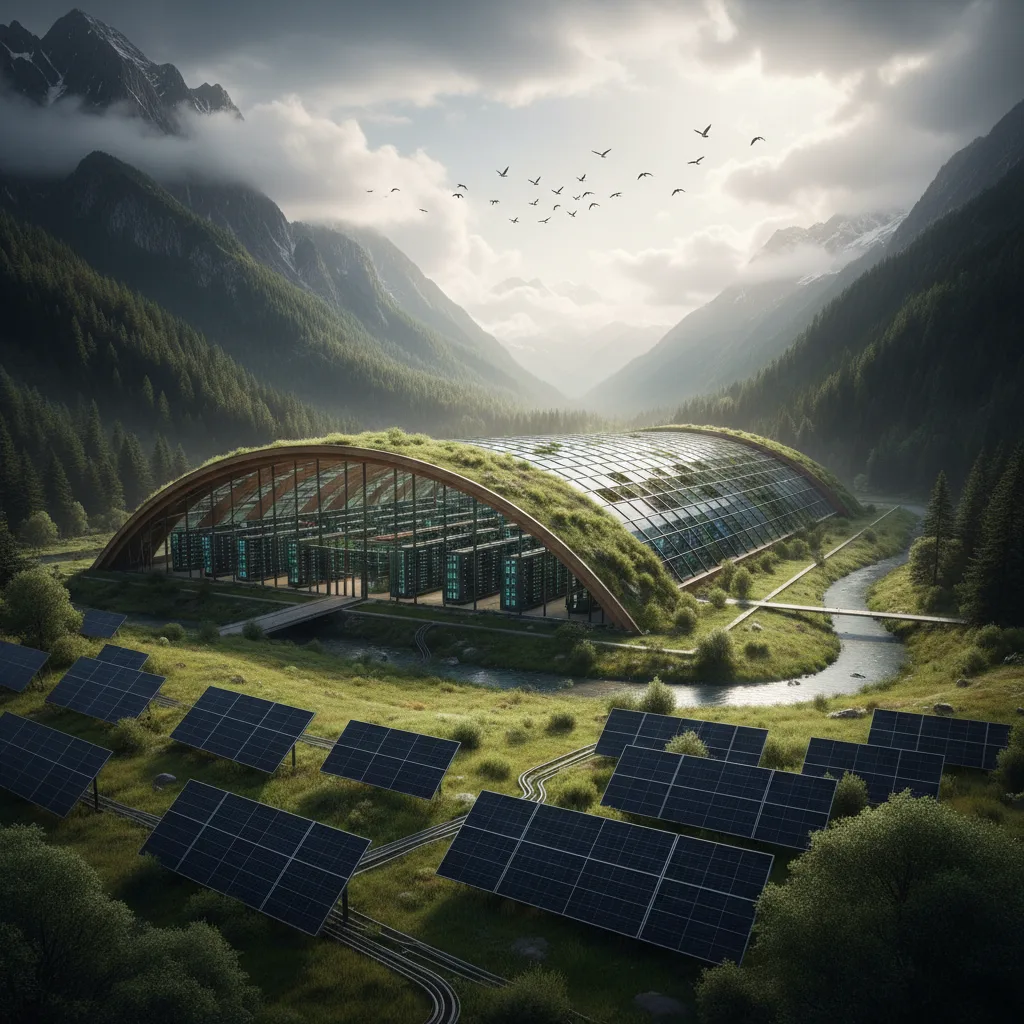
H3: Solar, Hydro, and Other Lower-Emission Setups
Lower emission mining often centers on solar, hydro, wind, or mixed energy strategies. In theory, these reduce the carbon footprint tied to bitcoin mining. In practice, each comes with real tradeoffs.
Solar can work well in areas with strong sunlight and supportive economics, but intermittency is a genuine constraint. Hydro can offer stable low emission power, but location matters and capacity is limited. Wind can be attractive, yet it depends on transmission access and local grid design.
Sustainable alternatives to conventional bitcoin mining energy are not just technical ideas. They are location dependent business models. The phrase green mining only means something if the power source, uptime, and economics actually support it. If you want a hands on example, this guide on setting up a solar powered crypto mining operation is a practical resource.
H3: The Profitability Question Behind Sustainable Mining
Mining is a business with tight margins. If a cleaner setup cannot compete on cost, scale, or reliability, it is unlikely to dominate just because it sounds appealing.
That is why incentives matter more than branding. Sustainable mining grows when it aligns with lower electricity prices, favorable regulations, efficient hardware, and stable operations. It struggles when cleaner energy is too expensive, too intermittent, or too difficult to access at scale.
Good intentions don’t beat bad economics. If you want a more direct look at the numbers behind cleaner models, this piece on whether green mining can be profitable is worth your time.
H2: How to Think About Bitcoin Mining Energy Use as an Investor or Curious Reader
If you are trying to make sense of Bitcoin mining, avoid two easy mistakes.
The first is assuming that all criticism is anti crypto bias. The second is assuming that all defense of mining is industry spin. Both happen. Neither helps you think clearly.
A better approach is to separate three questions. How much energy does Bitcoin use? What kind of energy powers it? And do you believe the security and independence of the network justify that cost?
That framework helps beginners, investors, and skeptical readers stay grounded. It also makes it easier to avoid headline driven reactions. If you want a balanced perspective before forming a view, this article on addressing the environmental concerns of crypto mining is a useful complement.
H3: Questions Worth Asking Before Forming a Strong Opinion
Start with the basics.
Where is mining happening right now, not two years ago? What energy mix is actually involved? Are the numbers based on current hardware or outdated assumptions? Is the analysis focused on electricity use, carbon emissions, or both?
Also ask what is being compared. Are you comparing Bitcoin to another blockchain, to banking infrastructure, or to an idealized system that doesn’t exist in practice? Those distinctions matter more than most headlines suggest.
Most of all, be careful with absolute claims. Bitcoin mining is neither harmless nor uniquely easy to condemn. It is an energy intensive security system with real tradeoffs, and understanding those tradeoffs is more useful than repeating slogans in either direction.
H2: Conclusion
So, why does bitcoin mining use electricity?
Because Bitcoin’s proof of work system depends on nonstop computational competition. Miners run specialized hardware continuously to validate transactions, secure the network, and compete to add new blocks. That is the direct reason why bitcoin mining consumes power at the scale it does.
The bigger debate is whether that energy cost is justified. Critics see high electricity demand, emissions, and local environmental pressure. Supporters see the cost of maintaining a decentralized system that does not depend on centralized trust.
The most balanced view is this: Bitcoin’s environmental impact is not defined by electricity use alone. It depends heavily on energy source, mining location, regulation, hardware efficiency, and how the industry evolves over time. If you want to understand Bitcoin seriously, that nuance matters more than any dramatic headline.