

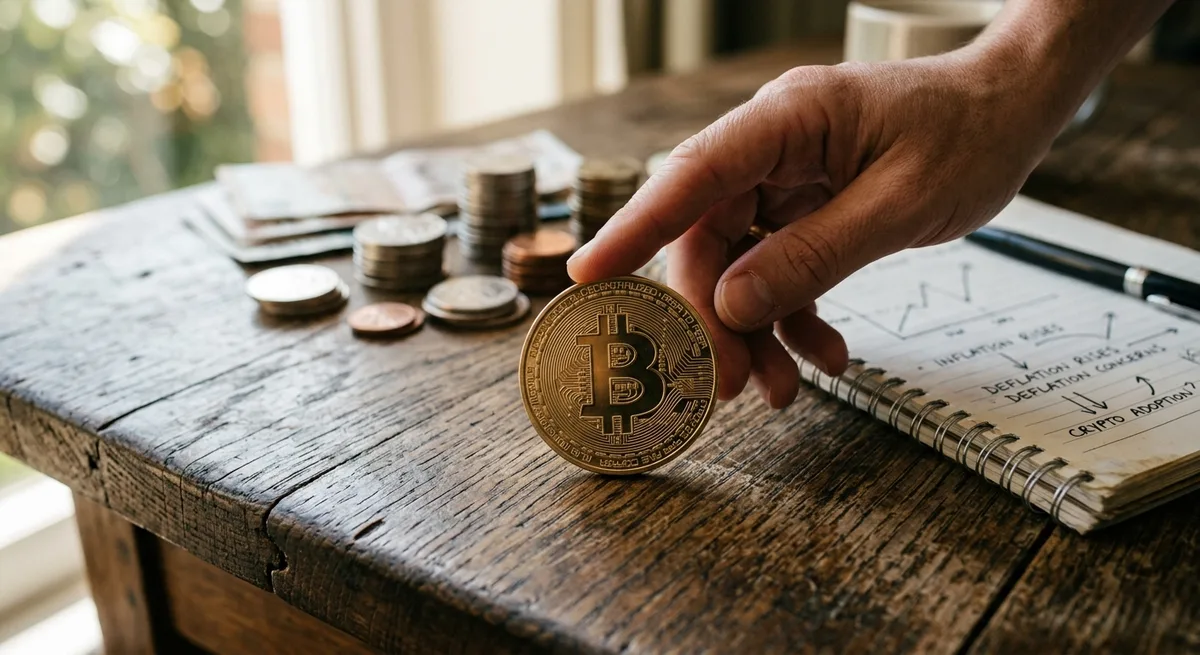
Bitcoin Inflation Explained: Is Bitcoin Deflationary?
Bitcoin Inflation Explained: Is Bitcoin Deflationary?
When people search for bitcoin inflation, they are usually trying to answer two questions at once.
The first: is Bitcoin itself inflationary? The second: can Bitcoin protect you when prices are rising in the broader economy? Those questions are related, but they are not the same thing.
Bitcoin does not inflate the way fiat currencies do. No central bank can decide overnight to mint millions of extra BTC. At the same time, new coins do enter circulation through mining, and that continues until the maximum supply is reached.
So the honest answer is more nuanced than a simple yes or no. Bitcoin has a built-in issuance schedule, its inflation rate falls over time, and its long-term scarcity is a big reason people compare it with gold. But none of that means Bitcoin’s price automatically rises whenever consumer prices do.
To understand whether Bitcoin is inflationary, deflationary, or something in between, you need to separate monetary supply from market price. That distinction makes the whole topic much easier to grasp, so that is where we will start.
What Does Inflation Mean in Bitcoin?

In everyday language, inflation usually means prices going up. Groceries, rent, energy. You feel it at the checkout.
With Bitcoin, the word means something different. It typically refers to the rate at which new BTC enters circulation. That is monetary inflation, not consumer price inflation.
This matters because a lot of confusion comes from mixing the two together. Bitcoin does not have an economy-wide basket of goods. It has a supply schedule. If you want a useful baseline for comparing the two systems, it helps to understand the broader Bitcoin vs fiat currency real difference. Once that distinction is clear, everything else follows more naturally.
Inflation in Traditional Money vs Inflation in Bitcoin
In traditional monetary systems, inflation often starts with money supply expansion. Central banks can cut rates, buy assets, or support credit growth. Governments run deficits that indirectly push more money into circulation. There is a lot of human discretion involved, and that discretion can shift quickly.
Bitcoin works differently. Its issuance is written into the code. New coins are released as rewards to miners who secure the network. There are no policymakers reacting to a crisis or trying to stimulate growth. It is a predefined release schedule, full stop.
This is why Bitcoin feels more transparent to many people. You can estimate future supply growth years in advance. With fiat money, future policy depends on political and economic decisions that nobody can fully predict.
That still leaves one major source of confusion, which is the relationship between inflation and price.
Why People Often Confuse Bitcoin Price Moves With Bitcoin Inflation
A rising Bitcoin price is not the same as rising Bitcoin inflation.
If BTC moves from $30,000 to $60,000, that does not mean Bitcoin became more inflationary. It means demand increased relative to available supply, or that liquidity, sentiment, and market structure pushed price higher. The supply schedule did not change.
The opposite is also true. Bitcoin’s inflation rate can keep falling while its price drops. That happens during risk-off markets, tighter monetary conditions, or heavy leverage unwinds.
The key point is simple: inflation in Bitcoin refers to supply issuance, while price is determined by what buyers and sellers are willing to pay. Separate those two ideas and the whole topic becomes much clearer.
How Bitcoin’s Monetary Policy Works
Bitcoin’s monetary policy is one of the main reasons people pay attention to the asset at all. Unlike traditional systems, the rules are not adjusted meeting by meeting. They are embedded in the protocol and enforced by the network.
New BTC is issued at a predictable pace, and that pace slows over time. This gives Bitcoin a supply framework that is transparent, measurable, and very difficult to change. That supply discipline is also central to what gives Bitcoin value, especially for people who care about scarcity and trustless rules.
New Bitcoin Is Created Through Mining Rewards
Bitcoin miners validate transactions and add new blocks to the blockchain. When they successfully mine a block, they receive a block reward, which consists of newly issued BTC plus transaction fees.
This is how new supply enters circulation. There is no central issuer pushing coins into the market on a whim. The release happens through a scheduled block production process, predictably and automatically.
If you want the deeper mechanics of reward timing and how issuance evolves after halvings, this guide on block reward emission schedules is worth reading.
The practical takeaway is this: Bitcoin supply grows because mining introduces new coins, but the amount introduced is controlled rather than discretionary.
The 21 Million Supply Cap and Why It Matters
Bitcoin has a hard cap of 21 million coins. That cap is one of the clearest differences between Bitcoin and fiat systems.
This does not mean all 21 million coins appeared on day one. It means the protocol limits how many can ever exist. New BTC keeps being issued over time, but the total cannot exceed that maximum. This article on the Bitcoin supply limit of 21 million covers the logic in more detail if you want to go deeper.
Why does it matter for the inflation debate? Because it creates a strict long-term boundary. Bitcoin can have temporary monetary inflation while new coins are still being released, but it cannot experience open-ended supply expansion. That ceiling is fixed.
Why Bitcoin’s Issuance Schedule Is Predictable
Every roughly four years, the block subsidy is cut in half. Supply growth declines step by step. No committee decides whether to speed up issuance next quarter. No sudden dilution because of an emergency lending program.
This predictability is a major reason investors compare Bitcoin with scarce monetary assets. The Bitcoin max supply explained article is worth a look if you want to understand the long-term implications of that design.
Once you understand that issuance is fixed and declining, the next logical question is whether that actually makes Bitcoin deflationary.
Is Bitcoin Deflationary or Just Disinflationary?
This is where language matters, maybe more than people expect.
Disinflationary means supply is still growing, but at a slower rate over time. Deflationary means supply is actually shrinking. These are not the same thing.
So is bitcoin deflationary? In the strictest sense, not yet. As long as new BTC is still being issued, total supply is still increasing. That makes Bitcoin better described as disinflationary. But there is a reason people keep reaching for the deflationary label, and it is not entirely wrong either.
Why Bitcoin Is Often Called Disinflationary
Bitcoin is called disinflationary because its inflation rate falls over time. Every halving reduces the amount of new BTC entering circulation.
Early in Bitcoin’s history, supply growth was high because block rewards were large relative to existing supply. Today, that growth rate is much lower. After each halving, it drops again. The Bitcoin halving explained guide lays out that cycle clearly if you want the full picture.
So the supply is still rising, just more slowly each cycle. That is the textbook definition of disinflationary. That said, there is still a reasonable case for the deflationary label.
The Case for Calling Bitcoin Deflationary
Some investors call Bitcoin deflationary because not all mined coins remain usable. Coins get lost permanently through forgotten private keys, destroyed storage devices, or wallets that nobody will ever access again. If you have been in this space for a while, you probably know someone who has a vague memory of an old wallet somewhere on a hard drive they cannot find.
If lost coins exceed newly issued coins over a period of time, the effective circulating supply available to the market can actually decline, even if total issued supply is still rising on paper.
There is also the long-term argument. Bitcoin’s issuance trends toward zero, and once it effectively ends, any additional coin loss would make usable supply more scarce over time. That does not make the deflationary label fully accurate today, but it explains why the debate exists.
The Most Accurate Answer for Readers and Investors
Bitcoin is not strictly deflationary right now because new coins are still being created. But it is structurally scarce, strongly disinflationary, and designed to become extremely low inflation over time.
For most people, that distinction is enough. You do not need perfect terminology to understand the real point: Bitcoin supply growth is limited, visible, and trending lower. That is a meaningfully different design from most monetary systems.
Bitcoin Inflation Rate Over Time
Bitcoin’s inflation rate has not stayed constant. It started high in the early years, then declined with each halving event. That trend matters because it shows how the bitcoin supply and inflation relationship changes as the network matures.
The pattern is clear even without a chart. Bitcoin began with aggressive issuance to distribute coins and secure the network. Over time, issuance became more restrictive. The halving is the reason.
How Halvings Reduce Bitcoin Inflation
Roughly every 210,000 blocks, Bitcoin cuts the block subsidy in half. The reward started at 50 BTC per block, then fell to 25, then 12.5, then 6.25, and now 3.125 BTC per block after the 2024 halving.
Each halving reduces the flow of new supply entering the market. Miners receive fewer newly created coins, and annual supply growth declines. The impact is not theoretical. Every halving materially lowers issuance, and that creates a useful way to view Bitcoin history in distinct monetary eras.
Historical Bitcoin Inflation Rates by Era
In the earliest years, Bitcoin inflation was extremely high because the network was small and new issuance was large relative to existing supply. That was expected for a bootstrapping phase.
During the mid-adoption phase, inflation fell sharply as the supply base grew and block rewards were cut. Bitcoin was still inflationary, but at a much lower rate.
In more recent periods, Bitcoin’s annual issuance has looked increasingly modest compared with many fiat systems, especially during years of aggressive monetary expansion. That is one reason the phrase bitcoin inflation rate vs traditional currency comes up so often in market discussions.
The broader trend moves in one direction only: downward.
What Happens When Bitcoin Inflation Approaches Zero
As Bitcoin inflation approaches zero, newly issued supply becomes less important to the network economy. Over time, miner revenue is expected to rely more on transaction fees and less on block subsidies.
For investors, the main takeaway is simpler than the technical debate. Bitcoin’s monetary expansion becomes smaller and smaller until it is effectively negligible. That does not guarantee any specific price outcome, but it does create a very different monetary profile from systems where supply can be expanded more flexibly.
How Does Bitcoin Perform During Inflationary Periods?
This is where many people expect a clean rule. Inflation rises, so Bitcoin should rise too. In reality, markets are rarely that tidy.
Bitcoin can attract attention during periods of high CPI, currency debasement fears, or aggressive money creation. But short-term performance still depends on liquidity, rates, macro sentiment, and whether investors treat Bitcoin as a risk asset or a hedge at that particular moment. Different frameworks for evaluating this are discussed across various Bitcoin valuation models, but no model removes uncertainty.
Bitcoin During Recent High-Inflation Environments
During 2020 to 2022, inflation concerns surged globally. Stimulus, supply chain disruptions, and monetary expansion pushed CPI readings much higher than normal in many economies.
Bitcoin initially benefited from the narrative of scarcity and debasement resistance. You could feel the energy in that period, with everyone talking about money printing and hard assets. But later, as central banks tightened policy and rates rose aggressively, Bitcoin fell sharply alongside other risk assets.
That is the key lesson. Inflation fears can support the long-term case for Bitcoin, but the short-term market response often depends on how policymakers react. If inflation leads to tighter liquidity, speculative assets can struggle even when the scarcity story remains intact.
Why Bitcoin Does Not Always Move Up When Inflation Rises
Bitcoin does not trade in a vacuum.
If inflation rises and central banks respond by hiking rates, capital becomes more expensive and risk appetite drops. Investors move toward cash, bonds, or defensive positions. In that environment, Bitcoin can fall even if its long-term scarcity thesis looks just as strong as before.
Regulation matters too. So does leverage. So does broad market panic. Simple headlines like “inflation is up, so buy Bitcoin” skip over a lot of messy reality in between. That is also why long-term investors tend to focus on different things entirely.
What Long-Term Investors Usually Focus On Instead
Long-term Bitcoin investors spend less time trying to match every CPI print with every daily candle. Instead, they focus on supply discipline, fiat debasement risk, adoption trends, and time horizon. They ask whether Bitcoin’s rules are credible over a decade, not whether it outperforms next month.
That approach does not remove risk. But it creates a more useful lens. And once you have that lens, the next question becomes how Bitcoin stacks up against inflation hedges people already know.
Bitcoin vs Traditional Inflation Hedges
When inflation rises, most people think about gold, cash, stocks, real estate, or inflation-linked bonds. Bitcoin enters that conversation because of its fixed supply and independence from central banks.
But Bitcoin is not just another version of those assets. It has unique advantages, unique risks, and a much shorter track record. The direct comparison many investors start with is Bitcoin vs gold as the best store of value.
Bitcoin vs Gold as a Store of Value
Gold has a long history, deep market acceptance, and lower volatility. Bitcoin has greater portability, easier verification, and a harder supply ceiling. That is why Bitcoin is often called digital gold. Both are scarce assets outside the direct control of any single government, but the risk profile is very different.
Gold is mature. Bitcoin is still evolving. For someone seeking short-term stability, gold may feel more reliable. For someone focused on long-term asymmetric upside tied to digital scarcity, Bitcoin may look more compelling. The tradeoff is that Bitcoin’s path is far less smooth.
Bitcoin vs Fiat Savings in an Inflationary World
Holding cash feels safe because the nominal value does not swing much. But in an inflationary environment, purchasing power can quietly erode year after year. You barely notice it until you do.
Bitcoin offers the opposite experience. It may preserve or grow value over long periods, but it can also suffer steep drawdowns in shorter windows. So the choice is not really between safety and danger in a simple sense. It is a tradeoff between predictable dilution and unpredictable volatility. Some people prefer near-term certainty. Others are more worried about long-term debasement.
That is why the smarter conversation is usually not all or nothing. It is about fit within a broader plan.
Where Bitcoin Fits in a Realistic Portfolio Discussion
Bitcoin works best when treated as one tool, not a magic answer.
If your time horizon is long, your position size is sensible, and you understand the volatility, Bitcoin may serve as a high-risk allocation tied to monetary scarcity. If you need short-term stability or cannot tolerate large drawdowns, it may be a poor inflation hedge for your specific situation. The right question is not whether Bitcoin is perfect. It is whether its properties match your goals, risk tolerance, and liquidity needs.
Risks and Misconceptions Around Bitcoin Inflation
Bitcoin’s supply design is one of the strongest parts of its thesis. But supply design alone does not guarantee a good investment outcome over your chosen time frame.
A lot of mistakes happen when people take a true statement about the protocol and turn it into a false promise about price. That is where nuance matters most.
A Fixed Supply Does Not Guarantee Stable Prices
Scarcity can support value. It does not create price stability by itself.
Price is still driven by demand, liquidity, market structure, and sentiment. If buyers disappear, a scarce asset can still drop hard. A fixed supply only tells you one side of the equation. This is one of the most important things for beginners to internalize. Bitcoin can be scarce, credible, and limited in supply while still experiencing major bear markets.
Bitcoin Can Be Scarce and Still Be Volatile
Volatility does not disprove Bitcoin’s scarcity. It just shows that adoption, sentiment, and market maturity still matter a great deal.
A young global asset with 24-hour trading, shifting regulation, and significant speculative participation will rarely behave like a stable savings account. That is why whether bitcoin can hedge against inflation depends heavily on time horizon. Over long periods, the scarcity story may matter more. Over short periods, market swings can completely dominate the thesis.
Why Context Matters More Than Simple Narratives
Bitcoin is not a one-sentence solution to inflation.
It exists within a broader system shaped by policy, regulation, global liquidity, adoption, infrastructure, and investor psychology. A strong monetary design helps. It does not cancel out every other variable.
If you are evaluating bitcoin inflation and investment strategy, you need to consider your own horizon, risk tolerance, entry timing, and actual reasons for holding it. Context matters more than slogans.
Key Takeaways for Anyone Researching Bitcoin Inflation
- Bitcoin inflation refers to new BTC entering circulation, not rising consumer prices.
- Bitcoin differs from fiat because its issuance follows a transparent protocol rather than discretionary policy decisions.
- Bitcoin is best described as disinflationary today because supply is still growing, but at a slower rate over time.
- Some people call Bitcoin deflationary because coins can be lost and because issuance trends toward zero, but that is not the strictest description right now.
- Bitcoin’s low and declining supply growth can strengthen its long-term appeal during inflationary periods, but short-term price reactions remain unpredictable.
- A scarce asset is not automatically a stable asset. Bitcoin can support an inflation-resistant thesis while still being highly volatile.
If you are researching bitcoin inflation, the most useful mindset is to understand the supply model first, then judge whether that model fits your own goals and risk profile.
Practical Questions to Ask Before Using Bitcoin as an Inflation Hedge
Before making any decisions, it is worth sitting down honestly with these:
- How long is your time horizon?
- Can you hold through a drawdown of 30 to 60 percent without panic selling?
- Do you understand how Bitcoin’s issuance schedule works?
- Is your position size small enough that volatility will not force a bad decision?
- Are you buying Bitcoin because you understand the thesis, or because a headline made it sound easy?
- Do you need liquidity in the near term?
These questions matter more than any slogan. If you can answer them honestly, you are already thinking about this better than most people do.
Conclusion: Bitcoin Inflation Is Predictable, but the Market Is Not
Bitcoin inflation is one of the most transparent parts of the asset. New supply enters circulation on a known schedule, the inflation rate falls over time, and the long-term cap creates real scarcity.
That makes Bitcoin very different from traditional monetary systems, and it explains why so many people see it as a potential hedge against inflation and currency debasement.
But predictable issuance does not mean predictable price. Bitcoin can still be volatile, trade like a risk asset for stretches at a time, and disappoint people who expect a straight-line relationship between inflation and market performance.
So is bitcoin deflationary? Not in the strict sense today. It is more accurate to say that Bitcoin is disinflationary by design, increasingly scarce, and structurally resistant to open-ended supply expansion.
If you understand that much, you are already ahead of most conversations about bitcoin inflation. More importantly, you are in a better position to think clearly about risk, timing, and whether Bitcoin actually fits your strategy.