

Bitcoin Forks Explained: Hard Fork vs Soft Fork
What Is a Bitcoin Fork?
If you’ve spent any time around Bitcoin, you’ve probably heard words like fork, hard fork, soft fork, or bitcoin split thrown around. They sound more complicated than they really are.
Here’s the short version. A Bitcoin fork happens when the network starts following different rules. Sometimes that change is smooth and coordinated. Sometimes it leads to conflict, uncertainty, and two separate blockchains running side by side.
That’s why understanding bitcoin forks properly matters. If you’re new to crypto, forks show you how Bitcoin evolves over time. If you already invest or trade, they can affect market behavior, wallet access, exchange support, and sometimes the coins you actually hold.
This article covers what a fork is, why they happen, the difference between a hard fork and soft fork in bitcoin, and what these events mean in practice. Real examples are included so the whole thing feels less abstract.
A Bitcoin fork is a change in the rules that software on the Bitcoin network follows.
Bitcoin works because thousands of participants run software that agrees on what counts as a valid transaction and a valid block. When those rules change, not everyone moves to the new version at the same time. If different groups follow different rules, the blockchain can diverge. That divergence is what people call a fork.
Think of it this way: some participants continue on one path, while others follow a different path based on updated rules. Sometimes the old and new rules can still work together. Sometimes they can’t.
This is a big part of understanding bitcoin network upgrades. A fork doesn’t always mean drama, and it doesn’t always mean a new coin appears. Some forks are just software updates that tighten rules or add features without creating a separate asset.
If you want a stronger base before going deeper, this overview of how Bitcoin works gives useful context for why rule changes matter at all.
A Simple Way to Visualize a Fork
The easiest way to picture a fork is to imagine a road.
Everyone’s driving on the same road. Then it reaches a split. One lane continues with the old traffic rules. The other follows a new set. If both lanes still recognize each other as valid, the split may not become permanent. If they no longer accept each other’s rules, you now have two separate routes going in different directions.
You can sketch this out yourself. Draw one straight line for the blockchain, mark the point where it branches, and label each branch. One is the original rule set, the other is the updated version. That image captures the basic idea behind a bitcoin blockchain split as simply as possible.
Why Do Bitcoin Forks Happen?
Bitcoin forks happen because people don’t always agree on how Bitcoin should work.
That disagreement can come from technical needs, security concerns, or deeper philosophical debates about what Bitcoin even is for. In open source systems, no single authority can force every participant to accept a change. Support has to come from the network itself, which makes things interesting.
Some forks are straightforward. Developers want to fix bugs, improve efficiency, strengthen security, or handle scaling better. Other forks happen because different groups hold competing ideas about Bitcoin’s purpose and future. If you want to understand that dynamic more deeply, this piece on the battle over blockchain governance is worth reading.
In many cases, forks are the visible result of a deeper argument about tradeoffs.
Technical Reasons vs Philosophical Disagreements
Technical reasons are usually easier to follow.
A fork might be proposed to improve transaction handling, patch vulnerabilities, reduce spam, or make the network more efficient. These are practical questions about how the protocol operates day to day. In that sense, bitcoin protocol changes often start as straightforward engineering choices.
Philosophical disagreements go further. Should Bitcoin prioritize being ultra-conservative or more adaptable? Should block space stay scarce or expand? Is Bitcoin primarily digital gold or everyday cash? These bigger debates end up shaping which technical proposals people actually support.
That’s why the technical and economic impact of a fork can be hard to separate. A seemingly small rule change sometimes reflects a much larger argument about what Bitcoin should become.
Hard Fork vs Soft Fork: What’s the Difference?
The core difference comes down to compatibility.
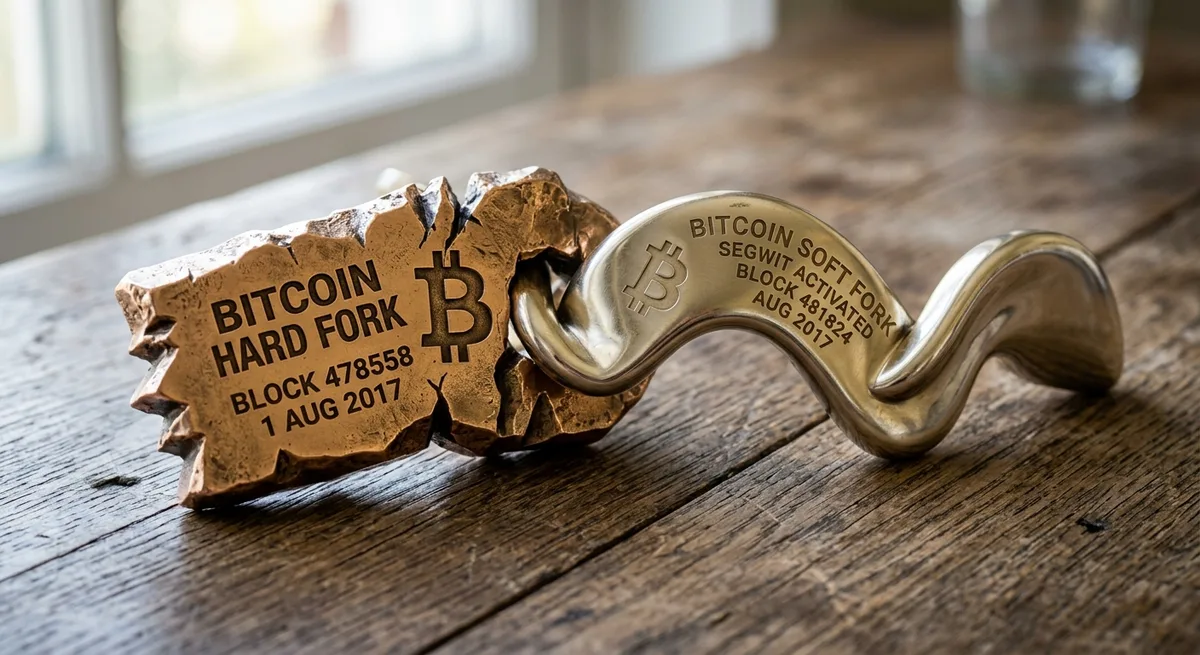
A hard fork changes the rules in a way that older software simply won’t accept. Participants who don’t upgrade may end up on a separate chain entirely.
A soft fork changes the rules in a way that remains compatible with older software. Older nodes might not fully understand the new rules, but they can generally still follow the updated chain as valid.
That compatibility gap is the key to the whole hard fork vs soft fork question. It affects whether a bitcoin split is likely, whether a new coin might appear, and how disruptive the change becomes for users and businesses.
What Is a Hard Fork?
A hard fork is a rule change that is not backward compatible.
Upgraded nodes accept blocks or transactions that older nodes reject. If part of the network upgrades and another part doesn’t, the blockchain can split into two separate versions. Each continues under its own rules, with its own supporters, infrastructure, and market price.
That’s why the answer to what is a bitcoin hard fork usually includes the risk of a permanent split. Hard forks are often linked to examples like Bitcoin Cash, where the disagreement was strong enough that one group chose to go its own way rather than stay under the same rule set. This doesn’t mean every hard fork becomes equally important. Some fail quickly because support is weak. Others survive and become their own network entirely.
What Is a Soft Fork?
A soft fork is a backward compatible update.
The new rules are stricter, but still fit within what older software can recognize as valid. Nodes that haven’t upgraded may not enforce the new rules themselves, but they can still accept blocks produced under them if enough of the network is on board. This makes a chain split much less likely when coordination is solid.
A soft fork is often the approach when the goal is to improve Bitcoin without creating a new currency. That said, soft forks still need support. If adoption is weak or contested, confusion can happen anyway.
Hard Fork vs Soft Fork at a Glance
Here’s the practical comparison:
| Feature | Hard Fork | Soft Fork | | — | — | — | | Compatibility with older software | Not compatible | Generally compatible | | Risk of chain split | Higher | Lower if adoption is coordinated | | New coin created | Possible and sometimes likely | Usually no | | Impact on users | Can be more disruptive | Often less disruptive | | Upgrade requirement | Needed to stay on new chain | Helpful, but older nodes may still follow |
If you take away one thing: the difference between a hard fork and soft fork in bitcoin comes down to whether old software can still function with the new rules.
What Happens During a Bitcoin Split?
A bitcoin split isn’t just a technical event on paper. It plays out across the whole ecosystem in real time.
Miners choose which chain to mine. Nodes choose which rules to enforce. Developers publish and maintain software. Exchanges decide what to list and what ticker symbols to use. Wallet providers decide whether to support one chain, both, or neither. Imagine checking your exchange account the morning after a major fork and seeing duplicate balances, different tickers, and a support notice saying withdrawals are paused. That’s actually what it looks like for a lot of people.
If enough participants align behind one version, the split may be short-lived. If support stays divided, the result can be two separate blockchains with different communities and different prices.
To understand this better, it helps to know who keeps the network running in the first place. This guide on what a Bitcoin node is is worth a read if you’re not fully clear on that.
Who Decides Which Chain Continues?
No single group decides on its own.
Developers can propose code, but can’t force adoption. Miners provide hash power, but mining alone doesn’t define legitimacy. Node operators enforce rules. Exchanges influence liquidity and visibility. Wallets shape user access. Investors and traders affect price and demand.
In practice, the chain that continues as dominant is usually the one that gathers the strongest mix of technical support, economic backing, and user trust. That’s why deciding whether to support a bitcoin fork is rarely simple. It’s not about who is loudest. It’s about who actually runs the software, mines the chain, lists the asset, and believes in its long-term value.
Real Examples of Bitcoin Forks
Theory is fine, but examples make forks feel real.
Some forks became major stories because they reflected deep disagreements about scaling and governance. Others showed how upgrades can happen without producing a separate coin at all.
Bitcoin Cash: A High-Profile Hard Fork
Bitcoin Cash emerged in 2017 after a prolonged debate over scaling.
One side believed Bitcoin should keep smaller block sizes and rely on solutions built around the base layer. The other argued that increasing block size was a more direct way to make transactions faster and cheaper on-chain. That disagreement wasn’t just technical. It reflected competing visions of what Bitcoin is actually for. Should it optimize for decentralization and caution, or push harder toward everyday payment use?
The result was a hard fork. Bitcoin Cash became a separate chain with a larger block size limit and its own asset, BCH.
This remains one of the clearest examples of a major bitcoin hard fork because it shows how governance disputes can turn into a permanent blockchain split. It also showed the effects of forks on cryptocurrency price, since both assets had to establish independent value after the split.
But the story didn’t end there.
Bitcoin SV: A Fork of a Fork
Bitcoin SV split from Bitcoin Cash in 2018.
People inside the Bitcoin Cash ecosystem disagreed on direction, governance, and technical priorities. So one fork created a new network, and that network later forked again. Bitcoin SV is a useful case study because it shows that forks aren’t always a one-time event. If the underlying disagreement stays unresolved, another split can follow.
If you want more background on that chain specifically, this article on Bitcoin SV explained goes into more detail.
This example also reminds investors that the risks around blockchain splits don’t disappear just because a previous fork already happened.
Soft Fork Example: Upgrades Without Creating a New Coin
A strong soft fork example is SegWit, short for Segregated Witness.
SegWit changed how certain transaction data was stored and counted. This improved efficiency, helped with transaction capacity, and addressed technical limitations that mattered for future development. Crucially, SegWit did not create a new coin. Bitcoin remained Bitcoin.
That makes SegWit one of the clearest answers to the question of whether every fork leads to a new asset. It doesn’t. Some upgrades are specifically designed to improve the network while keeping the ecosystem on one chain.
How Bitcoin Forks Affect Regular Users and Investors
For regular users and investors, forks matter when they affect access, clarity, and risk.
If a fork is minor and well coordinated, you may barely notice it. If it’s contentious, things can get messy. Exchanges may pause deposits and withdrawals. Wallet providers may issue warnings. Prices can move sharply. Support for one chain or another may stay unclear for a while.
There can also be accounting or tax consequences depending on where you live. In some jurisdictions, receiving coins from a new chain may create a reporting obligation. In others, the rules may still be unclear. That’s one reason caution matters more than hype during fork events.
If You Hold BTC During a Fork, What Should You Know?
The first thing to understand is custody.
If your BTC is held on an exchange, the exchange decides how it will handle the fork. It may support both chains, support only one, or delay access until the situation is clearer.
If you control your private keys, you may have more direct access to coins on both sides of a hard fork. But that also means more responsibility. You need to understand wallet support, safe claiming procedures, and the risk of scams pretending to help you claim forked coins. Fork periods attract fake wallets, fake support accounts, and misleading announcements. Verify information carefully. Check official sources. Avoid rushing just because social media is saying free money is on the table.
Trading opportunities during bitcoin forks do exist, but so do avoidable mistakes. In many cases, doing nothing for a short period is safer than acting too fast.
Risks Around Transactions and Network Confusion
One major risk during contentious forks is plain confusion.
Users may not know which ticker symbol refers to which chain. Exchanges may use different naming conventions. Deposit and withdrawal systems may be paused. Confirmation times can become less predictable if hash power shifts suddenly.
There’s also replay risk in some hard fork scenarios. A transaction intended for one chain could be copied or replayed on another chain if protections aren’t in place. For ordinary users, that’s a strong reason to avoid moving funds unnecessarily until the network situation is stable.
Forks, Mining, and Network Difficulty
When a fork creates two competing chains, miners have to choose where to direct their hash power.
That choice matters because it affects how quickly blocks are found, how secure each chain looks, and whether transaction backlogs start building. If one chain suddenly loses a lot of miners, block production can slow down until difficulty adjusts.
This is one of the most practical examples of the technical and economic impact of bitcoin forks. The technical side is about hash rate and block timing. The economic side shows up in miner incentives, user confidence, and market pricing.
If you want a deeper look at that dynamic, this article on what to consider about difficulty during a fork adds useful context.
For investors, the main takeaway is simple: mining support is one of the signals worth watching during a fork, because it directly affects stability.
Common Misunderstandings About Bitcoin Forks
Bitcoin forks often sound more dramatic than they are.
Part of that is because the word fork gets used for several different situations. Another part is that crypto media sometimes treats every split like a major crisis or every new chain like a windfall. Reality is usually more nuanced. Forks can be normal parts of open source development. They can also be messy, political, and risky. Both things can be true at once.
Not Every Fork Creates a New Cryptocurrency
This is probably the biggest misunderstanding.
A fork simply means the rules changed or the chain diverged at some point. That doesn’t automatically mean a new tradable asset appears. Soft forks often update Bitcoin without creating a separate currency. Even some hard forks never gain enough support to matter economically. So if someone hears about a fork and immediately assumes free coins are coming, that’s not a safe assumption to make.
A Fork Is Not Automatically a Crisis
A fork can look chaotic from the outside, but it’s not automatically a sign that Bitcoin is breaking.
Open source networks evolve through discussion, disagreement, and testing. Forks are one of the mechanisms through which that process plays out. Sometimes the outcome is smooth. Sometimes it’s contentious. What matters is the level of support, the clarity of communication, and the risks created for users.
Forks can create short-term uncertainty. They can also be part of how the system adapts over time. The more useful question isn’t whether a fork is scary. It’s how to evaluate it rationally.
How to Evaluate a Future Bitcoin Fork
If another fork appears, the best approach is to slow down and assess it piece by piece.
Start with the proposal itself. What changed? Is the purpose clear? Does it solve a real problem or mainly reflect a political split? Then look at support. Are major developers behind it? Are miners signaling for it? Do node operators, exchanges, and wallet providers plan to support it? Is there enough infrastructure for normal users to interact with it safely?
Think about risks too. Could the fork create transaction issues, market confusion, or security weaknesses? Are there realistic benefits, or mainly marketing claims?
Questions Worth Asking Before Taking Action
Before doing anything during a fork, run through these:
- Is the technical purpose clear and credible?
- Who is supporting it across developers, miners, businesses, and users?
- Will major exchanges list it, and under what ticker?
- Is your wallet prepared to handle the event safely?
- Does the fork introduce security concerns or replay risk?
- If you hold BTC on an exchange, what is that platform’s stated policy?
- If you self-custody, do you know how to protect your keys and avoid scams?
- Do you actually need to take action right now, or is waiting the safer move?
That last question matters more than people think. In crypto, doing nothing is sometimes the most disciplined move you can make.
Conclusion: Bitcoin Forks Explained in Plain English
A fork happens when the network starts following different rules.
Sometimes that change is backward compatible, making it a soft fork. Sometimes it’s not, making it a hard fork that raises the real chance of a bitcoin split. That’s the heart of the hard fork vs soft fork distinction.
Forks happen because people want upgrades, disagree on tradeoffs, or hold different visions for Bitcoin’s future. Some pass quietly. Others create new chains like Bitcoin Cash or Bitcoin SV. And not every fork creates a new coin.
For regular users, the main thing is not to panic or chase headlines. Focus on custody, exchange policies, wallet support, transaction risk, and whether the market has actually accepted the new chain. For investors, forks can create volatility and opportunity, but also confusion and avoidable mistakes.
Forks are part of how open networks evolve. The better you understand them, the less likely you are to get caught off guard.